
I remember the first piece of content I ever wrote for a client. It was a 500-word blog post about office furniture. I spent three hours on it, thought it was brilliant, and got back a one-line email: ‘Can you make it sound less like a school essay?’
That moment changed how I think about writing.
Content writing is not about sounding smart. It is not about showing off vocabulary. It is about being useful, clear, and easy to read. That is a lesson I had to learn the hard way, and it is the thread that runs through everything in this article.
I have spent years writing for brands, SaaS companies, healthcare platforms, e-commerce stores, and personal blogs. I have written content that flopped and content that brought in thousands of readers a month. Here is what I have learned.
What Content Writing Actually Means
People confuse content writing with copywriting all the time. They are related, but they are not the same thing.
Copywriting is writing that sells. It is the headline on a landing page, the words on a product page, the email that gets you to click ‘Buy Now’. It is persuasion with a deadline.
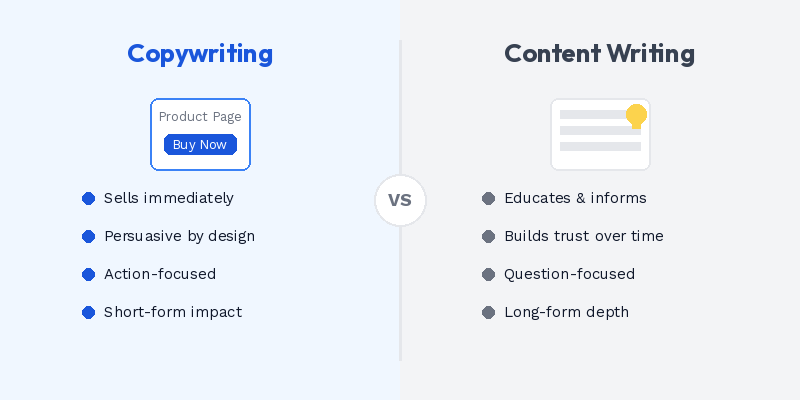
Content writing is writing that informs, educates, or entertains. It builds trust over time. It answers questions. It helps someone understand something they did not understand before. A blog post, a how-to guide, an in-depth explainer, a newsletter these are content.
The goal of content writing is not always to sell immediately. The goal is to build a relationship with a reader so that when they are ready to buy, they think of you first.
That distinction took me a while to fully understand. Once I did, my writing improved significantly.
The Research Phase is Where Good Content Starts
I never start writing without spending time on research first. This is the step most beginners skip, and it shows in their work.
Research is not just about gathering facts. It is about understanding the reader.
Understanding Who You Are Writing For
Before I write a single sentence, I ask myself: who is this person? What do they already know? What do they want to know? What problem brought them to this article?
If I am writing for a beginner, I avoid jargon. I define terms. I use analogies. If I am writing for an expert, I skip the basics and go straight to the nuance they care about.
Getting this wrong is the most common mistake in content writing. Writing too simply for an expert makes you look unserious. Writing too technically for a beginner makes you useless.
Keyword Research Without the Obsession
I do keyword research, but I do not let it control my writing. Here is how I think about it.
A keyword tells you what people are searching for. That is valuable. It helps me understand what questions to answer. But the keyword is the starting point, not the destination.
I look at search intent. If someone searches ‘how to start content writing’, they want a practical guide. If they search ‘content writing vs copywriting’, they want a comparison. The keyword tells me the topic. The intent tells me the format and depth.
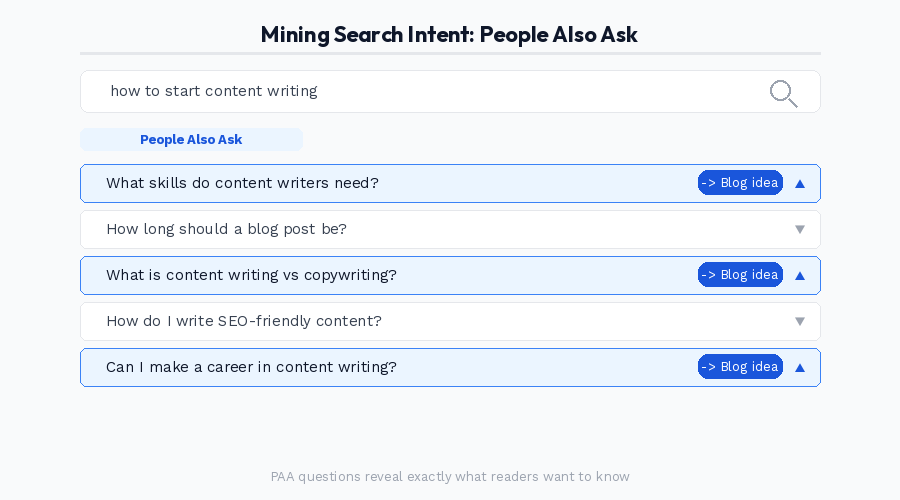
I use tools like Google’s ‘People Also Ask’ section and autocomplete to find related questions. These questions become the subheadings and supporting sections of my article.
Structure is important
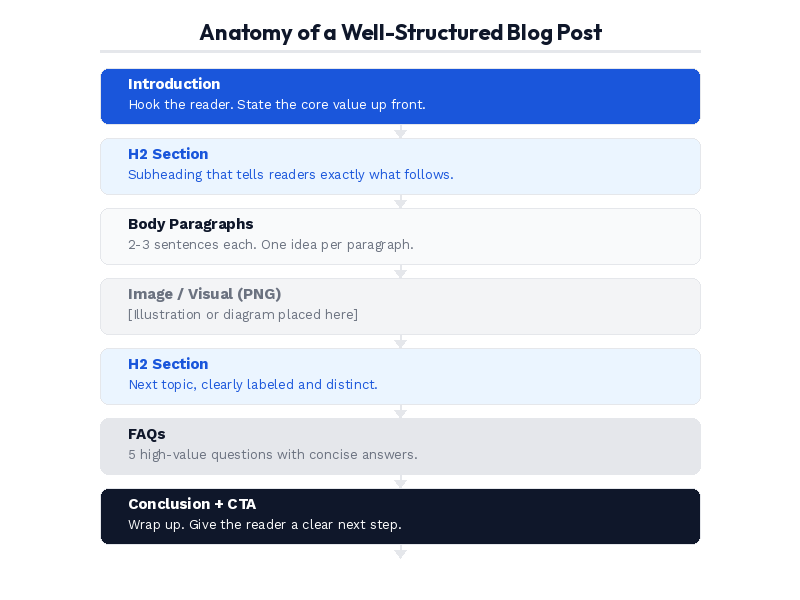
The best-researched, most insightful content will fail if it is poorly structured. Structure is what makes content readable. It is what keeps someone on the page.
I think of structure as a conversation. A reader should always know where they are in the article and what comes next. If they ever feel lost, I have failed them.
The Inverted Pyramid Approach
I learned this from journalism. Put the most important information first. Give readers the core idea up front, then expand on it with detail and context.
This is the opposite of how most people learn to write in school, where you build up to a conclusion. On the web, readers do not wait for a conclusion. They leave if they do not find value quickly.
So I lead with the payoff, then explain how I got there.
Short Paragraphs, One Idea Each
On the web, a paragraph should almost never be more than three or four sentences. Ideally, two or three sentences.
Each paragraph should contain one idea. When that idea is complete, I start a new paragraph. This makes content skimmable. A reader can run their eyes down the page, reading the first sentence of each paragraph, and get the gist of the entire article.
That is not laziness on the reader’s part. That is how people read online. Good content writing respects that.
Subheadings That Do Work
Subheadings are not decoration. They are navigation. A good subheading tells the reader exactly what the next section covers.
Vague subheadings like ‘More Tips’ or ‘Other Considerations’ are wasted space. Specific subheadings like ‘How to Write a Headline That Gets Clicks’ or ‘The Three-Step Editing Process I Use Every Time’ give the reader a reason to keep reading.
I write subheadings after I finish a section, not before. That way, they accurately describe what is there, not what I planned to write.
How I Actually Write: My Process From Blank Page to Draft
I used to stare at a blank page for thirty minutes before writing a word. Now I rarely spend more than five minutes before the words start flowing. Here is what changed.
The Messy First Draft
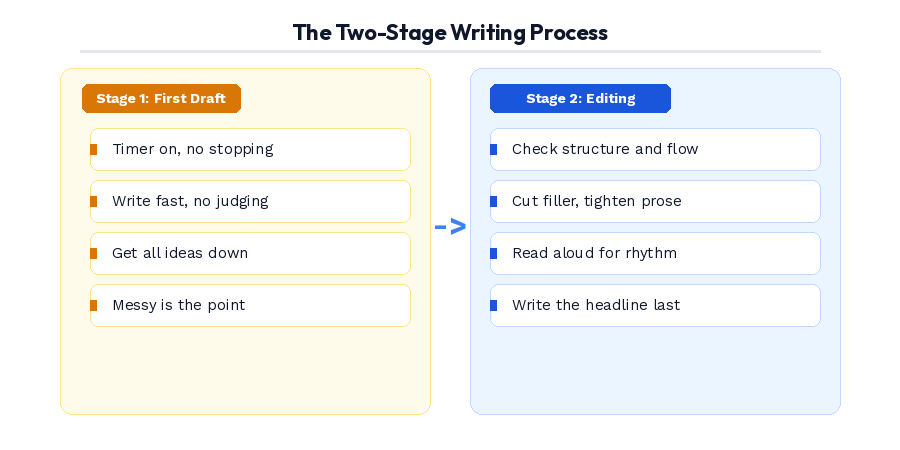
I write the first draft fast and without judgment. I do not stop to edit. I do not reread sentences I just wrote. I just get the ideas down.
The first draft is supposed to be bad. Its only job is to exist. You cannot edit nothing.
I set a timer for 45 minutes and write until it goes off. No checking email. No second-guessing. Just writing. I usually end up with more material than I need, which makes the next step easier.
The Editing Pass
Editing is where good content writing actually happens. I do at least two passes.
The first pass is structural. I check that the sections are in the right order, that each paragraph serves a purpose, and that nothing is missing. I move things around, cut whole sections if needed, and add in anything I forgot.
The second pass is at the sentence level. I tighten every sentence. I cut filler words. I replace weak verbs with strong ones. I check that each sentence says exactly what I mean and nothing more.
I also read the draft out loud. If I stumble over a sentence, it needs to be rewritten. If I have to read a sentence twice to understand it, it needs to be simpler.
The Headline is Last
Most writers write their headline first. I write it last, when I know exactly what the article delivered.
A headline makes a promise to the reader. I want to make sure the article keeps that promise before I write it.
I usually write ten to fifteen headline options before choosing one. The first headline is almost never the best one.
Tone and Voice: The Difference Between Forgettable and Memorable
Tone is not about being casual or formal. Tone is about sounding like a real person who cares about the reader.
The biggest tonal mistake I see in content writing is what I call ‘corporate fog’. Sentences like ‘We leverage synergistic solutions to optimize stakeholder outcomes.’ Nobody talks like that. Nobody thinks like that. And nobody enjoys reading it.
I write the way I would explain something to a smart friend over coffee. Direct, honest, and without pretending to be more important than I am.
Consistency Across a Brand
When I write for a brand, I spend time understanding their voice before I write a word. I read their existing content. I look at how they handle humor, how formal their language is, what topics they avoid, and what words they use repeatedly.
A brand voice guide is one of the most useful documents a content team can have. It keeps every writer sounding like one consistent person, regardless of who is actually writing.
If a brand does not have a voice guide, I create one before we start working together. It saves significant time and back-and-forth later.
Writing for SEO Without Sounding Robotic
There is a kind of content that reads like it was written for Google, not for humans. Sentences awkwardly repeat the target keyword. Paragraphs feel stuffed. The flow is wrong.
I have never had to choose between SEO and good writing. If the content genuinely answers the reader’s question clearly and in depth, Google rewards it. Search engines are better at understanding natural language than most people think.
I focus on covering the topic thoroughly. The keywords appear naturally because I am writing about the topic, and the topic contains those words.
Content Formats and When to Use Each
Not every topic calls for a blog post. Over the years, I have learned to match the format to the goal.
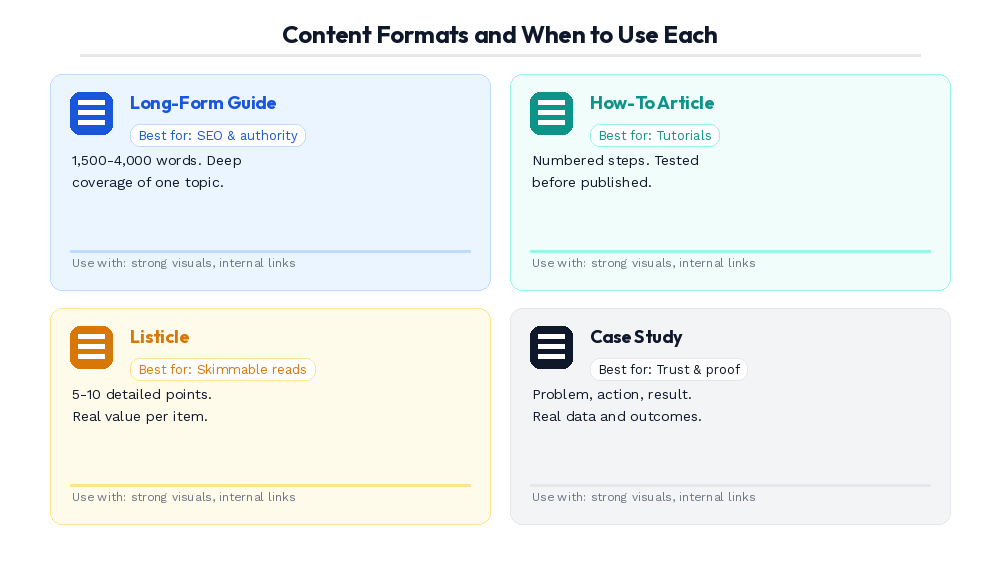
Long-Form Blog Posts and Guides
These are my most-used format. A well-researched long-form article between 1,500 and 4,000 words is the best format for building authority on a topic, ranking in search engines, and genuinely helping a reader understand something complex.
Long-form content is not about padding. Every section needs to earn its place. If a section does not add value, I cut it.
How-To Articles
These are structured differently from opinion or explainer pieces. They follow a clear sequence. Each step is numbered. The reader should be able to follow the steps and complete the task.
I always test a how-to before I write it. If I cannot follow the steps myself, neither can the reader.
Listicles
The listicle has a bad reputation because it is often used to produce shallow content quickly. But the format itself is not the problem. A listicle with genuinely useful, detailed points is one of the most readable formats on the web.
The key is that each list item needs to deliver value on its own. A list of ten shallow bullet points is worse than a list of five detailed, actionable ones.
Case Studies and Success Stories
These are underused in content writing, and they are incredibly effective. A case study shows a real result. It is proof, not just a claim.
I structure case studies around a simple arc: here was the problem, here is what we did, here is what happened. That arc is compelling because it mirrors how humans naturally process stories.
The Metrics That Actually Matter
In the early days, I measured success by page views. More views meant better content. That was a mistake.
Page views tell you how many people arrived. They tell you nothing about what happened after they arrived.
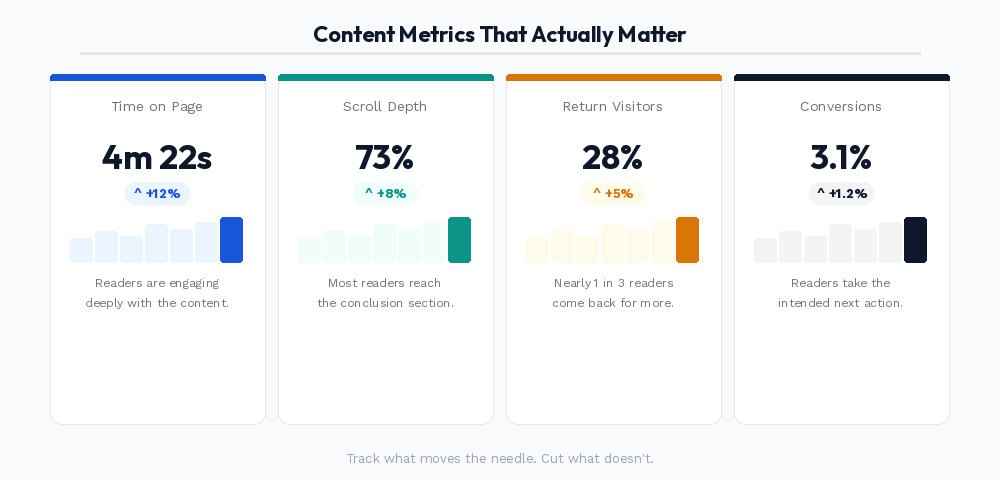
Time on Page
Time on page tells me whether people actually read what I wrote. A high page view count with a 20-second average time on page means people came, glanced, and left. Something is wrong. Either the title over-promised, or the content under-delivered.
Scroll Depth
Scroll depth tells me how far down the page people read. If most people drop off at 40 percent, I know the second half of the article is losing them. I go back and look at what changed at that point in the article.
Return Visitors
Return visitors are readers who came back. These are the people who found the content genuinely useful. They are the audience worth building for.
Conversions
Ultimately, content should do something for the business. It should generate leads, build an email list, drive product sign-ups, or build brand awareness in a measurable way.
I track what action a piece of content drives and connect that to the content goals we set at the start. If a piece of content cannot be connected to a business outcome, it is worth asking whether it should exist at all.
Common Mistakes I See (And Made) in Content Writing
I have made every mistake on this list at least once. I keep it close as a reminder.
- Writing for search engines instead of people: Google’s job is to find the content that best serves the reader. Write for the reader and the SEO follows.
- Skipping the brief: Writing without a clear brief wastes time. Know the goal, the audience, the tone, and the target keyword before you write a word.
- Weak introductions: If the first paragraph does not give the reader a reason to keep reading, they will not. The introduction has one job: earn the next paragraph.
- Passive voice: ‘The report was completed by the team’ is weaker than ‘The team completed the report’. Active voice is direct and confident.
- Ignoring the call to action: Every piece of content should end with a clear next step. Subscribe to a newsletter, read a related article, book a call. Do not leave the reader at a dead end.
- Publishing without editing: First drafts are not finished content. Always edit before publishing, even if only once.
- Inconsistent publishing: Content builds trust through consistency. One excellent article published every two weeks beats ten rushed articles published in one burst and then nothing for months.
What Makes Someone a Good Content Writer
I get asked this often. People want to know if they have what it takes.
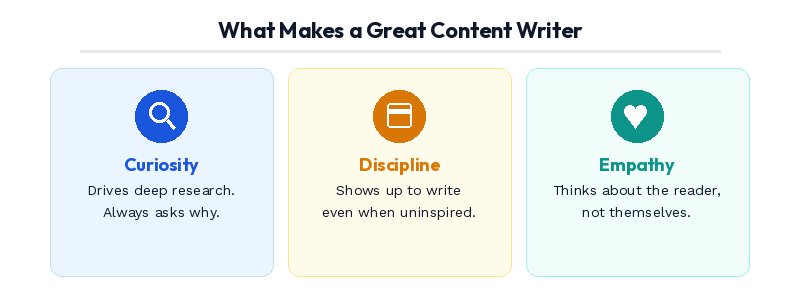
The honest answer is that most of what makes a good content writer is learned, not innate. I was not born knowing how to write clearly. I read constantly. I wrote badly for years. I took feedback seriously.
The things that matter most are curiosity, discipline, and empathy. Curiosity drives good research. Discipline keeps you writing when it is not exciting. Empathy makes you think about the reader instead of yourself.
If you have those three things and you write consistently, you will get better. That is as reliable a path as I have found.
Final Thoughts
Content writing is one of those skills that reveals itself slowly. You write, you get feedback, you write again. The gap between your taste and your ability slowly closes.
I still edit sentences three times before I am happy with them. I still write headlines I end up hating. I still occasionally get a piece back from a client with notes I did not expect.
What has changed is that I trust the process now. Research first. Structure clearly. Write fast. Edit slow. Measure what matters.
If you take nothing else from this article, take that sequence. It works. Every time.
Frequently Asked Questions
1. How long should a content writing piece be?
It depends on the topic and the goal. For SEO-driven blog posts, 1,500 to 3,000 words is a solid range for most topics. In-depth guides can go up to 5,000 words or more. Short-form content like newsletters or social posts should be as short as possible while still being useful. The rule I follow: write as much as the topic needs and not a word more.
2. Do I need to be an expert on a topic to write good content about it?
No, but you need to be willing to research thoroughly. Many of the best content writers are expert researchers and communicators, not necessarily subject matter experts. That said, writing in fields like medicine, law, or finance requires extra care with accuracy. When in doubt, have a subject matter expert review the content before it goes live.
3. How do I improve my content writing skills quickly?
The fastest way to improve is to write every day and read great content deliberately. When you read something that works, stop and ask yourself why it works. What did the writer do in the introduction to hook you? How did they structure the argument? What made their sentences easy to read? Then try to replicate those techniques in your own writing. Feedback from editors or peers also accelerates improvement dramatically.
4. How important is SEO for content writing?
SEO is important, but it should inform your content, not control it. Understanding what people are searching for helps you write content that answers real questions. But stuffing keywords into otherwise poor content does not work the way it once did. Search engines have become very good at understanding quality. Write clearly and thoroughly for the reader, and the SEO results tend to follow.
5. What is the difference between a content writer and a content strategist?
A content writer creates the actual content – the articles, guides, emails, and posts. A content strategist plans what content should be created, for which audience, on which platform, and toward which business goal. In smaller teams, one person often does both. In larger organizations, they are separate roles. Understanding strategy makes you a significantly better writer, because you understand why each piece of content exists and what it is supposed to achieve.
Written from personal experience as a professional content writer.
Latest Posts On Content Writing
- Best Laptops for Content Writers
- Best Plagiarism Checkers for Content Writers
- Best Content Writing Services: A Complete Review and Buyer’s Guide
- Best Writing Tools Every Content Writer Needs (Expert Picks)
- Writing for Different Buyer Personas: The Ultimate Guide
- Marketing Automation: How To Automate Writing Workflow
- User Generated Content: What It Is and How to Leverage It
- A/B Testing in Content Writing: What to Test and How
- Content Writer Job Responsibilities: A Complete Guide
- Freelance Writing Jobs for Beginners: How to Get Started and Get Paid
- Part-Time & Remote Writing Jobs: A Complete Guide
- Best Digital Content Creation Services Your Business Needs
- What is Content Writing?
- Content Writing Jobs: How to Find Work That Actually Pays
- How I Built My Writing Portfolio
- Best Content Writing Services: How to Choose the Right One for Your Business
- 15 Content Writing Tips That Helped Me
- Content Writing Rates: How Much Should You Charge?
- 10 Best Content Planning Tools
- 10 Best Portfolio Websites for Writers
- 10 Best Content Writing Courses I Have Tried and Tested as a Working Writer
- The Ultimate Guide to Creating a Content Marketing Strategy
- The Complete Guide to Content Optimization
- Writing Jobs: The Complete Guide
- Top 10 Writing Tools That Will Save You Hours
- 15 Writing Skills That Lead to High-Paying Job Opportunities
- Content Writing Types You Need to Know
- 10 Best Content Writing Services for Your Business Needs
- Content Style Guides: What They Are, & How To Build One
- Content Analytics: Strategies for Writers [2025]
- Crisis Communication Writing: Best Practices for Content Writers
- Creating Documentation and User Guides: The Ultimate Guide [2025]
- Content Optimization for Mobile Readers: Best Practices for Writers
- Storytelling in B2B Content: How to Engage Your Audience
- Content Creation for Lead Generation: The Ultimate Guide for Writers
- How to Write Effective Proposals and Pitches
- Content Auditing and Optimization: A Guide for Content Writers [2026]
- 5 Best Content Distribution Strategies For Writers [2025]
- The Future of Content Writing: Trends and Predictions
- Voice and Tone: Why Are They Important in Brand Writing?
- 10 Best B2B Content Writing Tools for Business Writers
- Steps to use Keyword Clusters to Improve Organic Traffic
- Freelance Writing Jobs – Full Guide (2024)
- 100+ Tips, Facts and Statistics on Content Writing
- What is Content Marketing?
- Best 10 AI Writing Tools for Content Writers
- Build SEO Strategy with Rand Fishkin’s Whiteboard Friday Guide
- The Art of Experimental Storytelling
- What Is E-A-T and YMYL In Google Algorithm
- How I Create Error-Free Content with Grammarly
- How I Use ChatGPT In My Content Strategy
- The Power of A/B Testing in Content Writing
