I still remember the day I landed my first content writer job. I had no portfolio. No formal degree in content writing. I had a blog nobody read, a Google Doc full of half-written essays, and a stubborn belief that I could do this.
Fast forward seven years, and I have written for SaaS companies, global media brands, and solo founders across three continents. I have worked on-site, remotely, and as a fully independent freelancer. I have made every mistake you can imagine, and I have also figured out what actually works.
This article is everything I wish someone had told me when I was searching for my first content writing job. Whether you are chasing content writer vacancy listings on job boards, exploring remote content writer jobs, or figuring out how to pitch your first freelance gig, this guide covers it all.
What Are Content Writing Jobs?
Content writing jobs involve creating written material for businesses, websites, publications, and brands. The goal of the content can vary. Sometimes you are writing to rank on Google. Sometimes you are writing to sell a product. Sometimes you are writing to educate an audience.
But at the core, content writing jobs are about using words to serve a specific purpose for a client or employer.
The term covers a wide spectrum. A content writing job at a tech startup might mean writing blog posts, case studies, whitepapers, and email sequences. A content writer vacancy at a news platform might be about producing fast, factual articles daily.
Content writing is not just about grammar and spelling. It is about understanding audiences, research, tone, structure, and strategy. That is what separates hobbyist writers from professionals who get hired and paid well.
Content writing jobs = writing that serves a business goal, not just personal expression.
Who Hires Content Writers?
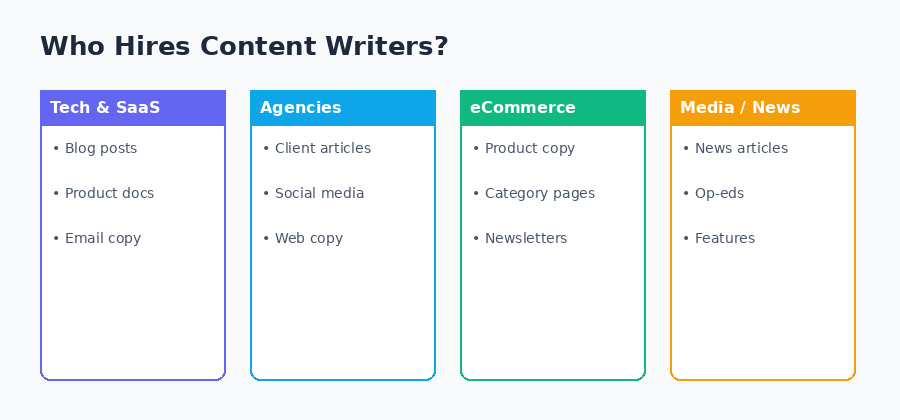
The honest answer is: almost every business that has an online presence hires content writers. But let me break it down so you can target the right opportunities.
Technology Companies and SaaS Brands
Tech companies are among the heaviest consumers of written content. They need blog posts, comparison articles, product documentation, onboarding emails, and help center guides. This is a goldmine for content writers because these companies usually have real budgets.
Digital Marketing Agencies
Agencies produce content for dozens of clients simultaneously. They hire writers constantly, both as full-time staff and as freelancers on retainer. Agency work is fast-paced but an excellent way to build a diverse portfolio quickly.
Media and Publishing Companies
Online magazines, news websites, and newsletters hire writers to fill their editorial calendars. Some pay per word. Some pay per article. Rates vary widely, but these roles give you bylines and strong editorial skills.
eCommerce Brands
Product descriptions, buying guides, and category page content are always in demand. eCommerce brands also need email campaigns, blog content, and social captions.
Healthcare, Finance, and Legal
These are niche but high-paying sectors. YMYL (Your Money, Your Life) content requires research-heavy writers who can translate complex topics into readable content. Expertise or willingness to learn pays off here.
Small Businesses and Solopreneurs
Coaches, consultants, and local businesses often need a website refresh, a few blog posts, or a monthly newsletter. These are often entry-level friendly gigs and a good way to start.
Tip: When you are starting out, target agencies and SaaS companies. They hire frequently and often have structured onboarding for new writers.
Types of Content Writing Jobs
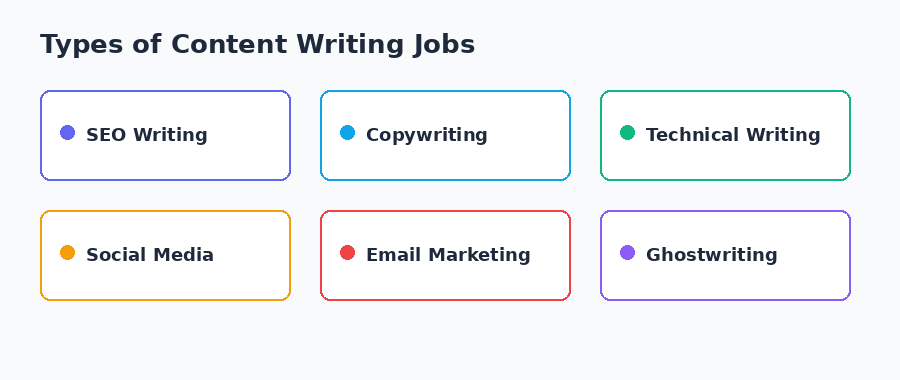
Not all content writing jobs are the same. Understanding the types will help you decide where to focus your energy.
SEO Content Writer
This is the most in-demand type of content writer job today. SEO content writers produce blog posts, articles, and landing pages optimized to rank on Google. You need to understand keyword research, search intent, and on-page SEO basics. Tools like Ahrefs, SEMrush, and Surfer SEO are commonly used in this role.
SEO writing is formulaic but rewarding. Once you learn the structure, you can produce articles efficiently and command strong per-word rates.
Copywriter
Copywriting is writing that sells. This includes website copy, ad copy, landing pages, and email sequences. Copywriters focus on persuasion, emotional triggers, and calls to action. It is one of the highest-paid types of writing work available.
Technical Writer
Technical writers create documentation, user guides, API references, and product manuals. This role suits writers who enjoy precision and have a leaning toward technology, software, or science. Technical writing jobs often pay higher than average because of the specialized knowledge required.
Social Media Writer
Social media writers craft posts, captions, threads, and content calendars for platforms like LinkedIn, Instagram, and X. This role requires an understanding of platform-specific tone, audience behavior, and trending formats.
Email Copywriter
Email marketing is one of the highest ROI channels for businesses. Email copywriters write welcome sequences, product announcements, newsletters, and promotional campaigns. Strong email writers are highly sought after and often work on performance-based contracts.
Ghostwriter
Ghostwriters write content that gets published under someone else’s name. This is common for executive thought leadership pieces, LinkedIn articles, and books. Ghostwriting pays well, but your name never appears on the work.
UX Writer
UX writers craft microcopy within apps and websites. Think button labels, error messages, onboarding tooltips, and interface text. It sits at the intersection of writing, design, and user experience.
Where to Find Content Writing Jobs
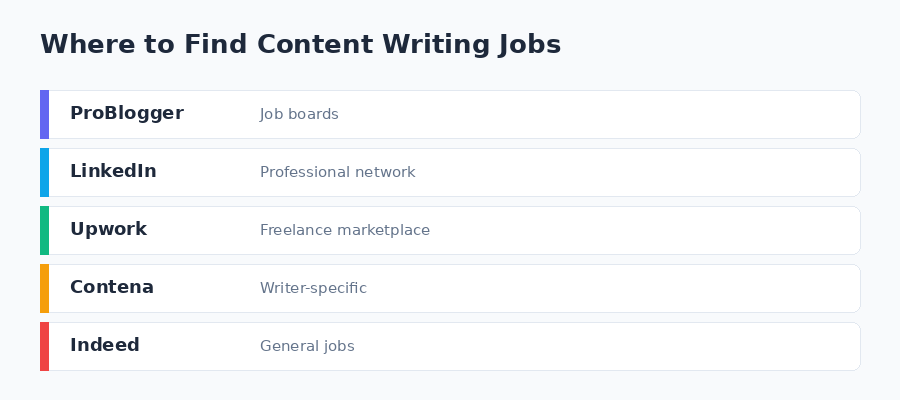
This is the part most beginner writers struggle with. The internet is noisy. Job boards are flooded. Here is where I actually found quality work.
1. ProBlogger Job Board
ProBlogger has been around for years, and it remains one of the most trusted places to find legitimate content writer jobs. The listings lean heavily toward blog writing and editorial roles. Most jobs here are remote-friendly. I landed two long-term clients through ProBlogger in my first year of freelancing.
The quality of listings varies, so read each post carefully. Look for clients who explain their brand, niche, and expectations clearly. Vague listings are often a red flag.
2. LinkedIn
LinkedIn is underused by new writers, and that is a mistake. Companies post content writer vacancies on LinkedIn daily. More importantly, LinkedIn lets you connect directly with content managers, marketing directors, and editors who are looking for writers.
Optimize your LinkedIn headline with phrases like content writer, SEO writer, or remote content writer. Post writing samples. Engage with content marketing professionals. Inbound opportunities will follow.
3. Upwork
Upwork is a freelance marketplace where clients post jobs and writers submit proposals. The competition is high, and rates can be low at the entry level. But Upwork is also where many writers build their first client base.
The key is to niche down. A profile that says I write SEO blogs for B2B SaaS companies will outperform a generic I write anything profile every single time. Be specific. Show samples. Write proposals that address the client’s problem, not just your credentials.
As your rating and reviews improve, you can increase your rates significantly.
4. Contena
Contena is a paid platform built specifically for content writers. It aggregates quality writing jobs from across the web. The membership cost weeds out casual browsers, which means the job listings tend to be higher quality than free boards.
If you are serious about finding content writing jobs remote, Contena is worth a trial month. It also offers courses and tools to help writers pitch and manage clients.
5. Indeed and We Work Remotely
Indeed is a broad job board, but searching for content writer, content strategist, or remote content writer jobs yields solid results. Many in-house content writing roles are posted here.
We Work Remotely is specifically for remote jobs. It is a great source for finding remote content writer jobs with companies that have fully distributed teams.
6. Cold Outreach and Direct Pitching
This is how I landed some of my best-paying clients. I would identify companies whose blogs I admired or whose content needed improvement, research the right contact, and send a short, specific pitch email.
Cold outreach requires more effort upfront, but you sidestep competition entirely. You are not applying for a posted job. You are creating an opportunity.
Pro tip: Set up Google Alerts for ‘we’re hiring a content writer’ or ‘content writer vacancy’ to catch fresh listings the moment they go live.
Skills Required for Content Writing Jobs
Let me be honest about what hiring managers actually look for. It is not a journalism degree. It is not perfect grammar. Here are the skills that matter.
- Research skills: You need to dig deep on topics, find credible sources, and synthesize information clearly.
- SEO basics: Understanding keywords, search intent, and how to structure content for Google is now a baseline expectation for most content writer jobs.
- Adaptable tone: You need to match the voice of different brands. The tone you use for a startup is different from a law firm.
- Strong editing: Good writers edit ruthlessly. First drafts are never final drafts.
- Deadline discipline: Content writing is a professional service. Missing deadlines damages client relationships.
- Basic formatting: Headers, bullet points, short paragraphs, and clear structure make content readable and scannable.
- Content tools: Familiarity with tools like Grammarly, Surfer SEO, Clearscope, Hemingway Editor, and Google Docs is expected.
You do not need all of these on day one. But the faster you build these skills, the faster you will land and retain good content writing jobs.
What Hiring Managers Look for in Content Writers
I have been on both sides of the hiring table. Here is what actually moves the needle when companies evaluate writers.
Portfolio Over Resume
Every hiring manager I have spoken to says the same thing: show me what you can write. A resume lists credentials. A portfolio shows capability. If you do not have a portfolio yet, create three to five writing samples on topics you want to be known for and publish them on Medium, a personal blog, or a Google Drive folder.
Niche Expertise
Generalist writers get passed over for specialist writers, especially at higher pay grades. If you write for fintech companies, lean into that. If you know SaaS inside out, make it obvious. Specialists command premium rates because they save editors time on research and revisions.
Understanding of SEO
Even roles that are not purely SEO-focused often expect writers to understand keywords and search intent. Mention this in your cover letter or profile if you have it.
Clear Communication
Writers who communicate professionally in emails, ask smart questions before starting a project, and deliver work with brief notes on their decisions are the ones who get repeat business. This matters more than raw talent.
Sample Quality
Your samples should be relevant to the job you are applying for. If you are applying for a SaaS content writer vacancy, send SaaS writing samples, not fashion blog posts. Tailor your portfolio for each significant application.
How to Pitch for Freelance Content Writing Jobs
Pitching is a skill in itself. Here is the framework I use and recommend to every new writer.
- Research the client first. Read their existing content. Identify a gap or an improvement you could offer. Mention this in your pitch.
- Keep it short. Three to four paragraphs maximum. Hiring managers do not have time for long introductions.
- Lead with value. Do not start with ‘I am a writer looking for work.’ Start with something relevant to them.
- Include one to two relevant samples. Not your entire portfolio. The most relevant pieces only.
- End with a clear, low-pressure call to action. Something like: ‘Happy to share more samples or jump on a quick call if you would like to discuss further.’
Here is a quick pitch template I have used repeatedly:
Subject: Content Writer for [Niche] | Helping [Brand] Grow Organic Traffic
Hi [Name], I came across [Brand]’s blog while researching [topic].
I noticed you have strong coverage on [X] but have not covered [Y], which is a high-intent topic your audience is likely searching for.I am a content writer specializing in [niche].
I have written for [2-3 brand names or types of brands]. Attaching a couple of samples that align with what you publish.
Happy to discuss further if this sounds useful.
Common Scams and Low-Quality Writing Jobs
Not every content writer vacancy is legitimate. I have been burned. Learn from my experience.
Red Flags to Watch For
- Pay is suspiciously low: Anything below $10 per 1000-word article is exploitative. Walk away.
- Test article requests without payment: Some ‘clients’ collect free content through fake trials. If a test is longer than 300 words, ask to be paid for it.
- Vague briefs and no contract: Legitimate clients provide clear briefs. No contract means no protection.
- Requests for personal financial info early: Never share bank details or tax information before a proper contract is in place.
- Content mills: Sites that pay pennies per word and have no editorial standards. They will drain your energy and devalue your work.
How to Protect Yourself
Use contracts for every project, even small ones. Tools like Bonsai or AND.CO offer free freelance contract templates. For larger projects, invoice 50 percent upfront. Use Upwork’s built-in payment protection when starting out. Trust your gut: if a client feels off, they usually are.
How Much Do Content Writing Jobs Pay?
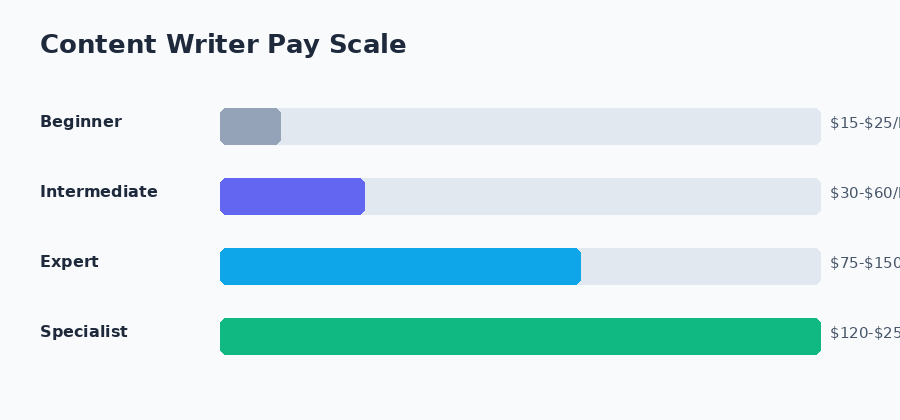
Pay varies widely depending on your niche, experience, and the type of client. Here is an honest breakdown based on my experience and industry data.
Beginner
New writers typically earn between 1 and 3 cents per word, or around $15 to $25 per article on content mills. This is not sustainable long-term. Move past this stage as quickly as you can by building a portfolio and raising your rates.
Intermediate (1-2 Years Experience)
With a decent portfolio and a couple of niche areas, intermediate writers can charge $0.05 to $0.15 per word. Monthly retainers at this level range from $500 to $2,000 depending on workload.
Experienced (3+ Years, Niche Specialist)
Experienced specialists who write for SaaS, healthcare, finance, or legal sectors regularly charge $0.15 to $0.50 per word. Monthly retainer clients can generate $3,000 to $8,000 per month from two to three anchor clients.
Expert / Senior Level
Top-level writers who combine deep niche expertise with strong SEO or conversion knowledge can charge $500 to $2,000 per article or $10,000 per month on full retainers. This is achievable, but it takes years of consistent effort.
Remote content writing jobs often offer the same rates as on-site roles. Many fully remote positions come with salaries ranging from $45,000 to $80,000 per year for full-time content roles.
Do not undersell yourself. Low rates signal low quality to experienced clients. Charge what your work is worth, and be willing to walk away from clients who cannot meet that.
Tips for Building a Sustainable Writing Career
Landing the first content writer job is a milestone. Sustaining and growing a writing career over years is a different challenge entirely. Here is what has worked for me.
Niche Down, Then Expand
When you are starting out, pick one or two topics you can own. Become the go-to writer for SaaS onboarding content, or personal finance for millennials, or B2B cybersecurity. Depth beats breadth at the beginning.
Build a Personal Website
Your personal site is your most powerful marketing tool. Include your bio, niche, writing samples, and a clear contact page. Even a simple two-page site improves your credibility enormously.
Collect Testimonials
After every project that goes well, ask for a short testimonial. Real quotes from real clients are more persuasive than any credential. Put them on your website and LinkedIn profile.
Raise Your Rates Regularly
Every six months, review your rates. If your calendar is full and you are turning down work, that is a signal to raise prices. Most good clients will stay. Those who leave create space for better-paying clients.
Invest in Continuous Learning
Content marketing evolves constantly. Google updates its algorithm. New content formats emerge. Invest a few hours each week in staying current through newsletters, communities, and courses. The writers who keep learning are the ones who stay relevant.
Build an Email List
Whether you are a freelancer or a full-time content writer, having your own audience gives you leverage. A newsletter with even 500 engaged subscribers can generate speaking invites, client referrals, and collaboration opportunities.
Diversify Your Income
Relying on a single client for most of your income is risky. Aim to have at least three to four active clients or income streams. Consider adding services like content audits, SEO strategy sessions, or workshops once you have the expertise.
Final Thoughts
Content writing jobs are genuinely accessible. You do not need a specific degree, a journalism background, or years of experience to get started. What you need is a commitment to quality, a willingness to learn, and the persistence to keep pitching until you find the right fit.
The market for content writer jobs has never been more varied. Remote content writer jobs are now the norm, not the exception. Content writing jobs remote offer flexibility, global opportunities, and competitive pay if you position yourself correctly.
Start where you are. Build as you go. Charge what your work is worth. And never stop improving.
The writers who succeed are not always the most naturally talented. They are the ones who show up consistently, communicate professionally, and treat every project as an opportunity to do their best work.
That is how you build a writing career that lasts.
Frequently Asked Questions
1. Do I need a degree to get a content writing job?
No. Most clients and companies care about your portfolio and writing quality, not your academic credentials. A strong collection of relevant writing samples will almost always outweigh a degree. Focus on building your portfolio early and showcasing your niche expertise.
2. How do I find remote content writer jobs with no experience?
Start by creating writing samples on topics you want to be known for. Publish them on a personal blog or Medium. Then apply to entry-level content writer vacancies on ProBlogger, Upwork, and LinkedIn. Be transparent about being a new writer, but let your samples speak for you. Volunteer for small paid projects to build your track record.
3. What is the difference between a content writer and a copywriter?
Content writers primarily create educational, informative, or entertaining content such as blog posts, articles, and guides. The goal is usually to attract and retain an audience. Copywriters write persuasive content designed to drive action, such as sales pages, ad copy, and email campaigns. Many writers do both, but they require slightly different skills and mindsets.
4. How much should I charge for my first content writing job?
For your first few projects, charging $0.05 to $0.08 per word is reasonable while you build your portfolio. Avoid writing for free beyond very short test pieces. As you gain reviews and samples, increase your rates. Many writers raise rates every six months. Do not stay at entry-level rates once you have proof of your quality.
5. Are content writing jobs at risk from AI?
AI tools like ChatGPT and Gemini have changed how content is produced, but they have not eliminated demand for skilled writers. Companies still need human writers for original research, brand voice, nuanced storytelling, and high-trust content like medical, legal, and financial topics. Writers who learn to use AI as a tool rather than fear it as a threat are in the strongest position.