I still remember the first time someone asked me what I charged for a blog post. I panicked. I said something vague. They agreed. Later, I realized I had charged half of what I should have.
That one mistake cost me hundreds of dollars. And I repeated it more times than I want to admit.
If you are a freelance writer or a content professional trying to figure out your content writing rates, this article is for you. I am going to walk you through everything I have learned after years of writing professionally. I will cover how to set your rates, what factors change the number, and how to stop leaving money on the table.
By the time you finish reading, you will have a clear idea of what to charge and why.
- Why Getting Your Content Writing Rates Right Matters
- The Basics: How Freelance Writers Typically Charge
- Content Writing Rates by Experience Level
- Content Writing Rates by Content Type
- Content Writing Rates by Niche
- Factors That Influence Your Content Writing Rates
- How to Calculate What You Actually Need to Earn
- How to Raise Your Content Writing Rates Without Losing Clients
- Red Flags: When a Client’s Budget Is Too Low
- How to Present Your Rates to Clients
- Content Writing Rates: Quick Reference by Project Type
- Should You List Your Rates Publicly?
- Building Long-Term Income as a Content Writer
- Frequently Asked Questions
Why Getting Your Content Writing Rates Right Matters
Most new writers charge too little. I did the same. I thought low rates would help me win more clients. In reality, they attracted clients who did not value good content writing.
Low rates also create a trap. When you are busy but broke, you do not have time to find better clients. You get stuck.
On the other hand, charging too much without backing it up with quality also backfires. Clients expect results. If your rates do not match your output, you lose trust fast.
The goal is to find a rate that reflects your skill level, covers your costs, and still gets you hired. That balance exists. It just takes some thought to find it.
Key Insight: Your rate is not just a number. It signals your positioning in the market. Charge like a professional, and clients treat you like one.
The Basics: How Freelance Writers Typically Charge
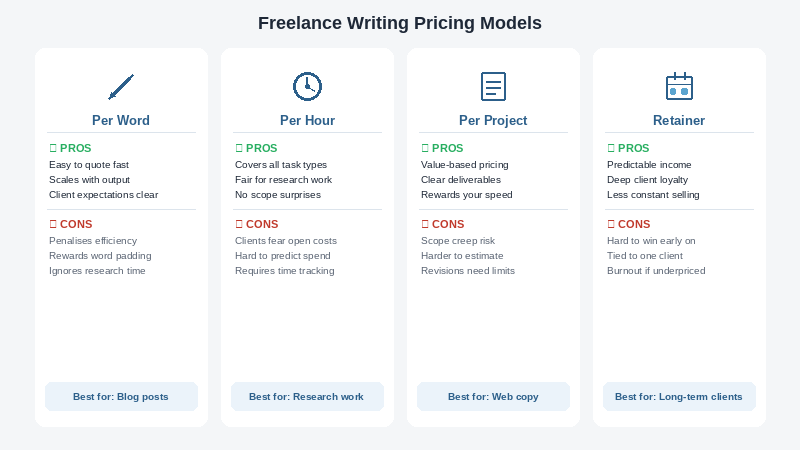
Before we talk numbers, let me explain the different pricing models. Most writers use one of four methods.
Per Word
This is the most common model for new and mid-level writers. You agree on a rate per word and multiply it by the word count of the piece.
Example: If you charge $0.10 per word and write a 1,500-word article, you earn $150.
The per-word model is simple. But it can work against you when you write fast. A skilled writer can produce 1,500 words in an hour. At $0.10 per word, that is $150 per hour, which sounds great. But if you undercharge per word, the speed works against your income.
Per Hour
Some writers, especially those doing research-heavy or technical content, prefer hourly billing. This model protects you when a project takes longer than expected.
The downside is that clients sometimes get nervous about open-ended costs. You may need to give an estimated range upfront.
Per Project (Flat Fee)
This is my preferred model now. You quote a fixed price for the whole piece. The client knows exactly what to expect. You know exactly what you will earn.
Flat fees reward efficient writers. If you finish a project faster than expected, your effective hourly rate goes up.
Retainer
Retainer arrangements are where you produce a set amount of content each month for a fixed monthly fee. These give you income stability and are worth pursuing as you grow your client base.
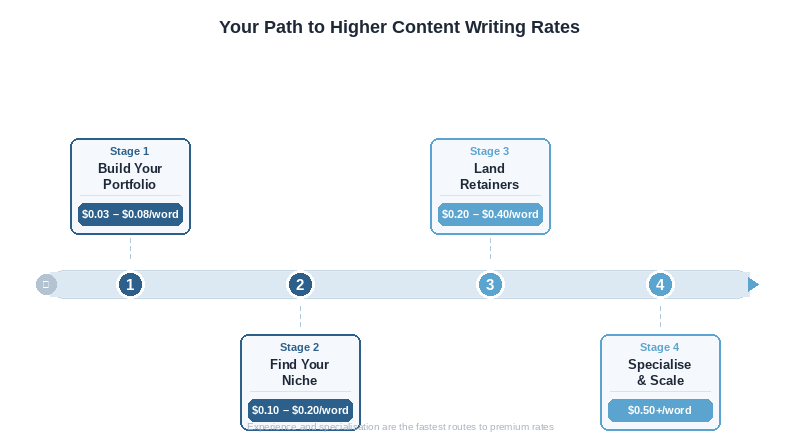
Content Writing Rates by Experience Level
Your rates should grow as your skills and portfolio grow. Here is how the market generally breaks down.
| Experience Level | Per Word Rate | Per Hour Rate | Per Article (1,000 words) |
|---|---|---|---|
| Beginner (0-1 year) | $0.03 – $0.07 | $15 – $30 | $50 – $100 |
| Intermediate (1-3 years) | $0.08 – $0.15 | $30 – $60 | $100 – $250 |
| Experienced (3-5 years) | $0.15 – $0.30 | $60 – $100 | $250 – $500 |
| Expert / Specialist (5+ years) | $0.30 – $1.00+ | $100 – $200+ | $500 – $2,000+ |
These numbers are averages. They vary based on niche, client type, and your location. Do not anchor your rates purely on experience years. Anchor them on the value you deliver.
I have seen writers with two years of experience charge more than some with seven years, simply because they specialized and built a strong portfolio in a profitable niche.
Pro Tip: When you raise your rates with existing clients, give them at least 30 days’ notice. Frame it as a reflection of growth, not just a price hike.
Content Writing Rates by Content Type
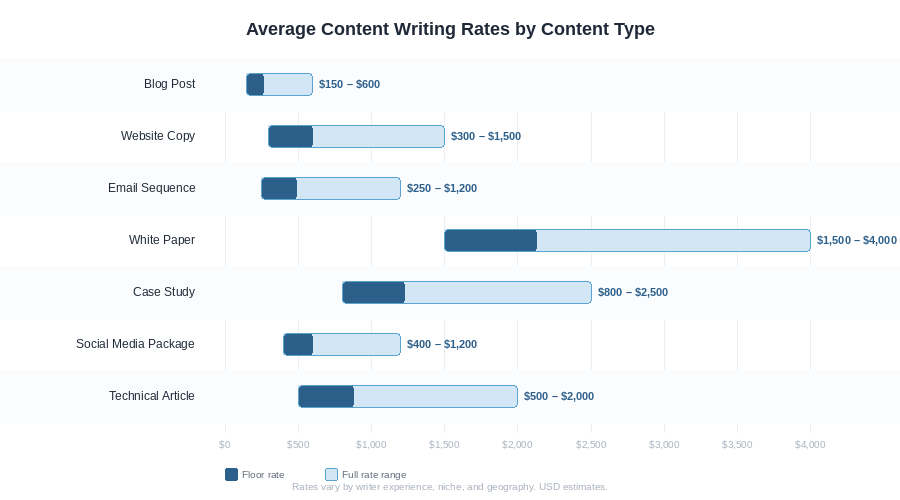
Not all content is priced the same. Some formats require more research, more skill, or more time. Rates should reflect that.
Blog Posts and Articles
This is the most common type of freelance content. A standard 1,000-word blog post typically ranges from $75 to $500 depending on depth and the writer’s experience.
Long-form blog content (2,000 to 4,000 words) that requires research, sources, and SEO optimization can go from $300 to $1,500 or more.
Website Copy
Website copy is often higher-priced because it sits at the heart of a business. Home pages, About pages, and service pages have a direct impact on conversions.
A full website copywriting project (5 to 7 pages) can range from $1,500 to $5,000 or more for experienced writers.
Email Newsletters
A single email can range from $100 to $500. Email sequences (a series of onboarding or sales emails) are usually priced as packages, often starting at $500 and going up to $3,000.
White Papers and Case Studies
These require deep research and a professional tone. White papers typically start at $1,000 and can go up to $5,000 or more. Case studies usually fall between $500 and $2,000.
Social Media Content
Individual social media captions are often priced as monthly packages. Expect ranges of $300 to $1,500 per month for a set number of posts per week.
Technical and B2B Content
If you write for SaaS companies, finance, healthcare, or other specialized industries, you can charge a premium. Technical content often commands rates that are 30% to 100% higher than general content.
Content Writing Rates by Niche
Your niche is one of the biggest factors in how much you can charge. I learned this the hard way when I moved from writing general lifestyle content to B2B SaaS content. My income nearly doubled.
Some niches pay significantly more than others because the content directly affects business revenue, or because fewer qualified writers exist.
| Niche | Demand | Rate Premium |
|---|---|---|
| Finance and Fintech | Very High | High (+40-80%) |
| Healthcare and Medical | High | High (+30-70%) |
| SaaS and Technology | Very High | High (+40-80%) |
| Legal | Moderate | Very High (+50-100%) |
| Marketing and Advertising | Very High | Moderate (+20-40%) |
| Travel and Lifestyle | High | Low (+0-20%) |
| General Blogging | Very High | Low (baseline) |
Picking a niche is not just about money. It is about building expertise that compounds. The longer you write about one subject, the better your content gets. And the better your content, the higher your rates can go.
My Experience: When I specialized in B2B content marketing, I stopped competing with hundreds of general writers and started competing with a much smaller pool. That shift alone let me raise my rates without losing clients.
Factors That Influence Your Content Writing Rates
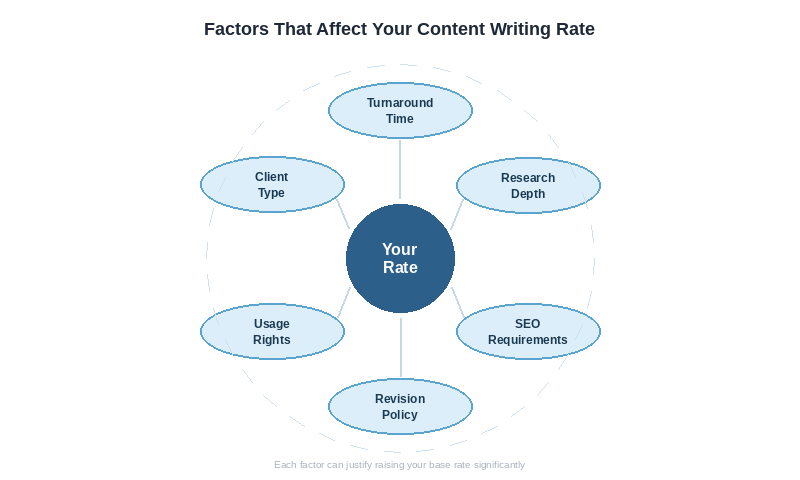
Your rate is not one-size-fits-all. Several variables affect what you should charge for any given project.
Turnaround Time
Rush jobs should always cost more. If a client needs a 2,000-word article in 24 hours instead of five days, that demands a rush fee of 25% to 50% on top of your regular rate.
Research Depth
An opinion piece takes less time than a well-researched, data-backed article. If you need to read studies, interview experts, or dig through reports, factor that into your quote.
SEO Requirements
If a client wants SEO-optimized content with keyword research, meta descriptions, internal linking suggestions, and structural recommendations, you are providing more value than a writer who just puts words on a page. Charge accordingly.
Revisions Policy
I always include one or two rounds of revisions in my quotes. After that, additional revisions are billed separately. Define this clearly in your contract to avoid revision creep.
Usage Rights
If a client wants to put your name on the content (bylined), it is typically priced differently from ghostwriting, where they take credit. Ghostwriting often commands a premium because you give up the portfolio credit.
Client Type
Startups with limited budgets pay less than established companies. Enterprise clients with content teams and larger marketing budgets will often pay more, but they also have stricter standards and longer approval processes.
How to Calculate What You Actually Need to Earn
Many writers set rates based on what they see other writers charge. That is a mistake. You need to start with what you need to earn, then work backwards.
Here is the calculation I use:
- Calculate your monthly expenses. Include rent, food, utilities, software, insurance, taxes, and savings goals.
- Add 30% to 35% for self-employment taxes (depending on your country).
- Estimate how many billable hours you can realistically work in a month. Most freelancers have 100 to 120 billable hours after accounting for admin time, marketing, and breaks.
- Divide your target monthly income by your billable hours. That is your minimum hourly rate.
- Convert your hourly rate into per-word or per-project rates using your average writing speed.
Example: If you need $4,000 a month and can bill 100 hours, your minimum hourly rate is $40. If you write 1,000 words per hour, you need to charge at least $0.04 per word just to break even. Factor in research time, edits, and admin work and that number climbs quickly.
Reality Check: Most writers underestimate how many non-writing hours go into freelancing. Client communication, invoicing, pitching, and revisions can take 30-40% of your working time. Price accordingly.
How to Raise Your Content Writing Rates Without Losing Clients
Raising your rates is uncomfortable. I have been there. But staying at the same rate for years means your real income drops as inflation rises.
Here is what has worked for me:
Announce Rate Increases in Advance
Give clients at least 30 days of notice before a rate increase kicks in. This shows professionalism and gives them time to adjust budgets.
Tie It to a Value Upgrade
If you are raising rates, pair it with something tangible: a faster turnaround, more detailed briefs, improved SEO optimization, or better research depth. It becomes easier for clients to say yes.
Do Not Apologize
State your new rate matter-of-factly. Do not over-explain or apologize. Say something like: ‘My rate for this type of content is now $X effective from [date]. I would love to continue working with you at this rate.’
Let Some Clients Go
Not every client will follow you to higher rates. That is okay. Let the ones go who cannot pay what you are worth. Use that freed-up time to pursue better-paying opportunities.
Raise Rates With New Clients First
It is often easier to charge higher rates with new clients than to raise them with existing ones. Use each new client as an opportunity to test a higher rate. If they say yes, you have proof the market supports it.
Red Flags: When a Client’s Budget Is Too Low
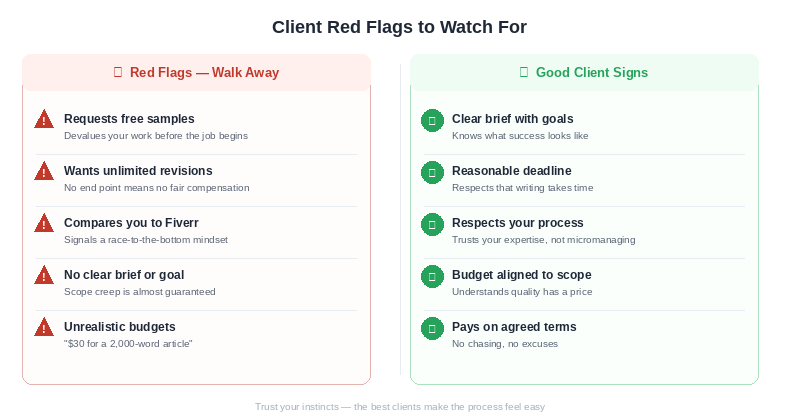
Low-budget clients are not always a bad thing, especially when you are building your portfolio. But there are warning signs that a project is not worth the trouble.
- The client asks for a ‘quick’ 2,000-word article for $20. That is not quick, and $20 is not a rate.
- They want unlimited revisions for a fixed fee. This is a trap.
- They compare you to Fiverr writers. If they want Fiverr pricing, send them to Fiverr.
- They have no brief, no deadline, and no clear goal. Disorganized clients cost you more time than they pay.
- They ask you to write a ‘sample’ for free. No. Your portfolio is your sample.
I have taken on every one of these clients at least once. None of them ended well. Learning to say no is part of growing as a freelance writer.
How to Present Your Rates to Clients
How you communicate your rates matters almost as much as the rates themselves. Here is what I have learned.
Lead With Value, Not Hours
Do not say ‘I will write this article in 3 hours at $50 per hour.’ Say ‘This article is $150. It will include keyword optimization, a clear structure, and two rounds of revisions.’
Clients buy outcomes, not time.
Use a Written Proposal or Quote
Never quote verbally without a written follow-up. A simple email or document that outlines the scope, word count, deliverables, revision policy, and total price protects both of you.
Be Specific About What Is Included
List exactly what the client gets. Number of words, number of revisions, whether SEO optimization is included, the turnaround time. Ambiguity causes disputes.
Do Not Over-Negotiate
It is fine to make small adjustments for long-term clients. But do not slash your rates just because a client pushes back once. If your rate is fair, hold it.
Script That Works: ‘My rate for this project is $X. That includes [deliverables]. I can get started by [date]. Would you like to proceed?’
Content Writing Rates: Quick Reference by Project Type
| Project Type | Word Count | Rate Range (USD) |
|---|---|---|
| Short blog post | 500-800 words | $75 – $200 |
| Standard blog post | 1,000-1,500 words | $150 – $500 |
| Long-form article | 2,000-4,000 words | $400 – $1,500 |
| Home page copy | 400-700 words | $300 – $800 |
| Full website (5-7 pages) | 2,500-5,000 words | $1,500 – $5,000 |
| Email newsletter | 300-600 words | $100 – $500 |
| Email sequence (5 emails) | 1,500-3,000 words | $500 – $2,500 |
| White paper | 2,500-5,000 words | $1,000 – $5,000 |
| Case study | 500-1,500 words | $500 – $2,000 |
| Social media package (monthly) | Varies | $300 – $1,500/month |
| Technical article | 1,000-2,000 words | $300 – $1,500 |
| Product descriptions (per item) | 100-200 words | $25 – $100 each |
These are ranges, not guarantees. Your rates should reflect your experience, niche, and the complexity of each project.
Should You List Your Rates Publicly?
This is a debate in the freelance writing community. I have tried both approaches.
Listing rates on your website filters out clients who cannot afford you. It saves time and sets expectations. But it can also limit you from quoting higher for complex projects or bigger clients.
My current approach: I list a starting rate (‘from $X per project’) on my website but do not publish a full pricing menu. That way, clients know roughly what to expect, but every quote is still custom.
Whatever you choose, be consistent. If you list rates publicly, honor them or explain clearly why a project might cost more.
Building Long-Term Income as a Content Writer
Rates matter. But so does the structure of your freelance business.
Diversify Your Client Base
Do not rely on one or two clients for most of your income. If one leaves, you should not lose 80% of your revenue. Aim for no single client making up more than 30% of your income.
Focus on Retainers
Retainer clients give you monthly predictability. Pitch ongoing content packages to clients who need regular blog posts, newsletters, or social content. A retainer of $1,000 to $3,000 per month from three to four clients is a solid foundation.
Productize Your Services
Create clear service packages with fixed prices. A ‘Monthly SEO Blog Package’ that includes four 1,000-word articles, basic keyword research, and meta descriptions for $1,200 a month is easier to sell than custom quotes every time.
Invest in Your Skills
The writers who earn the most are the ones who keep learning. SEO writing, conversion copywriting, technical content, and AI-assisted workflows are all skills that can unlock higher rates.
Frequently Asked Questions
1. What is a fair content writing rate for a beginner?
If you are just starting out with no portfolio, a rate of $0.03 to $0.07 per word is common. That translates to roughly $30 to $70 for a 1,000-word article. Do not go below $0.03 per word for original content. Anything lower is not worth your time once you factor in research and revisions. Build your portfolio with a few low-rate projects, then raise your prices as soon as you can.
2. How do I know if my rates are too low?
A few signs your rates are too low: You are booked solid but still struggling to pay bills. Clients accept your rates immediately without any negotiation. You feel resentful working on projects. You have not raised your rates in over a year. If two or more of these apply to you, it is time to revisit your pricing.
3. Should I charge per word or per project?
Both models work. Per-word pricing is transparent and easy to explain. Per-project pricing is often better for clients who want cost certainty, and it rewards you when you write efficiently. I recommend starting with per-word pricing when you are new, and shifting to project-based pricing as you gain experience and can accurately estimate the time each job requires.
4. How do content writing rates differ for ghostwriting?
Ghostwriting typically commands a premium of 20% to 50% above your standard rate because you are giving up the byline and the portfolio credit. Some ghostwriters charge even more for high-profile projects like business books or thought leadership articles. Always specify ghostwriting rates separately in your contracts.
5. Is it okay to negotiate my content writing rates?
Yes, within reason. Small adjustments for long-term relationships, large volume commitments, or ongoing retainers are normal. But do not cut your rate simply because a client asks. If they push back hard, it often means they do not value the work, not that your rate is wrong. Hold your rate for clients who respect your work. Negotiate for clients who are genuinely worth investing in for the long term.
Final Thoughts
Setting your content writing rates is not a one-time decision. It is something you revisit as you grow, as the market shifts, and as your skills deepen.
The most important thing I can tell you from experience is this: charge what your work is worth. Not what you think the client will accept. Not what the writer on a forum said they charge. What your skills, your time, and your expertise are actually worth.
Start where you are. Build from there. Raise your rates consistently. And never stop improving your craft.
The writers who do well in this field are not always the best writers. They are the ones who treat writing as a business and price themselves accordingly.
Remember: Every time you undercharge, you signal to the market that your work has low value. Price with confidence, back it up with quality, and the right clients will follow.