Everything I wish someone had told me before I spent three years sending the wrong samples to the wrong clients.
When I first started writing for clients, I had no portfolio. What I did have was a Google Doc stuffed with blog posts I had written for fun, a few college essays, and the unshakeable confidence that my writing spoke for itself. It did not.
I lost pitches I should have won, got passed over for gigs I was perfectly qualified for, and spent the better part of a year wondering why nobody was taking me seriously. Then a client who actually gave me feedback said something I will never forget: “I wanted to hire you, but I had no idea what you could do.”
That sentence changed everything for me. A portfolio is not just a collection of your past work. It is your most persuasive sales tool, your first impression, and often the deciding factor between you and the other ten writers pitching the same gig.
In the years since, I have built portfolios on every major platform, restructured them for different industries, thrown out samples I thought were brilliant in favor of ones that actually converted, and slowly figured out what works. This article is everything I know.
- What a Writing Portfolio Actually Is (And Is Not)
- Why Your Portfolio Is More Important Than Your Resume
- When I Realized My Portfolio Was Broken
- What to Include in Your Writing Portfolio
- Where to Host Your Portfolio
- How to Organize Your Work
- Creating Samples When You Have No Published Work
- Keeping Your Portfolio Updated
- Tailoring Your Portfolio for Specific Clients
- Mistakes I Made So You Do Not Have To
- The Power of Testimonials in a Writing Portfolio
- Tools I Use to Manage My Portfolio
- How Your Portfolio Evolves With Your Career
- FAQs
What a Writing Portfolio Actually Is (And Is Not)
This sounds obvious, but hear me out, because I got this wrong for a long time. A portfolio is a curated selection of your best, most relevant work. The word “curated” is doing a lot of heavy lifting in that sentence.
When I was starting out, I treated my portfolio like an archive. I put everything in it. Long-form features next to 300-word product descriptions next to academic essays. It was a mess.
A portfolio is not a resume. A resume tells people where you have been. A portfolio shows people what you can do right now, for them, in a format they can immediately picture on their own website or publication.
The moment I started thinking about my portfolio from the client’s perspective rather than my own ego, everything changed.
Your portfolio is also not fixed. The biggest mistake I see writers make is treating their portfolio like a monument they built once and occasionally dust off. Your work changes. Your niche shifts. Your skills evolve. The portfolio has to keep up. More on this later.
Why Your Portfolio Is More Important Than Your Resume
I have spoken to dozens of content managers and editors over the years, and nearly all of them say the same thing: they barely read resumes. What they do read is writing samples. One editor at a tech company told me she can tell within two paragraphs whether a writer fits their voice. That is two paragraphs. Your entire academic history, your list of publications, your carefully crafted bio, all of it comes second to whether those first two paragraphs sing.
A portfolio is your most persuasive sales tool. It is your first impression, and often the deciding factor between you and ten other writers pitching the same gig.
This is also why I think a strong portfolio matters far more at the beginning of a career than credentials. I know writers without journalism degrees or fancy bylines who consistently land high-paying clients because their portfolio is exceptional. I also know writers with impressive resumes whose portfolios are an afterthought, and they struggle to get traction. The work is what matters. The portfolio is how you prove it.
When I Realized My Portfolio Was Broken
About eighteen months into my career, I got a response to a pitch that stopped me cold. A content director wrote back and said: “Your samples are well-written, but they read like blog content for a general audience.
We publish technical SaaS case studies. Do you have anything closer to that?” I did not. I had not even thought about the gap. I was sending the same five samples to every client regardless of what they actually needed.
That was the moment I realized a portfolio is not one thing. It is a strategic tool you shape for each context you operate in. Sending a travel essay to a B2B fintech brand is not just irrelevant, it signals a lack of understanding of the client’s world.
From that point on, I started thinking about my portfolio in layers: a general-purpose version for initial outreach, and tailored versions I could pull up for specific industries or content types.
What to Include in Your Writing Portfolio
Let me walk you through what I currently include in mine, and more importantly, why each element is there.
Your Best Published Samples
These are the crown jewels. Published work carries implicit credibility because an editor or brand already said “yes” to it. When I have a piece published on a recognizable platform, I lead with it. The publication’s name does the first round of persuasion for me before the client reads a single word.
But I have learned to be ruthless here. A mediocre piece published on a well-known site is not necessarily better than an exceptional piece published on a smaller one. What I ask myself is: does this sample demonstrate the specific skill I want to be hired for? If the answer is no, it does not belong in the portfolio even if the publication is impressive.
Spec Samples (When You Are Starting Out)
For the first year or two, I did not have enough published work to fill a portfolio. So I wrote spec samples: original pieces created specifically for my portfolio, not for a client or publication.
A spec sample is not a lie. It is a demonstration of ability. Every copywriter, journalist, and content strategist who has ever started from scratch has done this.
The key is to make spec samples look and feel like real work. I wrote spec blog posts targeting real brands in industries I wanted to work in. I formatted them the way I would if they were actually going up on a CMS.
I gave them proper headlines, subheadings, and bylines. When clients asked if these were published, I was honest: I said they were portfolio samples, but the quality of the writing made the question irrelevant.
A Range of Formats
A strong portfolio shows that you can do more than one thing. Mine currently includes long-form blog posts, a case study, a white paper excerpt, email sequences, and a product description set. This range signals versatility. It tells a potential client that I can scale my writing up or down, formal or conversational, short or exhaustive, depending on what they need.
That said, do not include a format just to have it. A weak white paper hurts more than no white paper at all. Every sample you include should be genuinely excellent, or it should not be there.
A Clear Bio and Contact Information
I have visited countless writer portfolios where I had no idea who the person was, what they specialized in, or how to reach them. Your bio needs to answer three questions instantly: who are you, what do you write about, and who do you write for. Keep it short. Two to three focused paragraphs, maximum. Clients do not have time to read a life story. They want to know if you are the right fit, fast.
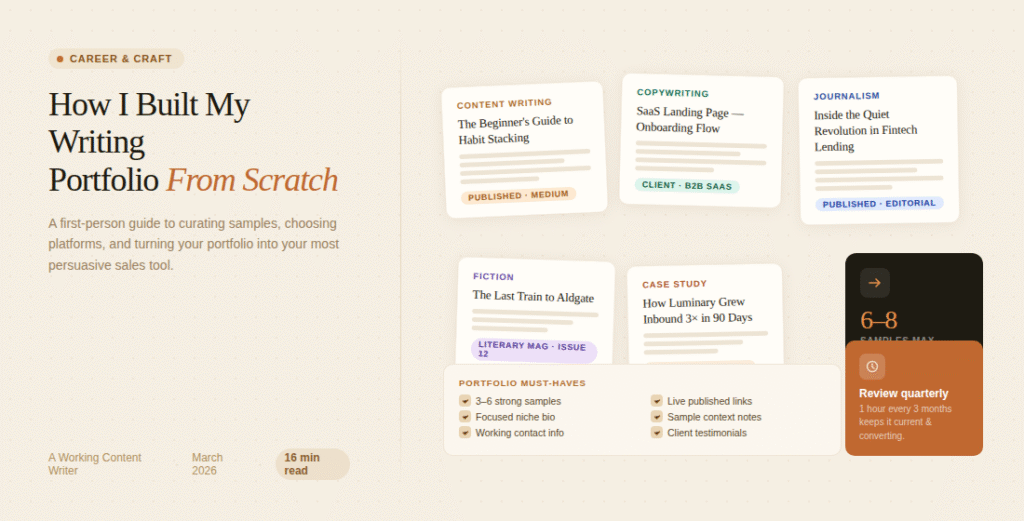
| QUICK CHECKLIST: PORTFOLIO MUST-HAVES |
| ? Three to six of your strongest, most relevant samples (published or spec). |
| ? A focused bio explaining your niche, audience, and writing style. |
| ? Clear contact information or a contact form that actually works. |
| ? Links to live published pieces wherever possible. |
| ? Optional but valuable: a brief note on your process, tools, or turnaround time. |
Where to Host Your Portfolio
This is where writers spend far too much time overthinking and not enough time actually building. I have tried nearly every major platform at this point, and here is what I can tell you from direct experience.
The Content Writing Craft
If you are building your portfolio alongside a personal brand, The Content Writing Craft works well as a central writers directory. Instead of just listing samples, you can turn your portfolio into a living asset by publishing articles, showcasing expertise, and attracting organic traffic.
The advantage here is ownership and control. You decide how your work is presented, how it is structured, and how it grows over time. It does take more effort compared to plug and play platforms, but the long term payoff is significantly higher if you are serious about content writing as a career.
Contently
This was my first portfolio home and I still recommend it to newer writers. Contently is free, built specifically for writers, and does a good job of pulling in published clips automatically when you link your bylines.
The interface is clean and professional. The limitation is that you do not own the URL and customization options are minimal. But as a starting point, it is excellent.
Muck Rack
Muck Rack is particularly powerful if you are targeting journalism, PR, or media clients. It aggregates your published work and builds a profile around your bylines.
I used it heavily when I was pitching editorial clients. The built-in search means that clients and editors actually discover you there, which is a benefit most portfolio platforms cannot offer.
Your Own Website
This is the gold standard, and I wish I had built mine sooner. Having your own domain signals professionalism and permanence. It says you are not a passing freelancer; you are a business. I use WordPress, but platforms like Squarespace, Wix, and Webflow all work well for writer portfolios.
The key is to keep the design clean and let the writing take center stage. Flashy templates with animated intros are not what clients are looking for when they are about to trust you with their brand’s voice.
The one thing I would say is this: do not wait until your website is perfect to launch it. I spent four months “almost” having a website up because I kept tweaking the design. A simple, live portfolio beats a perfect one that does not exist yet.
LinkedIn is not a portfolio platform, but it functions as one if you use it correctly. I upload samples directly to my profile using the “Featured” section and I keep my “About” copy tight and specific.
LinkedIn is where many content managers will look you up after receiving a pitch, so it needs to be consistent with what they see on your main portfolio. Think of it as a secondary portfolio that reinforces the primary one.
How to Organize Your Work
Organization is the unsung hero of a good portfolio. I have seen portfolios with excellent writing that felt chaotic because there was no logic to how the samples were arranged. I have also seen modest portfolios that felt authoritative because the structure made instant sense.
The approach I use now is to organize by industry or content type rather than by date. Chronological order made sense to me early on because it felt like showing progress, but clients do not care about my career timeline.
They care whether I can write what they need. So my portfolio groups work into categories: technology, health and wellness, finance, and marketing. Within each category, I lead with the strongest piece.
If you have deep specialization in one area, make that clear at the top. I spent a period of my career writing almost exclusively for SaaS companies, and during that time my portfolio opened with a dedicated SaaS section before anything else. That specificity got me better clients and higher rates than anything else I have done.
Creating Samples When You Have No Published Work
The most common question I get from writers starting out is some version of: “How do I build a portfolio when I have nothing to put in it?” I understand the frustration. It feels like being asked to have experience before getting experience. But there are real, practical solutions.
First, write for yourself. Pick three brands or publications you genuinely want to work with and write a sample piece for each, targeting their actual audience, in their actual tone, at their actual word count.
Do not just write something vague and slap a brand name on it. Actually study how they communicate. Read their existing content. Then write something that fits so naturally that it could have come from their editorial calendar. This exercise alone will teach you more about tone-matching than any course.
Second, guest post. Most industry blogs accept guest contributions, and many smaller publications are hungry for content. You are not going to get paid for this at first, but you will get bylines. A published byline is always more persuasive than a spec sample, even on a modest platform. I wrote several guest posts in the early years of my career specifically to have published links I could include in my portfolio.
Third, do not underestimate content you have already created. If you have been blogging, even casually, those posts can become portfolio samples with a bit of polish.
If you have written for student publications, community newsletters, or even internal company communications in a previous job, those are legitimate samples. I did not include my college newspaper articles forever, but for the first two years of my freelance career, they helped fill the gap.
Keeping Your Portfolio Updated
This is the part most writers neglect, and I have been guilty of it too. Life gets busy, client work piles up, and the portfolio sits there quietly going stale. I once went back to my portfolio after a stretch of intensive client work and found samples that were two years old, written in a niche I had long moved out of, for an audience I no longer targeted. I was essentially advertising a version of myself that no longer existed.
Now I have a simple rule: every quarter, I spend one hour reviewing my portfolio. I ask myself three questions. First, does every sample still represent my best current work?
Second, does the portfolio reflect the type of work I want to be hired for now, not the work I was doing two years ago? Third, are there any new pieces from the past three months that should replace something older?
This quarterly check also includes looking at the technical side of things. Are all my links still live? Has any publication I have worked with changed its URL structure, which would break my links?
I have lost several strong clips over the years because publications got bought, rebranded, or shut down. When that happens, I try to save a PDF or screenshot of the piece so I at least have a record, even if the live link is gone.
Tailoring Your Portfolio for Specific Clients
Once I had a solid general portfolio, I started doing something that made a noticeable difference in my pitch conversion rate: I stopped sending everyone the same portfolio. Instead, I created a short, curated “pitch packet” for each pitch that contained only the two or three samples most relevant to that specific client.
This is not as complicated as it sounds. I keep a folder of all my strong samples, organized by format and industry. When I write a pitch, I spend five minutes selecting the samples that most closely match what that client publishes. A B2B software company gets my SaaS case study and my technical explainer blog post. A wellness brand gets my long-form feature on mindfulness and my product-focused wellness article. Nobody gets my travel essays unless I am pitching a travel publication.
Every quarter, I spend one hour reviewing my portfolio. I ask whether each sample still represents my best work, and whether it reflects the kind of client I want today.
The result is that clients feel like I understand their world specifically, not just content writing in general. That signal of understanding is often worth more than having twice as many samples, because it answers the question they are quietly asking: “Does this writer get what we do?”
Mistakes I Made So You Do Not Have To
I have made most of the mistakes that are possible to make with a writing portfolio, so let me save you some time.
I included too much work for too long. In the beginning, I thought more samples meant more evidence of skill. What it actually meant was that clients had to work harder to find what was relevant to them. Fewer, better samples always outperform an overwhelming archive. I now keep my main portfolio to six to eight pieces, maximum.
I kept samples that I had outgrown. There was a batch of articles I wrote in my first year that I was genuinely proud of at the time. By year three, I had grown so much as a writer that those early pieces were doing me harm by being in my portfolio. It is hard to take down work you worked hard on, but if it no longer represents what you can do, it has to go.
I did not include context alongside my samples. A writing sample dropped on a page with no explanation can leave a client guessing. I now add a one- to two-sentence note next to each sample explaining the brief I was given, the audience it was written for, and any notable results if I have them.
“Written for a SaaS company targeting mid-market procurement teams; ranked on page one of Google within eight weeks” tells a far richer story than the article alone.
I ignored the visuals of my portfolio for too long. Writing lives on a screen, which means its presentation matters. Dense, unbroken text, hard to navigate menus, and broken image links undermine even the best writing. Clients form an impression of your professionalism before they read a word. Your portfolio’s design is part of your pitch whether you like it or not.
The Power of Testimonials in a Writing Portfolio
I added a testimonials section to my portfolio relatively late, and it was one of the best decisions I made. Writing is a trust business. Clients are handing you their brand’s voice, which is an intimate thing. Social proof from real clients does a kind of persuasion that the writing itself cannot always do alone.
My approach is to keep testimonials specific and results-focused. A generic “great writer, would recommend” is nice but forgettable. A testimonial that says “she understood our technical audience in ways our previous writers never did, and the blog she wrote for us generated more inbound leads in one month than anything we had published before” is a different thing entirely.
I ask clients for testimonials after delivering work they were clearly happy with, and I gently guide them toward specificity by asking what concrete difference the writing made for them.
You do not need many. Two or three strong, specific testimonials placed near your samples can have a dramatic effect on how seriously clients take your pitch. I keep mine brief and attributed (with permission) to the client’s name and company role.
Tools I Use to Manage My Portfolio
I keep a running Google Sheet with every piece I have ever published or created for portfolio purposes. Each row includes the title, the publication or client, the content type, the industry, the date, the live URL (and a backup PDF), and a quick note on performance data if I have it. This means that when I am building a pitch packet, I can filter by industry or content type and immediately see my options.
For my actual portfolio site, I use WordPress with a clean theme that keeps the focus on the writing. I use a simple PDF exporter to create downloadable versions of spec samples so that clients who prefer to read offline can do so easily. For the occasional client who wants to see a portfolio presentation rather than a website link, I use a Notion page that I can customize quickly with a curated selection of samples.
The tool does not matter as much as the habit of maintaining it. Whether you use Notion, Contently, your own WordPress site, or a simple PDF, what matters is that you know where everything is and can update it without friction. The portfolio you actually maintain is infinitely more valuable than the portfolio you plan to build someday.
How Your Portfolio Evolves With Your Career
The portfolio I have today looks almost nothing like the one I had three years ago. The writing is better, obviously. But more importantly, the strategy behind it is different. Early on, I was trying to show range because I was figuring out what kind of writer I wanted to be.
The portfolio was exploratory. Now it is focused. It exists to attract a specific type of client in a specific industry at a specific price point.
This evolution is natural and important. A portfolio that is appropriate for a writer in their first year is not appropriate for a writer in their fifth year, and vice versa.
The writers I admire most treat their portfolio as a living document that reflects not just where they have been but where they are actively choosing to go.
If you want to break into a new niche, your portfolio needs to start reflecting that ambition before you have the work to fully back it up. Write the spec samples. Build the bridge before you need to cross it.
There is also a pricing dimension to this. As your rates increase, the caliber of your portfolio needs to keep pace. A $50-per-article writer and a $500-per-article writer can both have excellent portfolios, but the $500 writer’s portfolio needs to be impeccable in its curation, presentation, and specificity. Clients paying premium rates expect premium signals at every stage of the engagement, including the very first one.
| Final Thoughts Building a writing portfolio is one of the most important and most underestimated things you can do for your writing career. It is not a chore you knock out once and forget. It is an ongoing act of professional self-definition. Every sample you include says something about who you are as a writer and who you are trying to serve. If I could go back and give myself one piece of advice at the start, it would be this: stop worrying about not having enough work and start being strategic about the work you already have. Curate ruthlessly. Present thoughtfully. Update consistently. Show clients not just what you have written, but exactly why you are the right writer for what they need to write next.Your portfolio is not a record of your past. It is an invitation to your future. Build it accordingly. |
FAQs
How many samples should I include in my writing portfolio?
Between six and eight – maximum. More samples don’t signal more skill; they make clients work harder to find what’s relevant to them. Every piece you include should be genuinely excellent and targeted to the type of work you want to be hired for. If a sample no longer represents your best current writing, it needs to go, regardless of how proud you were of it when you wrote it.
What should I do if I have no published work yet?
Write spec samples – original pieces created specifically for your portfolio, not for a client. Pick three brands or publications you genuinely want to work with, study how they communicate, and write something that fits their voice, audience, and word count so naturally it could have come from their editorial calendar. You can also guest post on industry blogs for free bylines, or polish casual writing you’ve already done – blog posts, student publications, internal company communications. A well-executed spec sample with context beats a mediocre published clip every time.
Should I have one portfolio or different versions for different clients?
Both. Maintain a solid general-purpose portfolio for initial outreach, but build the habit of creating a short curated pitch packet – two or three samples – tailored specifically to each client you’re approaching. A B2B software company should see your technical and SaaS work. A wellness brand should see your health and lifestyle writing. Nobody sees your travel essays unless you’re pitching a travel publication. That signal of understanding is often worth more than having twice as many samples.
Which platform is best for hosting a writing portfolio?
Your own website is the gold standard – it signals permanence and professionalism – but don’t let the pursuit of a perfect site delay you from having anything live at all. For writers just starting out, The Content Writing Craft is free, built for writers, and professionally presented. If you’re targeting journalism or media clients, Muck Rack is particularly strong because editors can discover you there. LinkedIn’s Featured section works as a reliable secondary portfolio. The platform matters far less than the habit of keeping it current.
How often should I update my portfolio, and what exactly should I review?
Once a quarter, for about an hour. Ask yourself three things: does every sample still represent your best current work; does the portfolio reflect the type of client you want to attract now, not two years ago; and are there new pieces from the past three months worth swapping in? Also check the technical side – confirm all links are still live, since publications get bought, rebranded, or shut down with no warning. When a live link disappears, save a PDF so the work isn’t lost entirely.