When I first started content writing, I thought I already knew what it involved. You write something, you publish it, people read it. Simple.
I was wrong.
Within weeks of landing my first freelance project, I realized that writing for the internet is an entirely different skill from writing an essay or a report. There are readers to understand, search engines to satisfy, structures to follow, and value to deliver. All at the same time.
It felt like a lot. And for a while, it was.
But over time, I found that good content writing comes down to a handful of principles that anyone can learn. Once those clicked for me, everything became clearer. My writing improved. My clients noticed. And writing stopped feeling like guesswork.
In this article, I am sharing the 15 content writing tips that made the biggest difference in my journey. Whether you are just starting out or trying to sharpen your skills, I hope these lessons help you move faster and make fewer of the mistakes I made.
- What Content Writing Actually Is (And Why It Matters)
- Tip 1: I Always Start With the Reader, Not the Topic
- Tip 2: I Learned to Write Simply on Purpose
- Tip 3: I Structure Every Article for People Who Skim
- Tip 4: I Made SEO Basics Less Scary
- Tip 5: I Treat Headlines as Half the Work
- Tip 6: I Commit to One Idea Per Paragraph
- Tip 7: I Cut Ruthlessly During Editing
- Tip 8: I Use Writing Tools as a Safety Net
- Tip 9: I Understand Search Intent Before Writing Anything
- Tip 10: I Study Real Published Content Like a Student
- Tip 11: I Built a Portfolio Before I Had Paying Clients
- Tip 12: I Practiced Even When Nobody Was Paying Me to Write
- Tip 13: I Read With Intention, Not Just for Pleasure
- Tip 14: I Stopped Taking Feedback Personally
- Tip 15: I Always Include a Clear Call to Action
- Bonus: I Remind Myself That Writing Skill Is Built Over Time
- Final Thoughts
- Frequently Asked Questions
What Content Writing Actually Is (And Why It Matters)
Before I get into the tips, it helps to define what content writing really means. I used to confuse it with creative writing or journalism. They are related, but they are not the same thing.
Content writing is the process of creating written material that serves a specific purpose for a specific audience online. That purpose could be to answer a question, explain a concept, guide a decision, or prompt an action. The format changes depending on the goal. But the purpose stays constant.
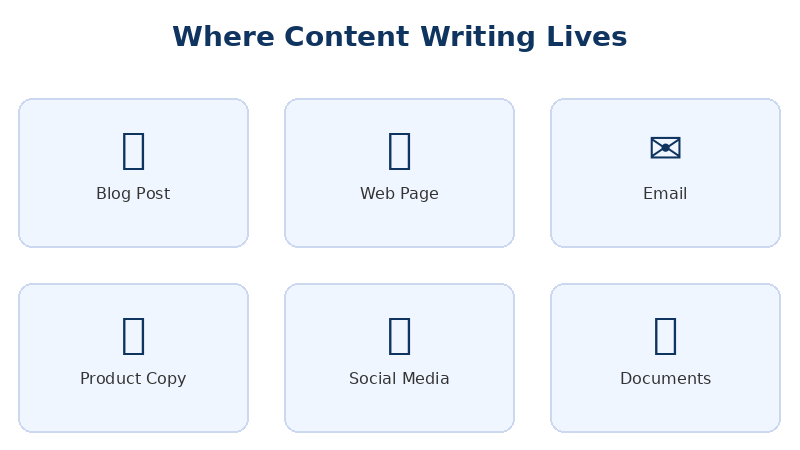
Content writing shows up in many places:
- Blog posts and long-form articles
- Website landing pages and about pages
- Product descriptions and category pages
- Email newsletters and drip sequences
- Social media captions and LinkedIn posts
- White papers, case studies, and guides
Each of these formats has its own rhythm and structure. But every single one shares a core requirement: it must be useful to the person reading it.
That usefulness is what separates content that ranks and converts from content that gets ignored. It is also what makes strong writing skills valuable whether you want to work with content writing agencies, offer freelance content writer services, or build your own platform.
Tip 1: I Always Start With the Reader, Not the Topic
This was the first major shift in how I approached writing. Early on, I would pick a topic and start typing. The result was content that felt unfocused, like I was talking to nobody in particular.
The fix was simple but powerful: before writing a single word, I ask who the reader is and what they actually want.
That one question shapes everything that follows.
Writing for a beginner looks completely different from writing for a professional. Beginners need clear definitions, relatable examples, and step-by-step logic. Experts want to skip the basics and get to nuance, data, or advanced strategy.
These days, I always define three things before I open a blank document:
- What problem does this article solve for the reader?
- What question brought them here in the first place?
- What would make this page the most helpful result they find today?
When I answer those questions first, the writing organizes itself. The structure, the tone, the depth, it all flows more naturally.
Tip 2: I Learned to Write Simply on Purpose
There was a time when I thought complex language made writing sound more professional. I used long words and dense sentences because I believed it showed expertise.
The feedback I received quickly corrected that belief.
Readers do not want to work hard to understand your point. If they have to re-read a sentence twice, you have already lost them. Clear writing is not lazy writing. It is considerate writing.
The principle I follow now is this: if a simpler word works just as well, I use the simpler word. If a shorter sentence carries the same meaning, I cut the longer one.
Compare these two sentences:
The implementation of strategic content methodologies enhances audience engagement and facilitates conversion optimization.
Good content strategies help you connect with more people and turn readers into customers.
The second version is easier to read, faster to understand, and far more trustworthy.
My best editing trick is reading my draft out loud. If I stumble on a sentence when speaking it, that sentence needs rewriting. The ear catches what the eye misses.
Tip 3: I Structure Every Article for People Who Skim
Here is something I had to accept early: most people do not read online content word for word. They scan. They look for headings that match what they need. They skim bullet points. They read the first sentence of a paragraph and decide if it is worth continuing.
If I write a solid 2,000-word article but format it as one long block of text, I have wasted that effort. The reader will leave before they even begin.
So I learned to structure content with both the deep reader and the skimmer in mind. Here is what that looks like in practice:
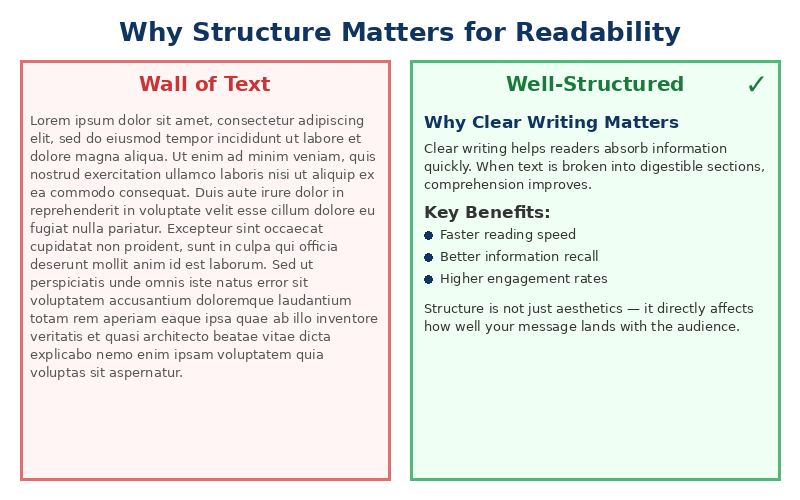
- Short paragraphs, usually two to four sentences each
- Clear H2 and H3 headings that tell readers what each section covers
- Bullet points for lists of three or more items
- Bold text to highlight key ideas, used sparingly so it stays meaningful
- Enough white space between sections to give the eye a rest
This structure also helps search engines. When Google’s crawlers read a well-organized page, they can identify what each section is about and how it relates to the overall topic. Good structure is simultaneously good UX and good SEO.
Tip 4: I Made SEO Basics Less Scary
When I first heard about SEO, I thought it was a technical discipline for developers and marketers, not writers. The terminology alone felt intimidating.
But here is what I eventually discovered: the basics of SEO are actually about serving the reader better. And most of them come naturally once you understand what search engines are trying to do.
Search engines want to deliver the most helpful, relevant, and trustworthy result for every search. Your job as a writer is simply to make your content that result.
The SEO basics that matter most for writers are:
- Understanding search intent: figure out why someone is searching for your topic. Are they looking for information, comparing options, or ready to buy? Your content should match that intent.
- Using keywords naturally: include your main keyword and related phrases in the title, introduction, headings, and throughout the body. Never force them in awkwardly.
- Writing clear, descriptive titles and meta descriptions: these are the first thing a searcher sees. Make them specific and honest.
- Covering a topic thoroughly: a complete, well-structured article that covers the key questions readers have tends to perform better than a thin piece that only touches the surface.
- Building topical authority: over time, consistently writing about a specific subject signals to search engines that you are a reliable resource on that topic.
I cannot stress this enough: clarity always comes before keyword density. Search engines are getting smarter every year. They reward content that genuinely helps people, not content that mechanically repeats phrases.
Tip 5: I Treat Headlines as Half the Work
A great article with a weak headline is like a great restaurant with no sign out front. People will not know to come in.
The headline determines whether someone clicks. Once they click, the introduction determines whether they stay. I cannot control whether someone stays if they never arrive, so I spend real time on my titles.
A strong headline usually does three things at once:
- It clearly tells the reader what they will learn or gain
- It includes the main keyword in a natural way
- It creates genuine interest without overpromising or misleading
For example:
Weak: Writing Tips
Stronger: 15 Content Writing Tips Every Beginner Should Know (With Examples)
The second version tells readers exactly what they will get. It signals specificity, which builds trust before they even start reading.
I now write three to five headline options for every article before choosing one. That small habit consistently produces better titles than the first idea that comes to mind.
Tip 6: I Commit to One Idea Per Paragraph
This sounds simple but it made a noticeable difference in how my writing read.
Early drafts of mine were messy because I tried to pack multiple ideas into a single paragraph. The result was dense, hard to follow, and exhausting to read.
The rule I follow now is strict: one idea per paragraph. The first sentence introduces the idea. The following sentences explain, support, or give an example. Then I move on.
This keeps paragraphs tight. It makes each section feel purposeful. And it naturally creates the short, skimmable paragraphs that work best for online reading.
When I am editing, if I notice a paragraph covering two ideas, I split it immediately. Two focused paragraphs are always better than one confused one.
Tip 7: I Cut Ruthlessly During Editing
Fluff is anything that takes up space without adding value. It might look like:
- Repeating the same idea in different words
- Vague sentences that gesture at a point without making it
- Filler phrases like ‘It is worth noting that’ or ‘In today’s world’
- Long-winded introductions that delay the actual content
I used to think longer articles were always better. More words meant more effort, and more effort meant more value. That is not how readers experience it.
Readers want the shortest path to the information they need. Every sentence that slows them down on that path is a sentence working against you.
My editing test is now this: I look at each sentence and ask, if I delete this, does the meaning of the article change? If the answer is no, the sentence is usually gone.
Shorter, sharper content almost always outperforms bloated content in both readability scores and reader satisfaction.
Tip 8: I Use Writing Tools as a Safety Net
Tools do not replace good writing. But they catch things that tired eyes miss. I learned this the hard way after submitting a draft with embarrassing grammar errors that I had read over multiple times without noticing.
These are the tools I use regularly:
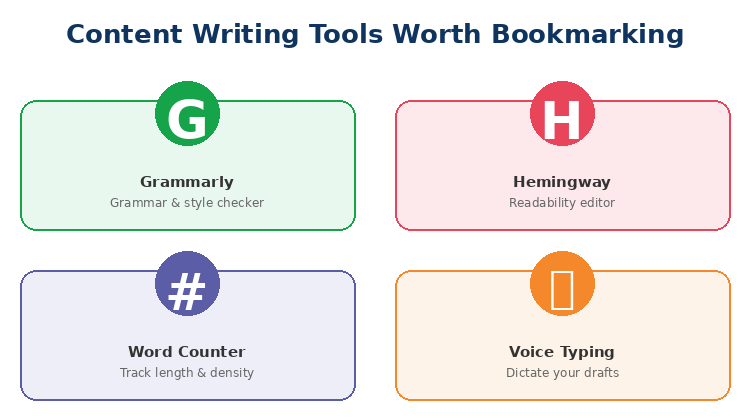
- Grammarly: catches grammar, punctuation, and sentence structure issues. The premium version also flags unclear phrasing and overused words.
- Hemingway Editor: highlights sentences that are too complex, overuse of adverbs, and passive voice. It gives your writing a readability grade so you know if you are writing at the right level for your audience.
- WordCounter.net: simple but useful for tracking length and checking keyword frequency without going overboard.
- Google Docs Voice Typing: I sometimes dictate a rough draft rather than typing it. Speaking out loud often produces more natural, conversational sentences than writing does.
That said, my most important editing tool is still a fresh read-through done slowly. No app catches everything a careful human reader will notice.
Tip 9: I Understand Search Intent Before Writing Anything
Search intent is the reason behind a search query. It is the single most important concept in content writing that nobody taught me at the beginning.
When someone types a phrase into Google, they are not just looking for information. They have a specific goal. Your content must match that goal, or it will not perform, no matter how well it is written.
There are four main types of search intent:
- Informational: the reader wants to learn something. Example: ‘what is content writing’.
- Navigational: they want to find a specific website or page.
- Commercial: they are researching options before making a decision. Example: ‘best content writing tools’.
- Transactional: they are ready to take action. Example: ‘hire a content writer’.
Before I write any piece of content now, I look at what is already ranking for my target keyword. The format, tone, and depth of those results tell me a lot about what Google believes the searcher actually wants.
Matching search intent is not about gaming the algorithm. It is about giving people exactly what they came looking for. That alignment is what earns both rankings and trust.
Tip 10: I Study Real Published Content Like a Student
Reading writing guides is useful. But reading actual published content with analytical eyes is even more valuable.
After I started working with clients and content writing agencies, I made it a habit to study the websites I was writing for. I would read through their homepage, their blog, their service pages. I was not just absorbing what they said. I was studying how they said it.
Questions I asked while studying strong content:
- How does the introduction pull the reader in without stating the obvious?
- How does each section transition into the next?
- Where do they use examples and why do they work?
- How do they handle technical information without losing the reader?
- What is the CTA and how is it framed?
Over time, this analysis built instincts. I stopped consciously thinking about structure and started feeling it. That is when writing really started to accelerate for me.
Tip 11: I Built a Portfolio Before I Had Paying Clients
One of the first questions any content writing company or freelance client will ask you is: can I see your work?
If you wait for paid work to build your portfolio, you will be stuck in a loop. No samples means no clients. No clients means no samples.
I broke that loop by creating unpaid sample work before I ever sent a pitch. I wrote blog posts on topics I was genuinely interested in. I created mock service pages for fictional businesses. I rewrote existing web pages as practice exercises.
None of this was commissioned. But it was real, complete, polished work that showed exactly what I could do.
You can host your portfolio samples in:
- A simple Google Drive folder organized by content type
- A free Notion page with links to each piece
- A portfolio site on platforms like Journo Portfolio, Contently, or Clippings.me
- Your own website if you plan to freelance long-term
What matters is not where it lives but what it shows. Clients want to see clear writing, good structure, and the ability to explain things well. Your samples do not need to be on a major publication. They just need to be good.
Tip 12: I Practiced Even When Nobody Was Paying Me to Write
Writing is a physical skill as much as a mental one. The more you do it, the more natural it becomes. Your sentences flow better. Your structure develops faster. Your editing eye sharpens.
But many beginners wait for clients before they start writing consistently. That is like waiting to be hired before learning how to drive.
I committed to writing something every day. Sometimes it was a full article draft. Sometimes it was a rewrite of an existing page. Sometimes it was just a 300-word reflection on a topic I was curious about.
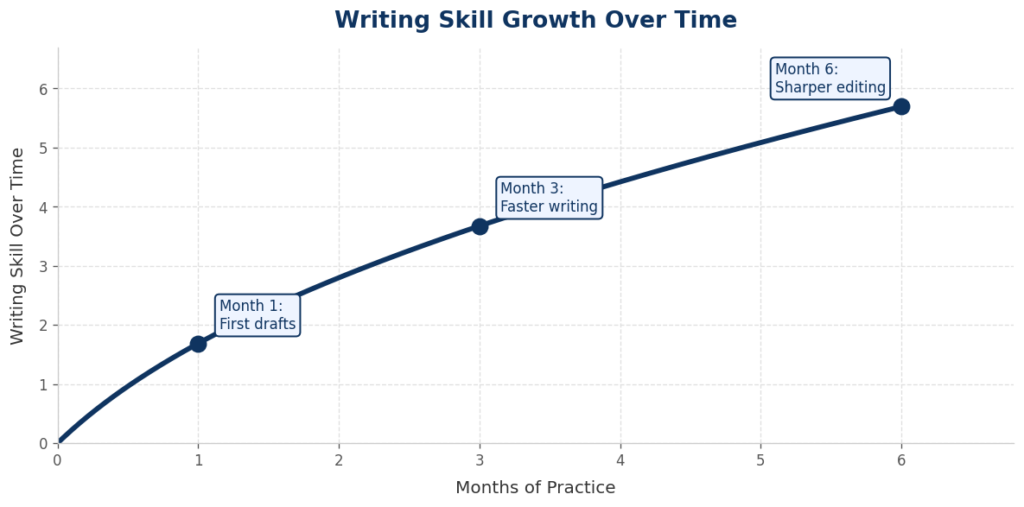
The compounding effect of that daily practice is hard to overstate. After three months of consistent writing, my drafting speed had doubled. After six months, my editing instincts were sharper than anything a course had taught me.
Consistency builds both skill and confidence. And confidence matters enormously when you are pitching clients and defending your work.
Tip 13: I Read With Intention, Not Just for Pleasure
Reading more does not automatically make you a better writer. But reading analytically does.
When I come across a piece of content that holds my attention all the way through, I stop and ask why. What did the writer do that kept me reading? Was it the pacing? The examples? The way they framed a problem before offering a solution?
When I come across something that loses me halfway through, I ask what went wrong. Was the structure confusing? Did the article fail to deliver on its headline promise? Did the writer spend too long on the obvious?
I read across formats too. Blog posts, product pages, email newsletters, LinkedIn articles. Each format has its own conventions and studying a variety of them gives you range.
Reading with intention is essentially a free masterclass in writing. It never stops being useful, no matter how experienced you become.
Tip 14: I Stopped Taking Feedback Personally
The first time an editor sent back my draft with significant revisions, I felt deflated. I had worked hard on that piece. The feedback felt like a judgment of my ability.
That mindset was holding me back.
Editors and clients are not criticizing you as a person. They are showing you where the writing could serve the reader better. That is exactly the same goal you have as a writer. When I reframed feedback that way, it became one of the most useful things anyone could give me.
Some of the best lessons I have ever learned came from revision notes. Things like: your introduction is burying the lead, this paragraph is making two different arguments, this transition is too abrupt.
Each of those notes taught me something I now look for in my own drafts before anyone else sees them. That is the real value of feedback: it trains your internal editor.
If you are not getting feedback, seek it. Share your drafts in writing communities. Ask a trusted reader to be honest. Critique your own work a day after writing it. Growth accelerates when you can see your own gaps clearly.
Tip 15: I Always Include a Clear Call to Action
Content writing rarely exists just to inform. It exists to move the reader from one place to another. That might mean reading the next article, signing up for a newsletter, booking a call, or downloading a resource.
A call to action is not manipulative. It is helpful. When someone finishes reading a useful article, they are often looking for what to do next. If you do not tell them, you have left value on the table.
The best CTAs I write feel like a natural extension of the content rather than a sudden sales push. They flow from what was just discussed and offer the reader a logical next step.
Good CTAs can be as simple as:
- ‘If you found this useful, read our guide on [related topic]’
- ‘Want feedback on your writing? Send us your draft’
- ‘Subscribe to get one practical writing tip every week’
- ‘Ready to hire a content writer? Here is how we can help’
Every piece of content I write ends with a CTA. Even if it is informal. Even if it is just a question that invites a comment or reply. Content without a next step is content that stops working the moment someone finishes reading it.
Bonus: I Remind Myself That Writing Skill Is Built Over Time
I want to end with something that nobody told me clearly enough at the start.
Writing is a skill. Skills take time. There is no shortcut to becoming a confident, capable content writer. There is only the work.
Some days writing is easy and the words flow and you feel genuinely good about what you have produced. Other days it is slow and frustrating and you wonder if you are cut out for this.
Both days are part of the process.
What separates writers who improve from writers who stagnate is not talent. It is consistency. Every article you write teaches you something. Every round of editing sharpens your eye. Every piece of feedback deposits something useful into your skill set.
A year from now, if you write and publish consistently, you will look back at your early work and see how far you have come. That progress is real. And it belongs entirely to you.
Final Thoughts
Content writing is not mysterious. At its core, it is about understanding people, communicating clearly, and consistently delivering value through words.
The 15 tips in this article are not abstract theories. They are lessons I learned by writing, failing, editing, and starting again. Some of them I figured out quickly. Others took months of mistakes before they clicked.
If I had to distill everything into a few sentences, it would be this:
- Write for the reader, not for yourself.
- Keep it clear, simple, and easy to navigate.
- Practice more than you think you need to.
- Take feedback seriously and use it to grow.
- Be patient. Good writing compounds.
Whether you are just starting out, looking to work with content writing agencies, or building a freelance practice, strong writing skills will serve you in every direction your career takes.
So: which of these tips are you going to start using in your very next piece of content?
Frequently Asked Questions
1. How long does it take to become a good content writer?
Most people start writing with noticeably more confidence after three to six months of consistent practice. By that point, you have developed enough instincts for structure, clarity, and editing to produce solid work efficiently. However, content writing is a long-term craft. Writers with five or ten years of experience still discover better ways to communicate. The growth never fully stops, which is honestly one of the things I love about this work.
2. Do I need to know SEO to work as a content writer?
You do not need to be an SEO expert, but you should understand the basics. Most content writing jobs and freelance projects expect writers to understand search intent, keyword usage, and how to structure content for both readers and search engines. The good news is that basic SEO is not hard to learn. Focus on search intent, natural keyword integration, and clear structure. Those three things alone will cover the majority of what clients expect from a content writer.
3. Can I build a writing portfolio without prior experience?
Yes, absolutely. I built my first portfolio entirely from self-directed work before I had a single paying client. Write sample blog posts on topics you care about. Create mock website copy for imaginary businesses. Rewrite an existing web page to practice improving structure and clarity. Polish those pieces to the same standard you would apply to paid work. Clients care about quality, not whether the work was commissioned. A strong unpaid sample beats a weak published one.
4. How do I improve my writing speed without sacrificing quality?
Speed comes from two things: practice and process. The more you write, the less mental effort individual tasks require. You stop deliberating over sentence construction as often and start doing it by feel. On the process side, always plan before you write. Outline your structure, identify your key points, and know your angle before you open a blank document. A five-minute outline saves thirty minutes of unfocused drafting. Separate your drafting from your editing too. Write fast and messy, then edit carefully. Trying to do both at once is one of the biggest speed killers I know.
5. What is the difference between content writing and copywriting?
Content writing and copywriting are related but distinct disciplines. Content writing focuses on informing, educating, or engaging an audience over time. Blog posts, guides, and newsletters are content writing. Copywriting focuses more directly on driving immediate action. Sales pages, ad copy, and landing pages are copywriting. In practice, good content often borrows from copywriting techniques like strong headlines and clear CTAs. And good copywriting often uses content-style storytelling to build trust. Many writers do both, and learning the conventions of each will make you more versatile and more valuable to clients.