A content writer’s workspace, where research, strategy, and storytelling all come together.
I have been writing content professionally for years. And in that time, the one question I get asked most often is: what does a content writer actually do all day?
It sounds simple. But the honest answer is: a lot more than most people expect.
Content writing is not just about stringing words together. It is a combination of research, strategy, SEO knowledge, deadline management, and constant learning. Every day looks a little different.
In this guide, I am going to walk you through every aspect of the content writer job responsibilities based on what I have experienced firsthand. Whether you are looking to hire a writer, become one yourself, or simply understand the role better, this article covers it all.
- What Is a Content Writer? (And What People Get Wrong About the Role)
- Core Content Writer Job Responsibilities
- Types of Content a Writer Is Expected to Produce
- SEO and Strategy: The Less Visible but Critical Side of the Job
- Collaborating with Teams and Stakeholders
- Managing Deadlines and Multiple Projects
- Staying Updated with Industry Trends
- Key Skills That Make a Great Content Writer
- Content Writer Job Requirements: What Employers Usually Look For
- What a Typical Day Looks Like for a Content Writer
- Common Challenges in the Content Writer Role
- How the Content Writer Role Is Evolving
What Is a Content Writer? (And What People Get Wrong About the Role)
Before diving into the duties, let me address a common misconception.
Many people think a content writer is just someone who types whatever a client asks for. That is far from the truth.
A content writer is a professional who creates written material that serves a specific purpose. That purpose could be to educate readers, rank on search engines, convert visitors into customers, or build brand awareness.
The content writer role involves being part researcher, part strategist, part editor, and part communicator. You are not just writing for the sake of writing. You are writing to achieve a goal.
That distinction matters a great deal when you look at the full scope of content writer duties.
Core Content Writer Job Responsibilities
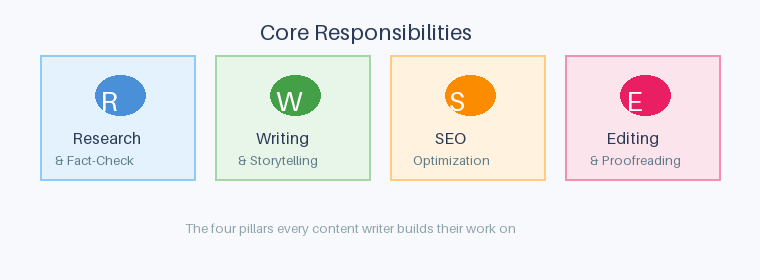
The four core pillars that define the content writer role.
Let me break down the main responsibilities that define this role. These are the tasks I deal with on a daily or weekly basis.
1. Researching Topics Thoroughly
Every piece of content I write starts with research. Before I type a single word of the actual article, I spend time understanding the topic from multiple angles.
This means reading credible sources, studying what competitors have written, looking at industry reports, and sometimes interviewing subject matter experts.
Research is not optional in content writing. It is the foundation. If your facts are wrong or your information is shallow, readers will notice. And so will search engines.
Content writer job requirements almost always include strong research skills because the quality of your output depends directly on the quality of your input.
2. Writing Original, Audience-Focused Content
Once I have done my research, I write. But writing for content is not the same as writing an email or a personal essay.
You have to write with your reader in mind at all times. Who are they? What do they already know? What do they want to learn? What action do you want them to take after reading?
This is what separates average content from effective content. Every sentence has to serve the reader in some way.
I always write in a clear, simple, and engaging tone. I avoid jargon unless the audience expects it. I use short sentences. I break things up with subheadings and paragraphs so the content is easy to read.
3. Optimizing Content for SEO
A significant part of my content writer duties involves search engine optimization. Writing great content that nobody can find is a wasted effort.
I research keywords before I write. I find out what people are searching for and how they phrase their queries. Then I naturally incorporate those keywords into the content, headings, meta descriptions, and image alt texts.
SEO is not about stuffing keywords. It is about helping search engines understand what your content is about so it can be shown to the right people.
I also pay attention to content structure, internal linking, and readability scores because these all affect how well a piece performs.
4. Editing and Proofreading
After writing comes editing. I never submit a first draft. Ever.
Editing is where good writing becomes great writing. I check for grammar errors, awkward phrasing, repetition, logical flow, and factual accuracy.
I also proofread for typos, punctuation issues, and formatting consistency. These small details matter because they affect the reader’s trust and the brand’s credibility.
Using tools like Grammarly or Hemingway App helps. But nothing replaces reading your own work out loud and thinking critically about every sentence.
Types of Content a Writer Is Expected to Produce

Content writers adapt their voice and format depending on the type of content being created.
The content writer job description often lists a wide range of content formats. Over the years, I have written in almost all of them. Here is what that looks like in practice.
Blog Posts and Long-Form Articles
This is the bread and butter of content writing. Blog posts typically range from 800 to 3,000 words depending on the topic. Long-form articles can go well beyond that.
These pieces are designed to educate, inform, or entertain. They are usually SEO-driven and aim to rank on search engines for specific keywords.
Website Copy
Website copy includes homepage content, about pages, service pages, and landing pages. This type of writing is more persuasive in nature.
It needs to communicate value quickly, speak directly to the target audience, and guide the reader toward a specific action like signing up, buying, or calling.
Social Media Content
Social content is short, punchy, and platform-specific. What works on LinkedIn does not necessarily work on Instagram or Twitter.
As a content writer, I understand the nuances of each platform and adapt the tone and format accordingly.
Email Newsletters and Campaigns
Email writing requires a very different skill. The subject line has to grab attention. The body has to deliver value fast. And the call to action has to be clear and compelling.
Email content is highly targeted and often personalized, which means it requires an understanding of audience segmentation and messaging.
Product Descriptions and E-commerce Copy
Product descriptions seem simple, but writing them well is an art. You have to highlight the features, translate them into benefits, and do it all in a limited word count.
This type of content directly influences buying decisions, so accuracy and persuasion both matter.
White Papers, Case Studies, and eBooks
These are long-form, research-heavy content formats often used in B2B marketing. I have written several of these and they require a deeper level of expertise, structure, and credibility.
They take more time but deliver significant authority and lead generation value when done right.
SEO and Strategy: The Less Visible but Critical Side of the Job
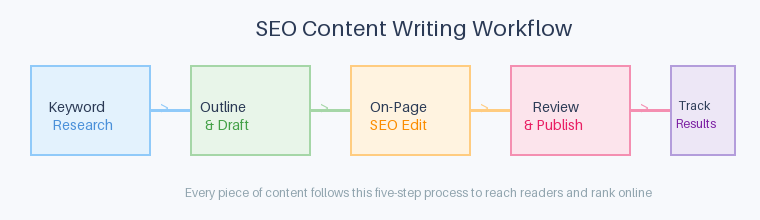
The five-step SEO writing workflow every content professional should follow.
One area that does not always make it into a content writer job description is the strategic and technical side of the work. But it is a huge part of what I do.
Before writing any piece, I think about where it fits in the overall content strategy. Is this a top-of-funnel awareness piece? Is it targeting a buyer who is close to making a decision? Is it designed to support another piece of content?
Understanding content strategy makes my writing more intentional and more effective.
On the SEO side, I use tools like Google Search Console, SEMrush, or Ahrefs to find keyword opportunities, understand search intent, and analyze what is already ranking for a given topic.
I also look at content gaps. If competitors are writing about a topic in a thin, unhelpful way, that is an opportunity for me to write something better and more comprehensive.
Content writer job requirements at more advanced levels increasingly include this kind of analytical and strategic thinking. It is not just about writing anymore. It is about knowing why you are writing something and what you expect it to achieve.
Collaborating with Teams and Stakeholders
Content writing does not happen in isolation. A big part of the content writer role involves working closely with other people.
I regularly collaborate with marketing managers who brief me on campaigns and goals. I work with SEO specialists who give me keyword lists and technical guidance. I coordinate with designers who need my copy before they can lay out a page or a social graphic.
Sometimes I work with subject matter experts who provide the technical knowledge I need to write accurately on complex topics.
This means I have to be a good communicator. I ask clear questions during briefings. I provide drafts on time. I respond to feedback professionally and make revisions without ego.
Strong communication is an underrated content writer duty. A writer who cannot collaborate effectively will struggle regardless of how talented they are.
Managing Deadlines and Multiple Projects
In any given week, I could be working on three blog posts, two landing pages, a product description update, and an email campaign. Deadline management is essential.
I use project management tools to keep track of assignments, due dates, and revision rounds. I build buffers into my schedule for unexpected requests. I communicate proactively when something is going to be late rather than going silent.
This is a skill that gets better with experience. In the beginning, it is easy to underestimate how long a piece will take, especially when it involves deep research or multiple revision cycles.
Over time, I have learned to scope projects more accurately and protect my time so I can consistently deliver quality work on schedule.
Staying Updated with Industry Trends
The content landscape changes constantly. Search engine algorithms update. New content formats emerge. Audience preferences shift.
Part of my content writer duties involves staying informed. I follow industry blogs, attend webinars, take online courses, and read widely across topics I write about.
This ongoing learning is what keeps my content fresh, relevant, and effective. A writer who stopped learning five years ago will produce content that feels dated and out of touch.
Staying current also means keeping up with changes in tools and platforms. AI writing assistants, new SEO tools, updated CMS platforms, and evolving social media algorithms all affect how content is created and distributed.
Key Skills That Make a Great Content Writer
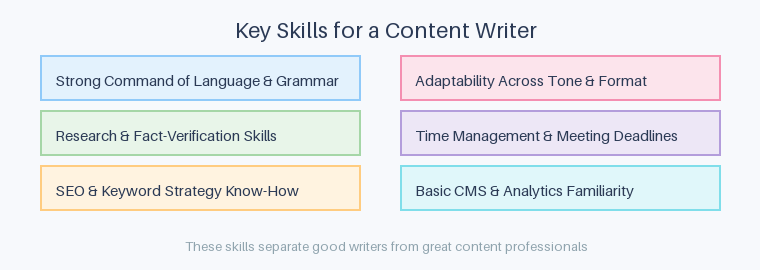
These six skills define what separates a capable writer from a truly effective content professional.
Now let me talk about the skills that the content writer job requirements typically ask for, and that I have personally found most valuable in my career.
Strong command of language: This goes beyond grammar. It means knowing how to structure sentences for clarity, vary sentence length for rhythm, and choose words that resonate with a specific audience.
Research ability: Being able to quickly find reliable information, verify facts, and synthesize complex ideas into simple language is a core skill.
SEO knowledge: Understanding how search engines work, how to use keyword research tools, and how to optimize content for both readers and algorithms.
Adaptability: Writing in different tones and voices for different brands, formats, and audiences without losing quality.
Attention to detail: Catching errors before they reach the reader. Ensuring consistency in style, formatting, and facts.
Time management: Delivering quality work across multiple projects without missing deadlines.
Basic analytics literacy: Understanding content performance metrics like page views, time on page, bounce rate, and conversion rate helps a writer improve over time.
Content Writer Job Requirements: What Employers Usually Look For
I have reviewed a lot of content writer job descriptions over the years, both as a candidate and to understand what clients are looking for. Here is what comes up most consistently.
- A portfolio of published writing samples across various formats
- Demonstrated experience with SEO and keyword integration
- Familiarity with content management systems like WordPress
- Strong editing and proofreading capabilities
- Ability to meet deadlines consistently
- Experience working with a style guide
- Basic understanding of analytics tools like Google Analytics
- Excellent communication and collaboration skills
Some employers also ask for a degree in English, Journalism, Communications, or Marketing. But in my experience, a strong portfolio matters far more than a degree. The work speaks for itself.
For specialized industries like healthcare, legal, or technology, content writers may also be expected to have some domain knowledge or be willing to learn quickly.
What a Typical Day Looks Like for a Content Writer
People often ask me what my day-to-day writing routine actually looks like. Here is a realistic snapshot.
I start my morning by reviewing any new briefs or feedback that came in overnight. If there is a revision request, I handle that first because it usually takes less time than a new piece.
Then I move into writing. I do my best deep work in the morning, so that is when I tackle the most demanding pieces. Longer articles or research-heavy content gets my prime hours.
Afternoons are usually for lighter tasks. Editing drafts I wrote earlier in the week. Doing keyword research for upcoming topics. Responding to emails or checking in with the team.
I also spend time each week doing ongoing learning. Reading industry news, exploring new writing tools, or reviewing how my previously published content is performing.
No two weeks are identical. Some weeks are deadline-heavy. Others are more research and planning focused. That variety is one of the things I genuinely enjoy about this role.
Common Challenges in the Content Writer Role
I want to be honest here. The role comes with real challenges.
Writer’s block: It happens to everyone. The key is having a system to work through it rather than waiting for inspiration to strike.
Vague briefs: Not every client or manager provides clear direction. Learning to ask the right questions upfront saves a lot of revision time.
Scope creep: Projects that start small can grow unexpectedly. Setting clear expectations about what is included in an assignment protects your time and sanity.
Inconsistent feedback: Sometimes feedback contradicts itself or comes from multiple people with conflicting opinions. Navigating this diplomatically is a real skill.
Keeping quality consistent: When you are producing a high volume of content, maintaining quality across every piece takes discipline and process.
These challenges are manageable. But acknowledging them is important because they are part of the reality of the content writer job responsibilities.
How the Content Writer Role Is Evolving
The content writer role is not static. It is changing rapidly and I have seen that firsthand.
AI tools are now part of the content creation process for many writers. I use them to assist with brainstorming, outlining, and editing. But AI cannot replace the judgment, creativity, and strategic thinking that an experienced human writer brings.
The demand for original, expert-driven content is actually increasing as AI-generated content floods the internet. Readers and search engines are both getting better at identifying shallow, low-quality content.
Skills like subject matter expertise, original research, and authentic storytelling are becoming more valuable, not less.
Writers who embrace new tools while deepening their human skills will be the ones who thrive in this evolving landscape.
Frequently Asked Questions
1. What are the primary content writer job responsibilities?
The primary responsibilities include researching topics, writing original content, optimizing for SEO, editing and proofreading, collaborating with team members, managing deadlines, and staying updated on industry trends. The role is much broader than just writing.
2. What does a content writer job description typically include?
A standard content writer job description includes duties like creating blog posts, web copy, and social media content, working with SEO tools, using a CMS like WordPress, meeting editorial deadlines, and coordinating with marketing and design teams. Some roles also require analytics knowledge.
3. What are the key content writer job requirements most employers expect?
Most employers look for a strong writing portfolio, demonstrated SEO knowledge, experience with content management systems, excellent editing skills, the ability to adapt tone and style, and a proven track record of meeting deadlines. A degree is helpful but a strong portfolio usually carries more weight.
4. What content writer duties go beyond just writing?
Many content writer duties extend beyond writing itself. These include conducting keyword research, analyzing content performance in tools like Google Analytics, working with briefs and style guides, collaborating with subject matter experts, handling revision cycles, and contributing to content strategy discussions.
5. Is SEO knowledge necessary for the content writer role?
Yes, SEO knowledge is now considered a core part of the content writer role rather than a bonus skill. Understanding search intent, using keyword research tools, applying on-page optimization practices, and knowing how to structure content for both readers and search engines is expected in most professional content writing positions.