How to Find Flexible Work That Fits Your Life
I still remember the exact moment I decided to stop waiting for permission to become a writer.
I was sitting at my office desk on a grey Tuesday afternoon, staring at a spreadsheet that had nothing to do with my actual life goals, and I thought: I write better emails than anyone in this building. Why am I not doing this for a living?
That was five years ago. Today, I work part-time as a freelance writer, entirely remote, and I earn more than I did in that salaried role. But I want to be clear about something: this did not happen overnight, and it was not luck. It took months of figuring out where to find part-time writing jobs, how to build a portfolio when I had zero published clips, and how to price my work fairly without underselling myself.
I made every rookie mistake in the book. I applied to content mills paying a penny per word. I sent cold pitches with no research behind them. I wrote an entire article for a client who ghosted me before paying. I learned from all of it.
This guide is everything I wish someone had told me at the start.
Why Part-Time Writing Jobs Are More Accessible Than Ever
The demand for written content has never been higher. Every business with a website needs a blog. Every brand launching a product needs copy. Every app needs microcopy. Every newsletter needs a writer behind it. The content economy is enormous and it is still growing.
What changed dramatically in recent years is where that work happens. Before 2020, most in-house writing roles required a physical presence. Writers either worked in agencies, newsrooms, or corporate offices. The global shift to remote work blew that model open. Now, companies that once insisted on office-based teams hire remote writers as a default.
That shift created a huge opening for people like me, and people like you, to build flexible writing careers without relocating or commuting or fitting into someone else’s rigid schedule.
| Why Writing Works as Part-Time Remote Work You need only a laptop and an internet connection to get started.Most clients do not care where you are located, only that you deliver quality work on time.You can scale your workload up or down based on your availability.Writing is one of the few skills you can develop and monetize simultaneously. |
I started with five hours a week. I wrote early mornings before my regular job started. Within six months, those five hours had turned into fifteen hours and a dependable monthly income that gave me enough confidence to gradually reduce my salaried hours.
The path is not identical for everyone, but the opportunity is genuinely there. Part time writing jobs are not a niche corner of the internet. They are a thriving, competitive, and financially viable career segment.
Understanding the Types of Remote Writing Jobs
One of the first mistakes I made was thinking that writing meant blogging. It does not. The field of remote writing jobs is broad, varied, and each category comes with its own income ceiling, required skills, and typical client profile. Knowing the landscape helps you choose where to focus your energy.
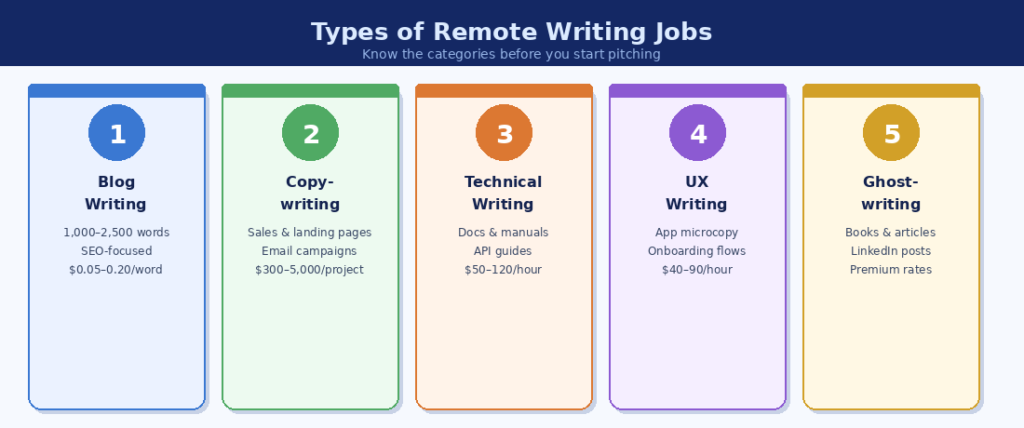
Five major categories of remote and online writing jobs
- 1. Blog Writing and Content Writing
- 2. Copywriting
- 3. Technical Writing
- 4. UX Writing
- 5. Ghostwriting
- The Content Writing Craft
- ProBlogger Jobs Board
- Upwork
- The Write Life and Contently
- Cold Email Outreach
- Step 1: Start a Blog on a Topic You Already Know
- Step 2: Guest Post on Established Publications
- Step 3: Publish on Medium or Substack
- Step 4: Write Spec Pieces for Dream Clients
- Step 5: Build a Simple Writer Website
- Understanding the Rate Spectrum
- How I Raised My Rates Without Losing Clients
- Protect Your Writing Time Block
- Use a Dead-Simple Project Tracker
- Set Clear Client Expectations from Day One
1. Blog Writing and Content Writing
Blog writing is where most new writers begin. Businesses pay writers to create articles that attract readers through search engines. A typical post runs between 800 and 2,500 words and rates range from three cents to twenty cents per word depending on your experience level and the complexity of the topic.
I started here. My first paid piece was a 1,200-word article about project management software for a SaaS company. I was paid $45 and I was thrilled. Today, I charge far more for similar work, but that first article taught me how to write for a business audience, how to structure content logically, and how to deliver on a brief.
Blog writing is competitive at the entry level, but it remains one of the best training grounds for developing the habits that every professional writer needs: consistency, clarity, and the ability to write for someone else’s voice and goals.
2. Copywriting
Copywriting is writing that sells. It includes landing pages, sales emails, product descriptions, ad copy, and marketing campaigns. Unlike blog writing, which aims to inform and attract, copywriting aims to persuade and convert. The difference matters enormously when it comes to pay.
I moved into copywriting in my second year and my income nearly doubled. A single landing page can earn you $500 to $5,000 depending on the client size and the stakes involved. Email sequences for software companies regularly pay $300 to $1,500 per campaign.
The learning curve for copywriting is steeper. You need to understand psychology, persuasion, and the basics of how marketing funnels work. But the investment in learning pays off fast.
3. Technical Writing
If you have a background in technology, engineering, medicine, or science, technical writing is one of the most financially rewarding work from home writing jobs you can pursue. Technical writers create user manuals, API documentation, software guides, white papers, and standard operating procedures.
The pay reflects the specialized knowledge required. Entry-level technical writing starts around $40 to $60 per hour. Experienced technical writers in the software industry regularly earn $80 to $120 per hour or more.
You do not necessarily need a technical degree, but you do need the ability to understand complex processes and explain them in simple, accurate language. If you already have subject matter knowledge, technical writing is worth exploring seriously.
4. UX Writing
UX writing is a relatively new and growing category. It involves writing the words that live inside apps, websites, and digital products. Button labels, confirmation messages, empty state text, onboarding flows, tooltips, and error messages all need to be written by someone.
Good UX writing is subtle but powerful. It guides users through a product without friction. Companies building consumer apps increasingly recognize that bad microcopy costs them users and conversions. That recognition translates into solid pay for writers who understand both language and user behavior.
Rates for UX writing tend to start around $40 to $70 per hour and scale quickly with experience and a strong portfolio of product work.
5. Ghostwriting
Ghostwriting means writing content that someone else publishes under their name. Executives, founders, coaches, and public figures often hire writers to produce books, LinkedIn articles, newsletters, and thought leadership content on their behalf.
I have ghostwritten for a CEO, a career coach, and a technology consultant. None of those pieces carry my name. All of them paid significantly more than equivalent bylined work, and all of them led to long-term client relationships.
The trade-off is clear: you give up the public credit in exchange for higher pay and often more interesting, substantive writing assignments. For many writers, that is an excellent trade.
Where I Actually Found My First Part-Time Writing Jobs
This is the section most freelance writing guides avoid being specific about. They say ‘there are many opportunities out there’ without telling you exactly where to look or how to approach it. I am going to be precise because precision is what helped me move from zero clients to a booked schedule.
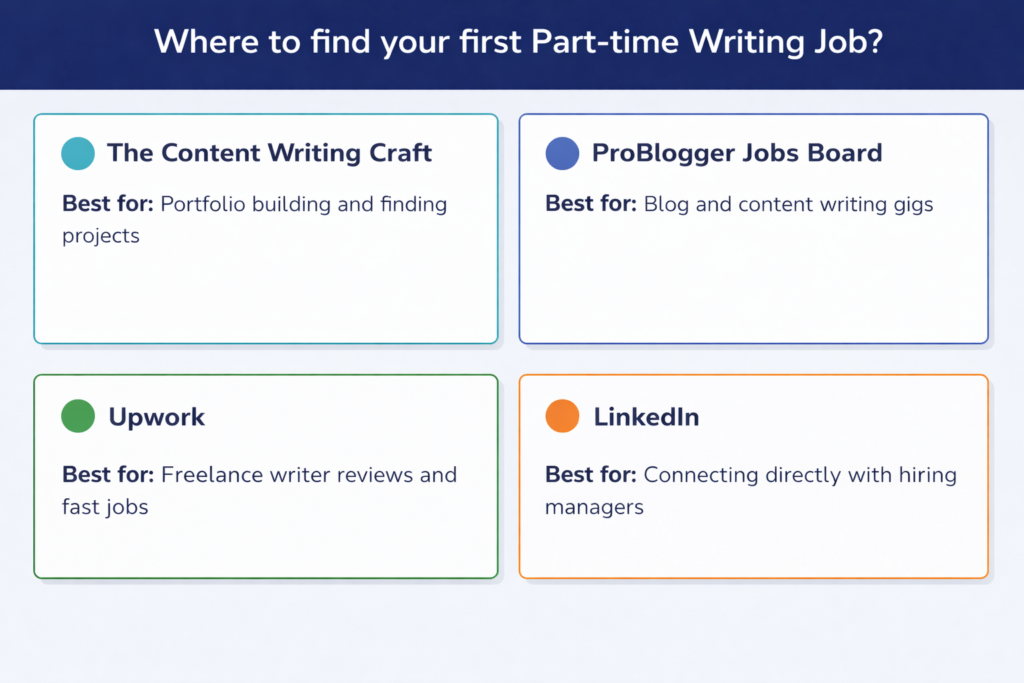
Top platforms I use to find remote and part-time writing work
The Content Writing Craft
This is a central resource designed for writers to showcase their portfolio in the writers directory and get writing projects. I recommend starting here because it combines visibility with opportunity. Instead of just applying for jobs, you position yourself so clients can find you.
My approach is simple: keep my profile updated, showcase my best samples, and stay active. This increases the chances of inbound opportunities without constant pitching.
ProBlogger Jobs Board
ProBlogger Jobs was the first platform where I landed a real, recurring client. It is a job board built specifically for content and blog writing positions. Every listing is from a real company or publication looking to hire a writer. It is free to browse and I recommend checking it daily when you are starting out.
My approach was simple: I read each listing carefully, tailored my application to the specific brief, and attached two or three writing samples that matched the topic. I applied to eight listings in my first two weeks and heard back from two. One of those turned into a three-month contract.
Upwork
Upwork is the largest freelance marketplace and it gets a mixed reputation. Some writers dismiss it because of low rates and high competition. My experience was more nuanced. Yes, many listings pay poorly. But Upwork gave me something valuable when I had no track record: a structured way to collect reviews and build credibility fast.
My strategy on Upwork was deliberate. I took two or three low-paying jobs specifically to earn five-star reviews. I over-delivered on every one. I then gradually raised my rates with each new proposal. Within four months, I was earning rates on Upwork that were competitive with other channels and I had a profile that clients trusted.
LinkedIn surprised me. I spent a year underestimating it. Then a content director at a healthcare company found my profile through a post I had written about content strategy, reached out, and offered me a contract. That single contract was worth more than six months of Upwork work.
LinkedIn works on a different logic than job boards. Instead of applying for work, you attract it by being visible, credible, and useful. I post about writing, content strategy, and freelance business topics two or three times per week. I comment thoughtfully on industry discussions. I connect with content managers and marketing leaders at companies I would like to work with.
LinkedIn also has a dedicated Jobs section where remote and part-time writing roles are posted daily. Set up filters for remote, contract, and part-time. Check it alongside your outreach activities.
The Write Life and Contently
The Write Life aggregates writing job listings from across the internet and publishes them in an organized, easy-to-browse format. I used it daily during my first year as a way to discover opportunities I would never have found otherwise. It covers everything from blogging gigs to magazine writing to corporate content roles.
Contently is a more exclusive platform designed to connect writers with large brands and publishers. Getting accepted requires a portfolio, but once you are in, the clients are serious and the rates are above average. I applied three times before being accepted. It was worth the persistence.
Cold Email Outreach
Cold outreach is the strategy most new writers avoid because it feels uncomfortable. It was the strategy that generated the highest quality, best-paying clients I have ever worked with.
My process is straightforward. I identify a company whose content I genuinely respect or whose blog has obvious gaps I could fill. I find the name of their content manager or marketing director using LinkedIn. I write a short, personal email.
My cold pitch emails are four sentences. One sentence introducing myself with a specific reference to their business. One sentence identifying a specific opportunity or gap I noticed in their content. One sentence about my relevant experience. One clear call to action, usually asking for a brief call or whether they accept guest pitches. My response rate hovers around fifteen percent, which is strong for cold outreach.
| The Hidden Job Market for Writers A significant portion of freelance writing work is never publicly posted. It moves through referrals, communities, and personal networks. Join writing Slack communities and Facebook groups. Tell your personal network you are a writer. Ask satisfied clients for introductions. Many of my current clients came from referrals by other writers who were too busy to take the work themselves. |
Building a Portfolio When You Have Zero Published Clips
The portfolio problem is the first wall every new writer runs into. You need samples to get hired, but you need to be hired to get samples. I spent two weeks frustrated by this before I realized the obvious truth: no one is stopping me from creating samples myself.
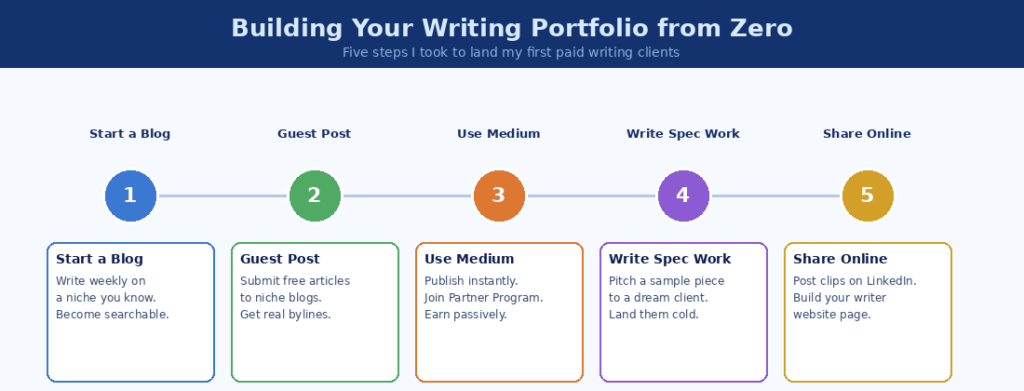
Five steps to build a writing portfolio from scratch with no prior clips
Step 1: Start a Blog on a Topic You Already Know
A personal blog is the fastest way to create writing samples with no gatekeepers. You do not need a professional design or a large audience. You need content that demonstrates your ability to write clearly, structure ideas logically, and engage a reader.
I started a blog about personal productivity. I wrote one post per week for ten weeks. Those ten articles became my first portfolio. When potential clients asked for samples, I sent them links to my blog. Two of my earliest clients specifically mentioned that the blog made them confident I could deliver what they needed.
Choose a topic that overlaps with the type of clients you want to attract. A blog about marketing will attract marketing clients. A blog about software will attract tech companies. Be strategic from the beginning.
Step 2: Guest Post on Established Publications
Guest posting gives your writing a home on a site with existing credibility and readership. Many blogs and content publications actively seek contributors because it gives them fresh content without paying a salary. In exchange, you get a byline, a published clip, and a link back to your site or portfolio.
Search for ‘write for us’ combined with your target niche on Google. You will find hundreds of legitimate opportunities. Submit to three or four at a time, expect rejections, and keep submitting. My first two guest posts were published within thirty days of starting my search.
Step 3: Publish on Medium or Substack
Medium and Substack let you publish immediately without needing your own website. Both platforms give your writing a clean, professional presentation and a shareable URL that looks credible in a portfolio or pitch email.
Medium has a Partner Program that pays you based on how much time subscribers spend reading your articles. The income is modest in the beginning, but it adds a passive revenue stream and, more importantly, gives your writing public visibility and engagement metrics you can reference with clients.
Step 4: Write Spec Pieces for Dream Clients
A spec piece is a sample article written specifically for a company you want to work with, without being hired first. You pitch it alongside a short email explaining your thinking and why it would work for their audience.
I wrote a spec how-to article for a cloud software company during my third month of freelancing. It was a topic I knew they covered regularly but had a gap in their existing content. I sent it with a short pitch. They published it, paid me for it, and hired me for four more articles over the next two months.
A well-executed spec piece does something a generic sample cannot: it proves you understand the specific client, their audience, and their content strategy. That is enormously persuasive.
Step 5: Build a Simple Writer Website
Your writer website does not need to be complex. It needs three things: a short bio that establishes your expertise, a portfolio section with your best four to six clips, and a contact form or email address. That is it.
I use a simple one-page site. It loads fast, looks clean, and gives potential clients everything they need to decide whether to contact me. LinkedIn profiles can substitute for a website in the early stages, but a dedicated site signals professionalism and commitment.
Setting Your Rates as a Freelance Writer
Pricing was the area where I made the most costly mistakes early in my career. I charged $10 for 1,000-word articles in my first month because I was afraid to ask for more. By month twelve, I was charging $150 for the same length. By year three, I was regularly earning $300 to $500 per article in my primary niche.
The mistake was not ignorance. It was fear. I was afraid that charging more would mean losing opportunities. What I eventually learned is that charging more actually attracts better clients, creates better working relationships, and results in less stressful, more fulfilling work.
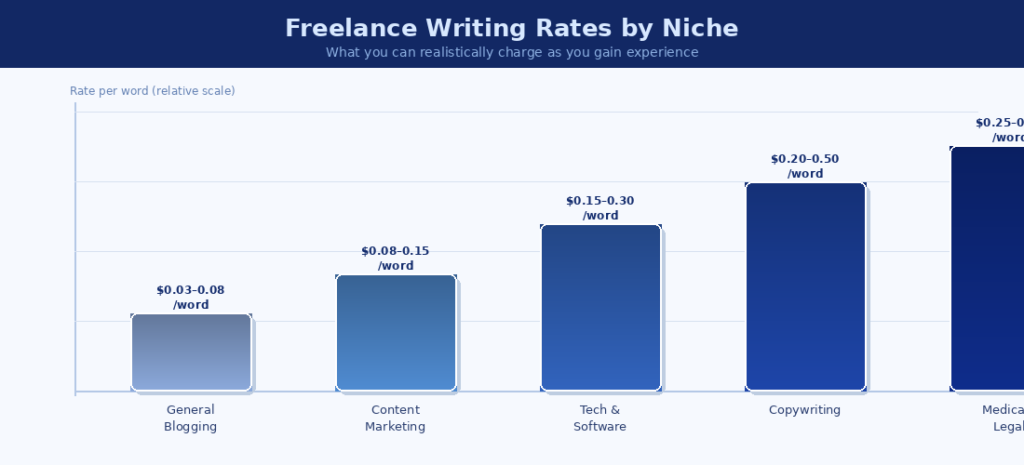
Typical freelance writing rates by niche – relative scale from general to specialized
Understanding the Rate Spectrum
Freelance content writing rates span an enormous range. Content mills and low-budget platforms pay one to three cents per word. That is genuinely not worth your time once you account for research, writing, and revision. Mid-range content writing pays five to fifteen cents per word, which is reasonable for part-time income while you build your portfolio.
Experienced writers in competitive niches earn twenty to fifty cents per word. Copywriters often work on project rates rather than per-word rates: $500 to $5,000 for a landing page, $300 to $1,500 for an email sequence, $2,000 to $10,000 for a full website copy project. Technical writers typically charge by the hour: $50 to $120 depending on the complexity and their experience.
| Writing Type | Typical Rate Range |
| General Blog Post | $0.05 to $0.15 per word |
| Content Marketing Article | $0.10 to $0.25 per word |
| Technical Writing | $50 to $120 per hour |
| Copywriting (Landing Page) | $500 to $5,000 per page |
| Email Sequence | $300 to $1,500 per campaign |
| Ghostwriting (Article) | $200 to $800 per piece |
| UX Writing | $40 to $90 per hour |
How I Raised My Rates Without Losing Clients
Rate increases work best when framed proactively and professionally. I give existing clients thirty days’ notice before any rate change. My email is brief and direct. I explain that my rates are increasing as of a specific date, express appreciation for the relationship, and confirm I look forward to continuing.
Most good clients accept a reasonable rate increase because they value consistency and do not want to restart the process of finding and onboarding a new writer. The few who push back are usually not clients worth retaining at any rate.
My rule of thumb: if your schedule is full or you are turning down work, raise your rates. If clients accept your new rate without hesitation, you raised it too little. Keep going.
| Pricing Rule I Still Live ByAlways name your rate before the client names their budget. Once you hear their number, it anchors the negotiation downward. State your rate confidently and without apology. You can always negotiate from there. But you cannot negotiate upward from a client’s budget anchor. |
How Much Can You Realistically Earn from Part-Time Writing?
I want to give you real numbers here, not aspirational ones. Real numbers from my experience and from writers I know personally who have built part-time or full-time writing incomes over the past several years.
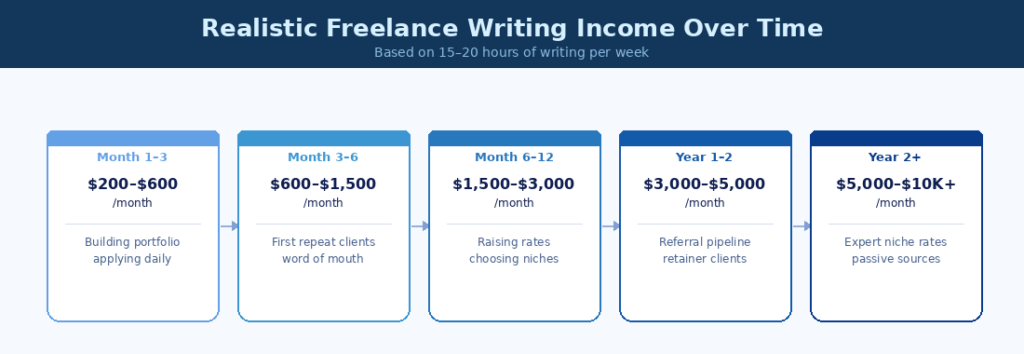
Realistic income milestones for part-time freelance writers (15 to 20 hours per week)
In my first three months, I earned approximately $400 total. That sounds discouraging when I write it out, but it represented weekends and early mornings learning a new skill, building my first clips, and figuring out the pitch process. The income was not the point yet. The foundation was.
By month six, I was earning $900 to $1,400 per month working roughly fifteen hours per week. I had three recurring clients, a growing portfolio, and a clear sense of which types of work I enjoyed most.
By the end of my first year, my monthly income from part time writing jobs had reached $2,500 to $3,200 consistently. That number has grown since as I specialized, raised my rates, and built relationships that generate referrals without active pitching.
The writers I know who earn the most are not always the most technically gifted writers. They are the most consistent. They pitch every week without exception. They deliver on time without excuses. They build relationships rather than chasing isolated transactions.
Managing Part-Time Writing Work Alongside Other Commitments
Flexibility is the great advantage of part time writing jobs. But flexibility without structure becomes chaos. I learned this the hard way when I had a full client roster, a day job, and family commitments all competing for the same limited hours.
Protect Your Writing Time Block
I write from 6 AM to 9 AM on weekdays. That window has been non-negotiable for four years. It is my creative peak, before email notifications and daily responsibilities dilute my focus. Protecting it required real decisions: I stopped checking my phone before 9 AM, I told my family what the boundary was, and I treated it like a professional commitment, not a hobby.
Your ideal window might be different. Evenings, lunch breaks, Saturday mornings. The specific time matters less than the consistency. Writing in the same window daily trains your attention and creates momentum that makes every session easier than the one before.
Use a Dead-Simple Project Tracker
I track every active project in a spreadsheet with six columns: client name, project type, word count, deadline, rate, and payment status. Nothing more. Checking it takes thirty seconds and keeps me from missing a deadline or losing track of an unpaid invoice.
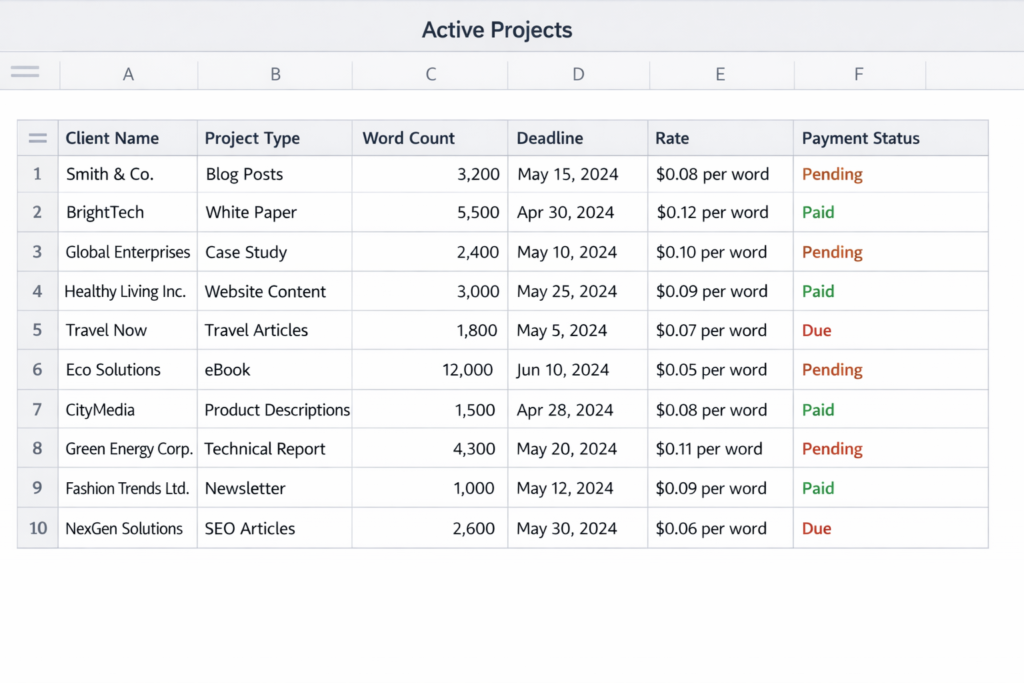
Trello, Notion, or a physical notebook work equally well. The tool is not the point. The habit of looking at your project tracker every morning is what prevents the mistakes that damage client relationships.
Set Clear Client Expectations from Day One
I use a simple written agreement on every project. It covers the deliverable, the deadline, the rate, the number of revision rounds included, and my communication hours. Having this in writing prevents ninety percent of the conflicts that new freelance writers typically experience.
Clients who push against reasonable boundaries before the project even starts are telling you something important. The boundaries are not the problem. The client fit is. The best client relationships I have are ones where expectations were clear from the first email.
Common Mistakes New Freelance Writers Make
I made every one of these mistakes. You do not have to.
- Undercharging to seem approachable. Low rates attract low-quality clients who demand the most and appreciate the least. Start at a rate that reflects your actual effort and stick to it.
- Working without a contract. I once wrote 3,000 words for a client who disappeared without paying. A simple written agreement would have protected me and made following up easier.
- Applying to everything without focus. Scattershot applications rarely convert. Target a niche, become genuinely knowledgeable in it, and pitch specifically. Specificity beats volume.
- Waiting to feel ready. There is no feeling-ready moment in freelancing. Confidence follows consistent action, not the other way around. Start imperfectly and improve with each project.
- Relying on a single client for all income. I lost my highest-paying client when they cut their content budget. Overnight. Always maintain at least three active clients to protect your income stability.
- Ignoring their own online presence. Your LinkedIn profile and writer website are your storefronts. Neglect them and you miss the inbound inquiries that come from being visible and credible online.
- Not pitching during busy months. The work you pitch today becomes the work you do in four to six weeks. Inconsistent pitching creates income gaps. Pitch every week, even when you are fully booked.
Tools That Make Remote Writing Work Easier
You do not need expensive software to succeed as a remote writer. The tools I use most have free tiers that are sufficient for years of professional work.
| Tool | What It Does for Me |
| Google Docs | Standard for client collaboration. Every client expects it. |
| Grammarly (Free) | Catches grammar errors and suggests clarity improvements before I submit. |
| Hemingway App | Flags complex sentences and passive voice. Keeps writing direct and readable. |
| Toggl Track | Tracks billable hours on hourly projects. Helps me understand where my time goes. |
| Wave (Free) | Sends professional invoices and tracks payments. Completely free. |
| Notion or Trello | Organizes active projects, client notes, and editorial calendars. |
| Google Calendar | Blocks my writing time and tracks client deadlines visually. |
| One Tool I Recommend Above All Others Google Alerts. Set alerts for your target niche keywords and for the companies you want to pitch. You get real-time news about your prospects delivered to your inbox, which gives you fresh, relevant hooks for cold pitches and helps you stay genuinely informed about the industries you write for. |
Frequently Asked Questions
1. Do I need a journalism or English degree to get part-time writing jobs?
No. The overwhelming majority of clients hiring for part-time writing jobs and remote writing jobs do not require any specific degree. What they care about is whether you can write clearly, meet deadlines, and understand their audience.
I have never been asked about my educational background by a freelance writing client. What I have been asked for: samples, a brief description of my experience, and my turnaround time. Your portfolio and demonstrated ability matter far more than any credential. If you write well and you can prove it with samples, you are qualified.
2. How long does it take to earn real money from part-time writing?
Most writers who pitch consistently can land their first paid assignment within two to four weeks. Building a reliable part-time income of $500 to $1,000 per month typically takes three to six months of regular pitching and relationship building.
The timeline depends on three factors: how frequently you pitch, how well-targeted your portfolio is, and the niche you choose. Writers who focus on a specific, high-demand niche tend to build income faster than generalists because their expertise makes them an easier decision for clients to make.
3. What are the highest-paying niches for remote writing jobs right now?
Based on my experience and conversations with other writers, the highest-paying niches in remote writing jobs currently include: B2B technology and software, personal finance and investing, cybersecurity, healthcare and medical content, and legal writing. These categories pay more because the subject matter requires expertise, the stakes for accuracy are higher, and the clients typically have larger content budgets.
That said, the most financially rewarding niche for you is one where you already have genuine knowledge or deep interest. Your writing will be naturally stronger, more accurate, and more authoritative, which is what premium clients are actually paying for.
4. How do I handle clients who keep asking for unlimited revisions?
Include a revision policy in your agreement before every project starts. My standard is two rounds of revisions based on the original brief. Any changes beyond that, or changes that represent a shift from the original brief, are billed at my hourly rate.
When a client pushes for more revisions than agreed, I reference the contract calmly and professionally. I do not argue or apologize. I simply note what was agreed and offer to continue with the additional work at the stated rate. This policy protects your time, trains clients to be thorough in their feedback from the start, and quickly identifies clients whose working style is genuinely incompatible with yours.
5. Can I find work from home writing jobs without using social media?
Absolutely. I built my first full year of freelance income without any social media presence beyond a basic LinkedIn profile. Job boards, cold email, and referrals from satisfied clients are entirely sufficient to build a sustainable part-time writing income.
That said, LinkedIn is in a category of its own for writers because it is both a professional network and a job board. I would not classify maintaining a LinkedIn profile as social media in the distracting sense. It is closer to having a professional presence in the places where your potential clients spend time. A simple writer website combined with LinkedIn and consistent cold outreach can power a full freelance writing career with no other social media required.
Final Thoughts: Your Writing Career Starts with One Honest Step
If you take one thing from this entire guide, I want it to be this: the writers who build successful part-time and remote careers are not the most naturally talented writers. They are the most consistent, the most willing to pitch before they feel ready, and the most committed to delivering quality work even on the days it feels hard.
I was not a gifted writer when I started. I was a determined one. I sent pitches that received no reply. I wrote articles I now find embarrassing to read. I undercharged for months and over-delivered for clients who did not appreciate it. But I kept showing up. I kept improving. And the improvement, compounded over time, is what built the career I have today.
Part time writing jobs and remote writing jobs are not a niche or a secret. They are a real, growing, accessible segment of the economy that rewards skill, reliability, and persistence. The market is not too crowded for a writer who delivers consistently and communicates professionally.
Start small. Write one piece this week. Pitch one client. Build one sample. The momentum you need is not waiting for some future version of yourself to be ready. It is waiting for you to take the first step with the skills and knowledge you have right now.
The best time to start was last year. The second best time is today.