I have written social media copy for startups, personal brands, e-commerce stores, and Fortune 500 accounts. Across all of them, one truth holds constant: the words matter more than most people think.
Scroll-stopping visuals get attention for half a second. The copy decides what happens next.
Social media copywriting is the craft of writing words that make someone stop scrolling, feel something, and take action. It is not about being clever. It is not about stuffing keywords into captions. It is about understanding people so well that your words feel written just for them.
In this guide, I am sharing everything I know about social media content writing, from building a strong foundation to writing platform-specific copy that performs. Whether you are just starting out with creating content for social media or you want to sharpen what you already do, this is the playbook I wish someone had handed me at the start.
- What Social Media Copywriting Actually Is (And What It Is Not)
- The Foundation: Know Your Audience Before You Write a Word
- The Hook: The First Line That Decides Everything
- Platform-by-Platform Copywriting Guide
- The Copy Framework That Drives Results: Hook, Value, CTA
- Voice: The Thing That Makes People Follow You Long-Term
- Writing With Emotion: The Engine Behind Every High-Performing Post
- The Writing Habits That Keep Me Consistent
- Before and After: What Good Social Media Copy Actually Looks Like
- Measuring What Works and Building a Feedback Loop
- The Most Common Social Media Copywriting Mistakes I Still See
- Frequently Asked Questions
What Social Media Copywriting Actually Is (And What It Is Not)
Before I could get good at social media copywriting, I had to unlearn some things.
I used to think it meant writing beautifully. Long, polished sentences. Impressive vocabulary. Carefully crafted paragraphs.
None of that works on social media.
Social media copy lives in a brutally competitive environment. Your post is competing with breaking news, baby photos, memes, and ads from brands with seven-figure budgets. Your reader is not sitting down to read. They are thumb-scrolling at 11pm, half-distracted, looking for something worth a second of their time.
That changes how you write entirely.
Good social media copywriting is fast, clear, and emotionally intelligent. It earns attention in the first line. It delivers value without wasting words. And it ends with a clear reason for the reader to do something, whether that is clicking, commenting, saving, or sharing.
It is also distinct from other forms of content writing. A blog post has the luxury of a warm-up. Social media copy does not. Every sentence has to work. There is no room for filler.
The Foundation: Know Your Audience Before You Write a Word
Every high-performing piece of social media content I have ever written started the same way. Not with an idea. Not with a format. It started with a person.
I mean a real, specific person. Someone with a specific frustration, a specific dream, a specific way of talking about their life.
When you write for that person, the copy lands. When you write for a vague, imaginary crowd, it gets ignored.
How I Build Audience Clarity Before Writing
Here is my actual process before I write a single word of social media copy:
- I read comment sections on my own posts and on competitor posts in the same niche.
- I search Reddit, Quora, and niche Facebook groups for the exact words people use to describe their problems.
- I note the phrases that keep coming up. Those phrases become my copy.
- I ask what the reader is feeling right before they encounter my post. Overwhelmed? Curious? Skeptical? Bored? Writing to that emotion is always more effective than writing to a topic.
The goal is to write copy that makes your reader feel like you have been reading their mind. That sense of ‘this was written for me’ is the foundation of all great social content creation.
| “When the reader thinks this was written for me, the copy has already done half its job.” |
The Hook: The First Line That Decides Everything
In social media copywriting, the first line of your post is not an introduction. It is a threshold.
Cross it and the reader stays. Miss it and they are gone.
I treat every opening line like the subject line of an email that could change someone’s day. It has to create an irresistible reason to keep reading, immediately.
The Five Hook Frameworks I Use Most
After testing hundreds of hooks across dozens of accounts, these are the five structures that consistently perform:
- The Bold Claim: ‘Most social media copywriting advice is completely wrong.’
- The Relatable Struggle: ‘I wrote three captions yesterday. Deleted all of them. Here is why.’
- The Counterintuitive Truth: ‘Posting more often is not the answer. Writing better is.’
- The Specific Promise: ‘Here is the exact hook formula I used to grow an account by 12,000 followers in 90 days.’
- The Direct Question: ‘What if your social media copy could do the selling before anyone clicks the link?’
Every one of these has the same underlying mechanic. They create an open loop in the reader’s mind. A question that needs answering. A tension that needs resolving. That is what keeps them reading.
Platform-by-Platform Copywriting Guide
One of the most common mistakes I see in social media content creation is treating every platform the same. Copy that wins on LinkedIn will fall flat on Instagram. What goes viral on X reads as spam on Facebook.
Each platform has its own culture, format, and reader psychology. Understanding those differences is what separates competent social media content writers from great ones.
Instagram is a visual platform, but the copy is what creates emotional depth.
Your caption serves the image. It adds meaning, context, or story that the visual alone cannot carry. The first line has to work before the ‘more’ cutoff because that is all most people see.
Write in short bursts. Use line breaks aggressively. White space is your friend here. Long blocks of text get skipped. Short, punchy lines get read.
Emojis work on Instagram when they serve a purpose. Use them as visual punctuation or emotional accents, not decoration. Hashtags still drive discovery. Use 5 to 10 targeted ones rather than 30 generic ones.
LinkedIn rewards depth and personal honesty in a way no other platform does right now.
The posts that perform best are not polished corporate announcements. They are real stories with a genuine lesson at the end. I have seen raw, unpolished 250-word posts about a failure outperform beautifully designed carousels because the writing felt human.
The structure that works best: open with a hook, tell a story, arrive at a lesson, close with a soft call to action or a question.
Kill the buzzwords. ‘Excited to share,’ ‘humbled,’ and ‘thought leader’ are LinkedIn cliches that make readers check out. Write the way you actually speak in conversation.
X (Twitter)
X rewards precision above all else. Every word is expensive. The best social media copy on this platform says something worth saying in as few words as possible.
Threads are powerful for ideas that need more room. But the opening tweet of any thread is a standalone hook. It has to earn the reader before the thread begins.
Opinions perform better than information here. Take a clear stance. Readers on X respond to conviction.
Facebook still rewards community and conversation, especially in groups and Pages with engaged followings.
Posts that invite opinions, ask questions, or share personal stories get strong organic reach. Write warm and direct, like you are talking to a friend at a table, not broadcasting to an audience.
Longer personal narratives work well here. Do not be afraid of a 200-word post if the story earns every line.
TikTok and Short-Form Video Captions
On TikTok, the caption is not the primary copy. The hook lives in the first three seconds of the video.
That said, captions matter for search and discovery. Keep them short, specific, and keyword-rich. Think of the caption as a search-friendly label for what the video delivers.
The social content creation for TikTok is really about scripting the video itself. The first line of your spoken script is your hook. Treat it with the same weight you would treat the first line of any social media post.
The Copy Framework That Drives Results: Hook, Value, CTA
After writing thousands of social posts, I have found one structure that works reliably across platforms and formats. I call it the Hook-Value-CTA framework.
It is simple. That is the point.
Hook
The first one or two lines. The only goal here is to earn the next sentence. Use one of the hook frameworks above. Create curiosity, validate a struggle, or make a bold claim. Do not warm up. Do not provide context. Get straight to the pull.
Value
This is the body of the post. It delivers on the promise the hook made.
Be specific. The biggest difference between forgettable social media copy and copy that gets saved and shared is specificity. Vague insights are everywhere. Specific, usable knowledge is rare.
Keep paragraphs short. One to three sentences. Use line breaks between each idea. The eye needs to move easily down the page. If the text looks like a wall, most people will not start reading.
Write the value section as if the hook created a debt. Your reader invested attention. The value section pays it back with interest.
CTA (Call to Action)
Every post needs to end with something. A direction. A question. An invitation.
I have found that conversational CTAs often outperform hard-sell ones, especially in organic content. ‘What has been your experience with this?’ performs better than ‘Click the link to buy now’ in most non-paid contexts.
Match the CTA to the goal. If the goal is engagement, ask a question. If the goal is traffic, give a clear, low-friction invitation to click. If the goal is saves and shares, tell them this is worth keeping.
Hard CTAs work best in paid ads and retargeting campaigns where the audience already has some trust in the brand.
| “Every post should leave the reader with somewhere to go, something to feel, or something to do. Neutral endings are invisible endings.” |
Voice: The Thing That Makes People Follow You Long-Term
Algorithms change. Trends fade. What builds a loyal audience that follows you across platforms and years is voice.
Voice is the consistent personality behind your social media content writing. It is the reason someone can read a post with your name removed and still know it is yours.
I developed my voice by accident at first. Then I noticed it and made a deliberate choice to lean into it. That shift made everything easier.
Questions I Use to Define Brand Voice
When I work with a client or creator on their social media copywriting voice, I ask these questions:
- If your brand were a person at a dinner party, how would they talk?
- What three words describe how you want your content to feel?
- What would you never say, no matter how popular it was?
- What is your opinion on the most debated topic in your niche? Are you willing to say it out loud?
That last one is important. Voice without a point of view is just style. The brands and creators that build real loyalty say things that not everyone agrees with. They have a perspective, and they hold it consistently.
Avoid writing to please everyone. Content that tries to appeal to all people connects with none of them.
Writing With Emotion: The Engine Behind Every High-Performing Post
Rational posts and emotional posts are not equal. I have tested both many times. Emotion wins.
Not tears-and-drama emotion. I mean writing that makes the reader feel something specific: curious, validated, proud, amused, relieved, motivated. Any of those is a win.
Before I publish any social media content, I ask myself one question: What will this reader feel when they finish reading?
If the honest answer is nothing, I rewrite.
How to Write Emotionally Without Manipulation
The key is specificity. Generic emotional language feels performative. Specific detail feels real.
Weak: “This client’s transformation made me so proud.”
Strong: “She messaged me on a Tuesday afternoon to say she had just made her first sale. She used three exclamation points. I sat with that message for a minute before I replied.”
See what changes. The first version tells the reader what to feel. The second one lets them feel it themselves. That is the difference between social media copy that scrolls past and social media copy that gets saved.
Use personal stories. Share the failure before the success. Be honest about the messy middle, not just the polished result. People are drawn to realness in a way they are not drawn to perfection.
The Writing Habits That Keep Me Consistent
The biggest problem most people face in social media content creation is not a lack of skill. It is a lack of system.
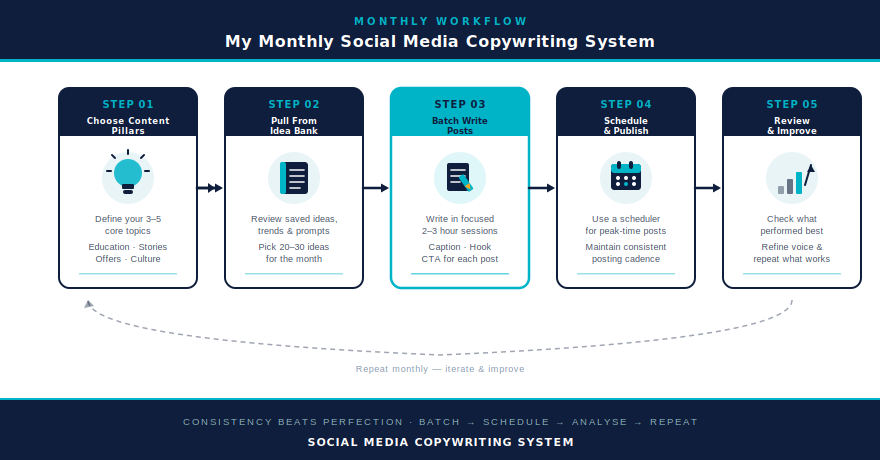
Staring at a blank screen every day, trying to come up with something new and brilliant, is a recipe for burnout. I have been there. Here is what I do instead.
Batch Writing
I write in batches. Once or twice a month, I block two to three hours and write 15 to 20 posts in one focused session.
I pick a content pillar or theme for each batch and write multiple angles on related ideas. Then I schedule them out across the month using a scheduling tool.
This approach keeps my creative energy high. Writing in flow state produces better social media copy than grinding out one post per day ever did.
The Idea Bank
I keep a running notes file on my phone for capturing ideas in real time. A conversation that surprised me. A mistake I made and what I learned. A result I did not expect. A question a client asked that I had never considered.
Real experience is the richest source of social content creation material. The problem is that most people let those moments pass without capturing them. I never let them pass.
Repurposing With New Angles
My best-performing posts get repurposed three or four times. Not copied and reposted. Taken and rewritten with a different hook, a different audience lens, or a different format.
A strong idea does not expire. A strong format is reusable. A strong story can become a post, a carousel, a video script, and a comment thread. The idea is the asset. The execution is flexible.
Before and After: What Good Social Media Copy Actually Looks Like
Theory only goes so far. Here are real before-and-after examples from my own work and client projects.
Example 1: Instagram Product Post
Before: “Our new skincare serum is now available. It is packed with natural ingredients that nourish your skin. Shop the link in bio.”
After: “I stopped using it for two weeks to test if it was actually working. By day five my skin was telling me something had changed. By day ten I caved and went back. The link is in bio if you want to see what the fuss is about.”
The second version has a story, a test, a personal admission, and a low-pressure CTA. It is social media content writing with a human voice. The product is mentioned, but it is not the focus. The experience is.
Example 2: LinkedIn Thought Leadership
Before: “Leadership is about empowering your people and creating environments where everyone can thrive. Great leaders listen.”
After: “My best manager gave me almost no advice. She asked questions until I worked it out myself. At the time I found it frustrating. A decade later I understand she was the best teacher I have ever had.”
Generic observations do not stop scrolls. Real, specific memories do. That is what social media copywriting comes down to in the end: trading vague ideas for specific moments.
Example 3: X (Twitter)
Before: “Creating content for social media is important for building your brand online.”
After: “Your content strategy is not broken because you are not posting enough. It is broken because you are not writing specifically enough.”
Short, pointed, and arguable. That is what earns engagement on X.
Measuring What Works and Building a Feedback Loop
Even the sharpest social media copywriting improves when you pay attention to data. I track four things consistently.
- Reach: How many people were exposed to the post?
- Engagement rate: Of those who saw it, what percentage interacted?
- Saves and shares: These are the highest-value signals. They tell you the content was useful or resonant enough to keep or pass on.
- Comments: What are people actually saying? Comments give you language, objections, and follow-up content ideas in one place.
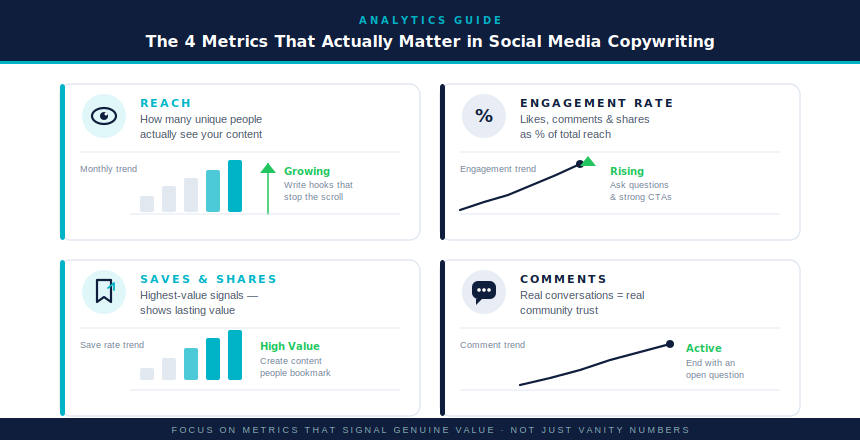
I do not chase likes. Likes are passive and easy. Saves, shares, and thoughtful comments are the metrics that predict real audience growth.
Every month I review my top five posts. I look for patterns: similar hooks, similar topics, similar emotional tones, similar structures. Then I write more content in that direction, with fresh ideas and new angles.
Social media content creation is a feedback loop, not a one-off effort. The writers who get consistently better are the ones who treat every post as a data point and every data point as a lesson.
The Most Common Social Media Copywriting Mistakes I Still See
After working with dozens of brands and content teams, these are the patterns that hold most people back.
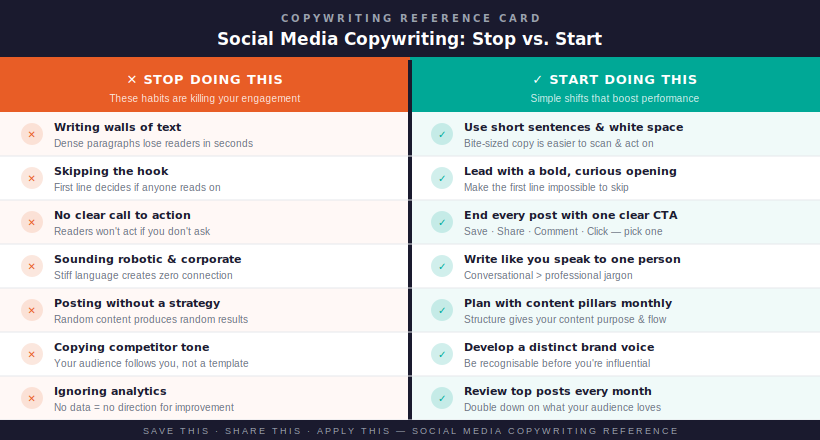
- Writing for yourself instead of your audience. Ask what the reader gets from this post, not what you want to say.
- Burying the hook. Starting with context, backstory, or pleasantries before the actual point. Start with the point.
- No CTA. Every post should give the reader somewhere to go or something to do, even if it is just a question.
- Trying to sell too early. Content that educates and entertains earns the right to sell. Do not skip the trust-building stage.
- Over-polishing. Perfect-sounding copy often feels cold. Raw specificity outperforms polished vagueness on every platform right now.
- Using the same format every time. Variety keeps your audience engaged even when the topic is familiar.
- Copying competitors instead of learning from them. Understand why a post performed well, then find your own angle on the same insight.
Frequently Asked Questions
1. How is social media copywriting different from other types of copywriting?
The biggest difference is competition for attention. A blog reader has already chosen to engage before they start reading. A social media reader is being interrupted mid-scroll. That makes the threshold for engagement far higher on social.
Social media copy also has to perform in seconds, not minutes. The hook, the value, and the CTA all need to land faster and more efficiently than in any other format. There is no warm-up. There is no patience. Every line has to earn the next one.
2. How long should social media copy be on each platform?
Length should serve the content, not the other way around. On X, shorter is almost always better. On LinkedIn and Facebook, longer storytelling posts often outperform short ones because readers expect more depth.
The real rule is that every word must earn its place. Write as long as the idea needs. Then cut everything that does not pull its weight. A 50-word post with no filler beats a 300-word post with padding every time.
3. How do I develop a consistent voice for social media content writing?
Write more and read it back. Voice reveals itself in patterns you repeat naturally. Once you spot those patterns, lean into them intentionally.
Define your voice with three adjectives. Then ask, for every post you write: does this feel like that? If it does not, rewrite it until it does. Voice is consistency over time, and consistency is built sentence by sentence.
4. Can social media copywriting actually drive conversions, or is it just for engagement?
It absolutely drives conversions. I have seen a single well-written LinkedIn post generate more qualified leads than a paid campaign with a five-figure budget. The difference is that social media copy builds trust before asking for anything.
The conversion path on social is usually longer than paid ads. But the leads it generates are often warmer, more informed, and more loyal. Social content creation that educates and connects consistently produces compounding returns that paid content rarely matches.
5. How often should I post to see results from social media copywriting?
Consistency matters far more than frequency. One exceptional, well-crafted post per week will outperform five mediocre daily posts. The algorithm rewards engagement, and engaged audiences require quality, not volume.
Start at a pace you can sustain without burning out. Build your system. Get better at the craft. Then add frequency from a position of strength. Posting less but writing better is always the smarter starting point.
Final Thoughts
Social media copywriting is one of the most underestimated skills in the digital landscape. It is also one of the most powerful when practiced with intention.
I have watched brands transform their audience relationships simply by changing how they write. Not by posting more, not by spending more on ads, but by learning to write copy that treats people as humans instead of targets.
The principles in this guide are not shortcuts. They are the result of years of testing, failing, adjusting, and improving. Every hook formula, every structural framework, every habit I have shared here was earned the hard way.
Apply them consistently. Let your audience teach you what resonates. Build the feedback loop. Get specific. Get real.
Social media content writing is a craft that compounds. Every post you write makes you sharper. Every lesson you pull from your data makes the next post better.
Start where you are. Write the next post better than the last one. That is the entire game.