I have been creating content for over a decade. And if there is one thing I have learned, it is this: content without strategy is just noise.
Early in my career, I used to write blog posts hoping someone would read them and magically become a customer. That did not work. What changed everything was understanding that content can be engineered to generate leads. Not by accident. Not by hope. But by design.
This article is a deep dive into content creation for lead generation. I will walk you through everything I know, from building the right foundation to using the exact types of content that convert. Whether you are a solopreneur, a marketer, or a business owner, these are strategies I have tested and refined personally.
| Lead generation is the process of attracting strangers and converting them into people who have expressed interest in your business. Content is the fuel that makes this happen. |
- Why Content Is Your Best Lead Generation Tool
- Understanding the Content Funnel
- Lead Magnets: The Engine of Content Lead Generation
- Building a Blog Strategy That Generates Leads
- SEO and Content Marketing Lead Generation: Making Your Content Findable
- Landing Pages: Where Content Meets Conversion
- Calls to Action: The Bridge Between Content and Leads
- Email Nurture: Turning Leads Into Customers With Content
- Repurposing Content: One Idea, Many Lead Generation Touchpoints
- Measuring What Works: Metrics That Matter in Lead Generation Content
- Common Mistakes That Kill Your Lead Generation Content Strategy
- Bringing It All Together
- Frequently Asked Questions
Why Content Is Your Best Lead Generation Tool
Paid ads stop working the moment you stop paying. Cold emails get ignored. But content? Good content keeps working for you long after you hit publish.
I call it the compounding asset. A well-written blog post can drive organic traffic for years. A great ebook can collect emails on autopilot. A thoughtful webinar can turn cold viewers into warm leads within an hour.
Content marketing lead generation is not just cheaper than paid ads. It is also more trustworthy. People are tired of being sold to. They want to be educated first. When your content helps someone solve a real problem, you earn their trust. And trust is what converts.
The Numbers Back This Up
Content marketing generates three times as many leads as traditional outbound marketing, at about 62 percent less cost. I am not just quoting a stat here. I have seen this play out in campaigns I have personally run. A single long-form guide I published for a client brought in over 400 leads in its first six months. No ad spend. Just content.
Understanding the Content Funnel
Before you write a single word, you need to understand where your audience is in their journey. This is what the content funnel is all about. I think of it in three stages.
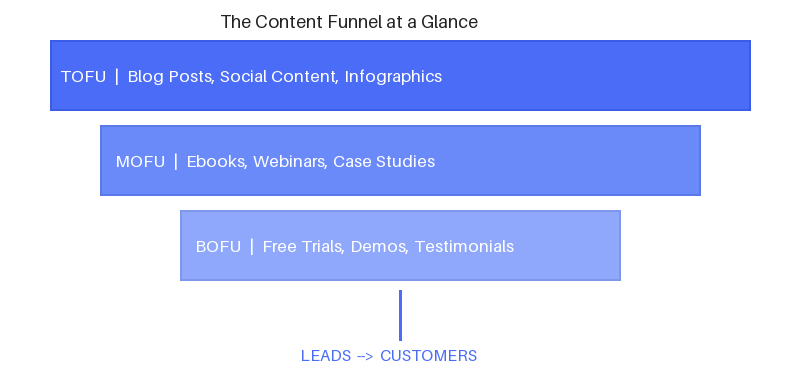
The content funnel: TOFU attracts, MOFU engages, BOFU converts
Top of Funnel (TOFU): Awareness
This is where people first discover you. They are not ready to buy. They have a problem and they are looking for answers. Your job here is to attract them with helpful content.
The content that works best at this stage includes blog posts, social media content, short videos, and infographics. Keep it educational. Keep it free. Keep it easy to find.
Middle of Funnel (MOFU): Consideration
Now your audience knows you exist. They are comparing options. They want more depth. This is where you offer something valuable in exchange for their contact information.
Think ebooks, webinars, email courses, and case studies. This is where the lead capture happens. You give them something genuinely useful. They give you their email address. Fair trade.
Bottom of Funnel (BOFU): Decision
These are the warm leads. They are close to making a decision. Your content here needs to remove doubt and build confidence. Free trials, product demos, testimonials, and comparison guides work extremely well at this stage.
I have seen companies skip the MOFU stage entirely and wonder why their BOFU content is not converting. The answer is always the same. You cannot rush trust. You have to earn it through the middle of the funnel.
Lead Magnets: The Engine of Content Lead Generation
A lead magnet is a piece of content so valuable that people willingly give you their email to access it. It is the cornerstone of any solid lead generation content strategy.
I have built dozens of lead magnets across different industries. Some flopped. Some brought in thousands of leads. Here is what I have learned separates the two.
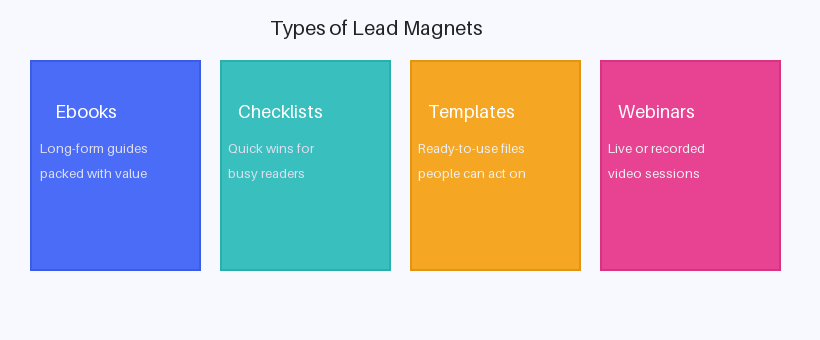
Four proven lead magnet formats and what makes each one effective
What Makes a Lead Magnet Work
The best lead magnets are specific, fast, and actionable. They solve one very clear problem and they deliver the solution quickly. Vague lead magnets fail. Specific ones win.
For example, “The Ultimate Marketing Guide” is too broad. But “A 7-Step Checklist to Writing Blog Posts That Rank on Page One” is specific. People know exactly what they are getting and exactly what it will help them do.
Types of Lead Magnets That Convert
- Ebooks and guides: Great for complex topics where depth signals expertise. Keep them visual and scannable.
- Checklists: My personal favorite for quick wins. Easy to create and extremely high perceived value.
- Templates: Give people something they can use immediately. A content calendar template, a pitch email template, an SEO audit spreadsheet.
- Webinars: Live or recorded, webinars build massive trust because people get to see and hear you.
- Mini email courses: A sequence of emails delivered over 5 to 7 days. Each email teaches one idea. This builds a habit of opening your emails before you ever pitch anything.
- Free tools or calculators: These are powerful because they are interactive and immediately useful.
| Pro tip: Always match your lead magnet to the content that promotes it. If your blog post is about social media marketing, your lead magnet should be a social media content calendar or posting checklist. Mismatched lead magnets destroy conversion rates. |
Building a Blog Strategy That Generates Leads
Most blogs fail at lead generation because they treat blogging as a publishing exercise rather than a conversion exercise. I made this mistake for years.
A blog post that generates leads is not just informative. It is structured to move the reader toward a next step. Every post should have a purpose beyond providing information.
Start With Keyword Research
I always start with what my audience is actually searching for. Use tools like Google Search Console, Ahrefs, or even free tools like Ubersuggest. Find questions your audience is asking and build content around those questions.
Focus on keywords with clear intent. Someone searching “best project management software” is much closer to a buying decision than someone searching “what is project management.” Both are valid, but they need different content and different lead magnets.
Structure Your Posts for Conversion
Here is the structure I use for every lead-generating blog post.
- Start with the problem: Hook the reader by naming their pain clearly.
- Deliver real value: Give them genuinely useful information. Do not hold back.
- Insert a contextual CTA: Midway through the post, offer a related lead magnet.
- Wrap with a strong conclusion: Summarize the key takeaways.
- End with a CTA: Always ask the reader to take a next step.
Long-Form Content Outperforms Short-Form for Lead Generation
I have consistently seen that posts over 2,000 words generate more leads than shorter posts. Not because length is inherently better, but because longer posts have more surface area for CTAs, more depth that builds trust, and more keyword coverage that brings in more traffic.
The goal is not to write long content. The goal is to write complete content. Cover the topic fully. If you need 4,000 words to do that, write 4,000 words.
SEO and Content Marketing Lead Generation: Making Your Content Findable
Writing great content is only half the battle. If nobody can find it, it generates zero leads. This is where SEO becomes a critical part of your lead generation content strategy.
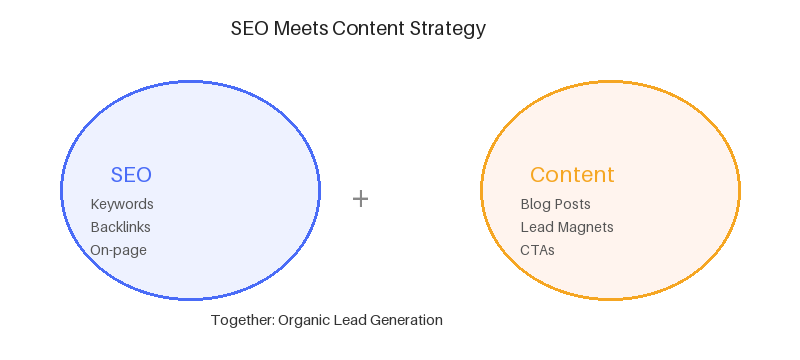
SEO and content strategy work together to drive organic lead generation
On-Page SEO Basics That Still Matter
I am not going to overwhelm you with technical SEO. Here are the fundamentals I apply to every piece of content I create for lead generation.
- Use your primary keyword in the title, first paragraph, and at least two subheadings.
- Write a compelling meta description that includes the keyword and a reason to click.
- Use internal links to guide readers to other relevant content on your site.
- Optimize images with descriptive alt text.
- Keep your URL short and include the keyword.
Topic Clusters Beat Isolated Posts
This changed my entire content strategy. Instead of publishing random posts, I now build topic clusters. A topic cluster is a pillar page that covers a broad topic in depth, supported by multiple cluster posts that cover related subtopics in detail.
For example, if my pillar page is “Content Marketing Lead Generation,” my cluster posts might cover lead magnets, landing page copywriting, email nurture sequences, blog SEO, and so on. Each cluster post links back to the pillar. This builds authority with search engines and keeps readers on your site longer.
Content Freshness Signals Matter
I make it a habit to revisit and update my top-performing posts every six months. Updating content with new information, adding internal links to newer posts, and refreshing examples can significantly boost rankings and keep the lead generation engine running.
Landing Pages: Where Content Meets Conversion
Your content brings people in. Your landing page closes the deal. A poorly designed landing page is like having a great sales pitch and then fumbling the handshake.
I have tested hundreds of landing page variations over the years. Here is what consistently works.
One Page, One Goal
Every landing page should have exactly one goal. One offer. One CTA. The moment you put two offers on a landing page, you split the reader’s attention and cut your conversion rate.
Write Headlines That Speak to the Reader’s Desire
The headline is the first thing people see. It needs to immediately communicate what the visitor will get and why it matters. I use the formula: “Get [Specific Benefit] Without [Common Obstacle].”
For example: “Get 50 Ready-to-Use Email Templates Without Starting From a Blank Page.” That is specific, desirable, and removes a real friction point.
Social Proof Removes Doubt
Testimonials, download counts, and subscriber numbers tell people that others have already said yes. This matters enormously. When someone sees “Trusted by 12,000 marketers,” they feel safer taking the next step.
Keep the Form Short
Every field you add to a form reduces conversions. Unless you have a specific reason to ask for a phone number or company name, stick to first name and email address. That is all you need to start a relationship.
Calls to Action: The Bridge Between Content and Leads
A call to action is the instruction you give your reader about what to do next. Without a clear CTA, even the best content leaves money on the table.
I have seen incredible content with terrible CTAs. The content educated the reader. The CTA confused them. And they left without converting.
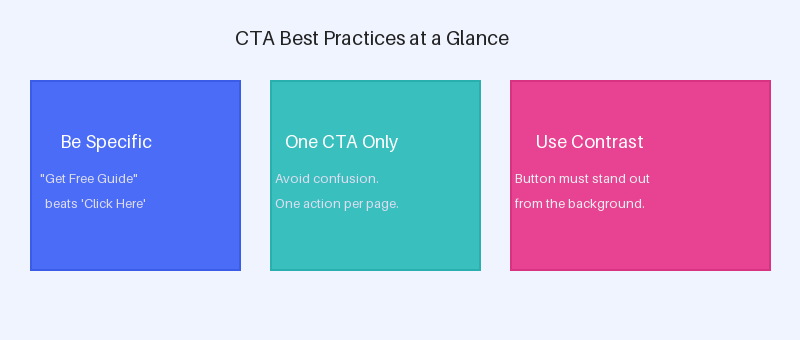
Three non-negotiable CTA principles that lift conversion rates
Types of CTAs That Work in Content
- Inline CTAs: Placed naturally within the body of your content. These work best when they relate directly to what the reader just learned.
- Exit-intent popups: Triggered when a user is about to leave. Offer something compelling enough to make them stay.
- Sticky sidebars: Always visible as the reader scrolls. Good for long-form content.
- End-of-post CTAs: Readers who make it to the end are the most engaged. Always have a CTA waiting for them there.
- Upgrade content boxes: These are contextual offers inside the content itself. For example, in a post about email marketing, you offer a downloadable email swipe file right in the middle of the article.
The Language of High-Converting CTAs
Never say “Submit.” Nobody wants to submit anything. Use action-oriented, benefit-driven language.
- “Download the Free Guide”
- “Get My Free Checklist”
- “Start My Free Trial”
- “Show Me How It Works”
The goal is to make the CTA feel like a reward, not a transaction.
Email Nurture: Turning Leads Into Customers With Content
Getting the email address is the beginning, not the end. What you do after someone subscribes determines whether they become a customer or forget you exist within a week.
I have built email nurture sequences for clients across industries. The structure I keep coming back to is what I call the 3-2-1 sequence.
The 3-2-1 Email Nurture Framework
- 3 emails that educate: Each email focuses on one specific insight related to your audience’s core problem. No selling. Just value.
- 2 emails that inspire: Share a case study, a success story, or a transformation. Help the reader see what is possible.
- 1 email that sells: By this point, you have earned the right to make an offer. Keep it simple, specific, and tied to the value you have already delivered.
This approach works because it mirrors the natural buying process. People need to be educated before they can be inspired. They need to be inspired before they are ready to buy. Content creates each of these conditions.
Segment Your List Based on Content Behavior
Not everyone who downloads your ebook is at the same stage. Someone who downloaded a beginner’s guide is different from someone who downloaded an advanced case study. Segment your list and send content that matches where each group is in their journey.
Behavioral segmentation based on what content someone consumed gives you the data to make this personalization possible. Most email platforms support this. Use it.
Repurposing Content: One Idea, Many Lead Generation Touchpoints
One of the biggest mistakes I see content creators make is treating each piece of content as a standalone effort. Writing a 3,000-word blog post and then moving on wastes most of the value you just created.
I repurpose every major piece of content I create. Here is how I think about it.
The Content Multiplication Model
Start with one core piece of long-form content, for example a comprehensive blog post or a recorded webinar. Then break it apart into multiple formats.
- A long-form blog post becomes 5 to 10 social media posts.
- A webinar recording becomes a blog post, a podcast episode, and multiple short video clips.
- A case study becomes an infographic, a LinkedIn post, and an email to your list.
- A research report becomes a SlideShare presentation, a blog post series, and a PR pitch.
Each format reaches a different audience segment and creates a new entry point into your lead funnel. You are not creating more content. You are making your existing content work harder.
| I once turned a single 45-minute webinar into 23 separate pieces of content, including blog posts, social clips, email sequences, infographics, and a podcast episode. The webinar became a lead generation system that ran for over a year. |
Measuring What Works: Metrics That Matter in Lead Generation Content
You cannot improve what you do not measure. I have seen content strategies fail not because the content was bad, but because nobody was tracking the right numbers.
Here are the metrics I track for every content-driven lead generation campaign.
Traffic to Lead Rate
This tells you how well your content is converting visitors into leads. If you are getting 10,000 visitors per month but only 50 leads, your content is attracting traffic but not converting it. The fix is usually better CTAs, more relevant lead magnets, or a landing page audit.
Lead Magnet Conversion Rate
Track how many people who see your lead magnet offer actually download it. A good conversion rate on a landing page is between 20 and 40 percent. Below 15 percent usually means the offer is not compelling enough or the form is too long.
Lead-to-Customer Conversion Rate
This is the ultimate metric. How many of your leads actually become paying customers? If this number is low, the issue is usually in the nurture sequence or in the quality of the leads you are attracting. Review your content to make sure it is attracting the right audience.
Content Attribution
Use UTM parameters on every CTA and track which pieces of content are driving the most leads. You will almost always find that 20 percent of your content drives 80 percent of your leads. Double down on what is working.
Common Mistakes That Kill Your Lead Generation Content Strategy
I have made every mistake I am about to list. Learning from them cost me time and money. Let me save you both.
- Creating content without a target persona: If you do not know exactly who you are writing for, your content will resonate with nobody.
- Neglecting the distribution: Great content with no promotion is invisible. Build a distribution plan before you publish.
- Skipping the follow-up: Many businesses capture a lead and then do nothing with it. The fortune is in the follow-up. Build your nurture sequence before your lead magnet goes live.
- Being inconsistent: Inconsistent publishing destroys audience trust. It is better to publish one excellent piece per week than to publish five posts and then disappear for a month.
- Optimizing for traffic instead of leads: Traffic is vanity. Leads are sanity. Always optimize your content for lead capture, not just page views.
- Ignoring mobile users: More than 60 percent of content is consumed on mobile. If your landing pages and CTAs are not mobile-optimized, you are losing a massive portion of your potential leads.
Bringing It All Together
Building a content strategy for lead generation is not a sprint. It is a system. It takes time to set up, but once it is running, it works for you around the clock.
I started this journey writing random blog posts hoping for results. Today, I run content systems that generate leads predictably, month after month, across multiple channels. The difference is strategy.
If I could give you one piece of advice to start with, it is this: pick one audience, identify their most pressing problem, create one excellent lead magnet that solves it, write content that attracts people with that problem, and build a simple email nurture sequence that earns their trust.
Do that well, and the leads will follow.
Frequently Asked Questions
1. How long does it take for content marketing to generate leads?
In my experience, you can start seeing initial results from content marketing within 60 to 90 days if you pair it with a solid lead magnet and a clear CTA strategy. Organic traffic from SEO typically takes 3 to 6 months to build meaningfully. Paid distribution can accelerate this timeline significantly. Consistency is the key variable. The businesses that see the fastest results are the ones that publish regularly and optimize based on data.
2. What is the best type of content for lead generation?
Based on my experience, long-form blog posts paired with a contextual lead magnet consistently outperform other formats in cost-per-lead efficiency. Webinars produce the highest-quality leads because they require a bigger time commitment from the audience, signaling stronger intent. For sheer volume of leads, ebooks and checklists are hard to beat. The best format depends on your audience, your industry, and where in the funnel you are targeting.
3. How do I create a lead magnet if I am not a designer?
You do not need to be a designer. Some of the best-performing lead magnets I have created are simple Google Docs formatted with headings, bullet points, and a logo. Tools like Canva make it easy to create polished-looking ebooks, checklists, and templates even if you have zero design background. Focus on the quality of the information first. Presentation matters, but substance is what earns the download.
4. How many CTAs should I include in a blog post?
I typically include three CTAs in a long-form post: one early (around the 25 percent mark), one in the middle (around 50 to 60 percent), and one at the end. All three CTAs should point to the same offer to avoid confusing the reader. Avoid using popups and sticky bars simultaneously with inline CTAs on every paragraph. Too many CTAs create friction instead of reducing it.
5. Can I use AI tools to help with content creation for lead generation?
Yes, and I use them regularly. AI tools are excellent for brainstorming topic ideas, creating outlines, drafting first versions, and repurposing content across formats. However, the strategy, the angle, the real examples, and the human insight still need to come from you. AI-generated content that lacks a distinct perspective or real experience tends to read as generic. Use AI to speed up the process. Use your expertise to make the content trustworthy and unique.