A first-person guide from a working ghostwriter, for writers and the brands they serve.
I write for a living. But most of the time, you will never see my name on anything I write.
That is not a complaint. That is the job description of a ghostwriter.
For years, I have written books that sit on bestseller shelves under someone else’s name. I have written LinkedIn posts that get thousands of likes for executives who have not typed a single word of them. I have written speeches, memoirs, blog series, brand manifestos, and even personal letters for clients who needed the right words but did not have the time, the skill, or the confidence to write them on their own.
If you are a writer thinking about offering ghostwriting services, I want to show you how this works from the inside. And if you are a brand, a business owner, or an individual wondering whether ghostwriting is something you should explore, I want to give you a straight answer on what it actually involves.
This is not a pitch. This is a plain-language guide to how professional ghostwriting services work, what ghost writers do every day, how ghostwriting agencies operate, and why ghostwriting companies exist in the first place.
- What Ghostwriting Actually Means
- How I Started Offering Ghostwriting Services
- What Services Do Ghost Writers Actually Offer?
- How to Structure Your Ghostwriting Services as a Writer
- What the Ghostwriting Process Looks Like From Start to Finish
- The Difference Between a Ghostwriting Agency and an Independent Ghost Writer
- What Brands Need to Understand About Ghostwriting
- How to Find and Vet Ghostwriting Companies or Ghost Writers
- Is Ghostwriting Ethical? Let Me Answer This Directly
- What I Have Learned From Years of Ghostwriting
- Final Thoughts
- Frequently Asked Questions
What Ghostwriting Actually Means
Let me start with the simplest version of the definition.
Ghostwriting means writing content for someone else that they will publish under their own name. The writer stays anonymous. The client takes authorship. The arrangement is agreed upon, paid for, and completely legal.
That is it. Nothing sneaky. Nothing scandalous.
The term comes from the idea that the writer is invisible, like a ghost. You see the words but you do not see the person behind them. Ghost writers have been around for centuries. Speechwriters, scribes, editorial collaborators. The only thing that has changed is the scale. Today, ghostwriting services cover everything from 300-word social media posts to 90,000-word memoirs.
Here is something people in this industry say often, and it is true: ghostwriting is not about stealing credit. It is about helping someone say what they already know, believe, or have experienced, but in a form that other people can actually read and absorb.
The ideas belong to the client. The execution belongs to the ghost writer. That is the deal.
How I Started Offering Ghostwriting Services
I did not plan to become a ghost writer. Most of us do not.
I was working as a freelance content writer, writing articles for businesses and the occasional brand blog, when a client asked me something unexpected: could I write their book? They were a consultant with fifteen years of real-world experience in operations. They had the knowledge. They had a rough outline. What they did not have was any interest in sitting down and turning that outline into a readable 60,000-word manuscript.
I said yes. I had no idea what I was getting into.
That first project taught me more about writing than the previous five years of my career combined. It taught me that ghost writing services are not just about putting words on a page. They are about disappearing into someone else’s perspective, their vocabulary, their way of explaining things, their sense of humour, their blind spots, and their strengths, and writing from inside that perspective so convincingly that even the client reads the draft and says, ‘Yes. That sounds exactly like me.’
That is the job. And once I understood it, I built my entire writing practice around it.
| The real skill in ghostwriting is not writing well. It is listening well enough that your writing sounds like someone else entirely. |
What Services Do Ghost Writers Actually Offer?
If you are a writer looking to position yourself in this space, or a brand trying to understand what is available to you, here is a clear breakdown of what professional ghostwriting services typically cover.
Book Ghostwriting
This is the flagship service in the industry. A client comes with an idea, a story, or a body of expertise. The ghost writer turns that into a full manuscript, typically between 40,000 and 90,000 words depending on the genre and purpose. Business books, memoirs, self-help books, leadership books, and personal narrative non-fiction are the most common categories.
For writers: this is the highest-paying category. It is also the most demanding. Expect four to twelve months of active work per project, deep client collaboration, and multiple rounds of revisions.
For brands and individuals: a published book is still one of the most powerful credibility tools available. If you have knowledge worth sharing but cannot write it yourself, book ghostwriting is how it gets done.
Blog and Article Ghostwriting
This is the bread and butter of most ghost writers who work in content. Businesses, entrepreneurs, and thought leaders hire ghost writers to produce regular blog posts, industry articles, and online content consistently, because consistency is what builds search rankings and audience trust over time.
The ghost writer produces content that sounds like the client wrote it. The client reviews, approves, and publishes it under their name. This happens thousands of times every day across every industry you can think of.
LinkedIn and Social Media Ghostwriting
LinkedIn ghostwriting has become a distinct service category of its own. Many of the thought leadership posts you read from founders, executives, and industry voices on LinkedIn were written by ghost writers working closely with those individuals. The same applies to Twitter threads, Instagram captions, and personal brand content across platforms.
For writers who can write short-form well, match a voice quickly, and understand what performs on social media, this is a lucrative and scalable part of a ghostwriting practice.
Speech and Presentation Writing
Keynote speeches, investor presentations, award acceptance remarks, TEDx talks. These are high-stakes pieces of writing that demand a specific skill set. The ghost writer needs to write for spoken delivery, not the page, which means rhythm, pacing, pausing, and audience energy all factor into the writing choices.
Podcast Scripts and Video Content
With the growth of personal brand content built on audio and video, ghost writers are increasingly being hired to write podcast episode outlines, full scripts, YouTube video scripts, and online course scripts. This is a conversational writing style and requires a different ear than long-form prose.
White Papers, Reports, and Thought Leadership Content
Companies and senior professionals regularly need long-form authoritative content that positions them as leaders in their field. Ghost writers research, structure, and write these pieces, which are then published under the company’s or individual’s name as original thought leadership.
How to Structure Your Ghostwriting Services as a Writer
This section is specifically for writers who want to build a ghostwriting practice or improve the one they already have. The way you structure and sell your services matters just as much as the quality of your writing.
Define Your Niche
The most successful ghost writers I know specialize. They are the business book person. The personal finance blogger. The healthcare thought leadership writer. The executive LinkedIn voice.
Generalist ghost writers exist and do fine work, but they are harder to market and harder to price at a premium. When you specialize, you can speak directly to the client who needs exactly what you offer, and you can command a higher rate because you bring domain knowledge alongside writing skill.
Pick one or two content categories and one or two industries to start. You can expand later. Specializing early accelerates everything.
Build a Voice-Matching Portfolio
Standard writing portfolios do not work well for ghostwriting. You cannot show the work you have done because it is published under someone else’s name. What you can do is create voice-matched samples. Pick three or four very different voices and write the same subject from each of those perspectives. Show a potential client that you can sound like a warm, personal storyteller and a precise, data-driven analyst and a sharp, conversational social media presence, all within the same portfolio.
That is the demonstration that matters. It shows range and it shows the core skill of ghostwriting: the ability to inhabit a voice that is not your own.
Price By Project, Not By Word Count
Word count pricing makes clients focus on length and makes you feel like a word factory. Project pricing reflects the full scope of the work: the discovery calls, the research, the drafting, the revisions, the voice development, and the ongoing communication throughout.
For newer ghost writers, blog post ghostwriting typically starts in the range of several hundred dollars per post and increases with experience and specialization. Book ghostwriting for independent professionals can range from tens of thousands of dollars upward depending on length, complexity, and the writer’s track record. Do not undersell the full scope of what ghost writing services involve.
Use Clear, Written Agreements
Every ghostwriting engagement, no matter how small, should be governed by a written agreement that covers the following:
- Scope of work: exactly what is being written and how long it is
- Revision rounds: how many are included, what counts as a revision
- Timeline and milestones: when drafts are due, when feedback is expected
- Payment terms: deposit upfront, milestone payments, final payment on delivery
- Confidentiality: that the ghost writer’s involvement remains private
- IP transfer: that all rights pass to the client on final payment
These are not optional. They protect both parties and they set a professional tone from the start. If a potential client refuses to sign a written agreement, that tells you something important about the engagement.
| Pro Tip for Writers: Keep a project brief template that you send to every new client before the first call. Ask about their audience, their goals for the content, their preferred tone, and any existing content they have produced. The answers tell you as much as anything they say in the actual conversation. |
What the Ghostwriting Process Looks Like From Start to Finish
Whether you are a writer building your process or a brand trying to understand what you are signing up for, here is how a professional ghostwriting engagement actually works.
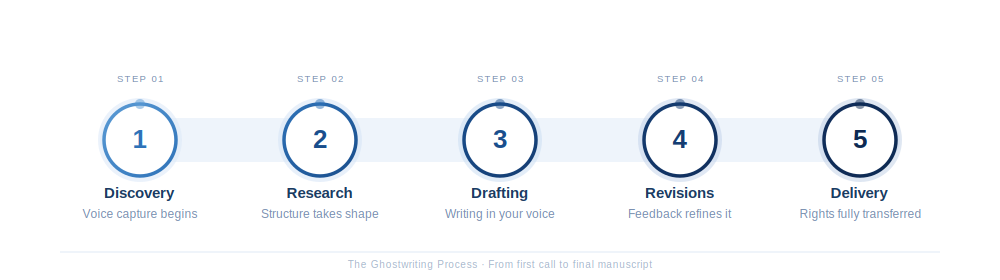
Step 1: Discovery and Voice Capture
This is the most important phase and the most skipped by inexperienced ghost writers. Before a single word of content is written, the ghost writer needs to understand the client deeply. This means extended recorded conversations, reviewing the client’s existing written and spoken content, understanding their audience, their vocabulary, their values, and the specific impression they want to create.
Voice capture is not a one-hour call. For book projects it can take two to four weeks. For ongoing blog work it might be a few focused sessions upfront. The goal is to reach the point where the ghost writer can hear the client’s voice clearly enough to write from inside it.
Step 2: Research and Structure
Once the voice is established, the ghost writer researches the subject matter, organizes the content structure, and produces an outline that the client reviews and approves.
For longer projects this outline is the skeleton of the entire manuscript. Clients who skip the outline review stage often regret it later when the full draft goes in a direction they did not expect.
Step 3: Drafting
The writing phase. The ghost writer produces the content in the client’s voice, working through the agreed structure. For book projects this is done in chapter-by-chapter batches so the client can review as the work progresses.
For blog and social content this happens on a delivery schedule. Good ghost writers do not wait for the draft to be perfect before sharing it. First drafts exist to be refined, not published.
Step 4: Client Review and Revisions
The client reads the draft and provides feedback. This is where most of the creative back-and-forth happens. A professional ghostwriting engagement builds in two to three rounds of revisions as standard.
Revision rounds are not a sign of failure. They are a built-in part of the process. What matters is that feedback is specific and that the ghost writer treats it as directional information, not personal criticism.
Step 5: Final Delivery and Rights Transfer
The finished, approved content is delivered in the format the client needs. For manuscripts, this typically means a Word document formatted to publishing standards.
For blog content, it might be a Google Doc or a direct upload to the client’s CMS. All rights transfer to the client completely. The ghost writer’s name is not attached unless the client specifically chooses to acknowledge them.
The Difference Between a Ghostwriting Agency and an Independent Ghost Writer
As someone who has worked both independently and with ghostwriting agencies, I can tell you that both models have genuine value. The choice depends on the project and the client.
Ghostwriting Agencies
A ghostwriting agency is a business that employs or contracts a managed roster of ghost writers and sells professional ghostwriting services as a structured offering. When a client hires a ghostwriting agency, they typically get an account manager who handles communication, a writer from the agency’s pool matched to their project, editorial oversight, and a formal contract framework.
The advantages of working with a ghostwriting agency are real: there is organizational accountability, project management infrastructure, a vetting layer that ensures writer quality, and scalability if a client needs multiple content types produced simultaneously. Ghostwriting companies at this level also carry professional indemnity and have established NDA frameworks.
The trade-off is that the personal relationship with the writer is mediated. You are working with an organization, not an individual. The creative chemistry that makes great ghost writing possible can sometimes get filtered through layers of management.
Independent Ghost Writers
Working directly with an independent ghost writer means a one-to-one creative relationship. The writer is entirely accountable to you. There is no middleman. The voice development and the creative chemistry are direct, and the writer has strong personal investment in the outcome.
The trade-off is that the client takes on more of the project management burden, and vetting quality requires more upfront work. Strong recommendations from trusted sources are the most reliable way to find a good independent ghost writer.
| For brands new to ghostwriting: a reputable ghostwriting agency is often the lower-risk entry point because the infrastructure and accountability are built in. For individuals who want a deeply personal creative partnership for a single major project like a book, an experienced independent ghost writer with strong references is often the better fit. |
What Brands Need to Understand About Ghostwriting
This section is written directly for brands, business owners, executives, and individuals who are considering using professional ghostwriting services for the first time.
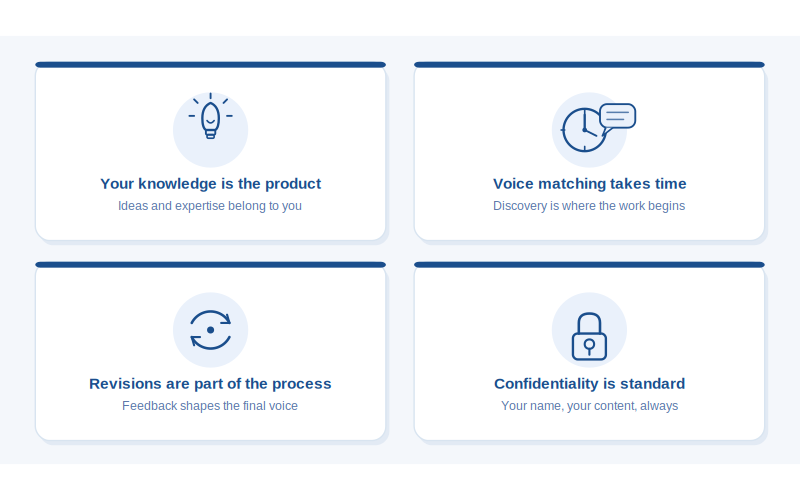
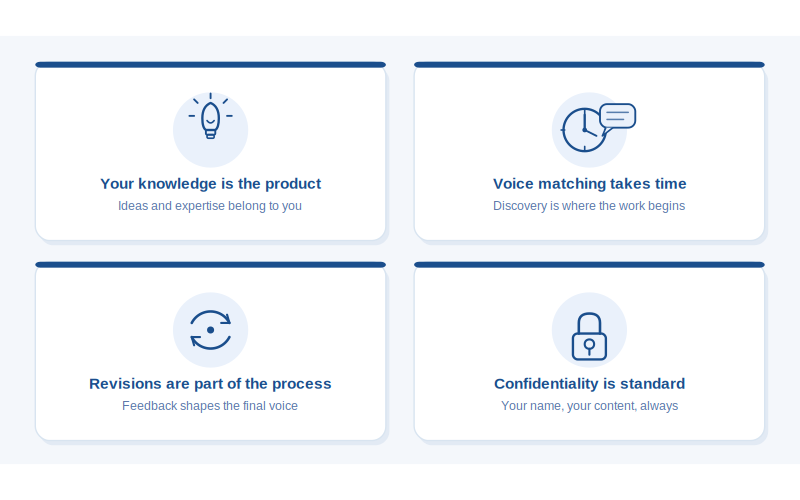
Your Knowledge Is the Product
The ghost writer is not inventing your expertise. They are translating it. When you hire ghost writing services, you are not outsourcing your ideas. You are outsourcing the craft of expressing them. The more clearly and generously you share your thinking, your stories, your perspective, and your goals with the ghost writer, the better the work will be. The best ghostwriting outcomes come from clients who show up fully to the discovery process.
Voice Matching Takes Time, and That Time Is Worth It
One of the most common frustrations I hear from brands who have had disappointing ghostwriting experiences is that the content did not sound like them. Almost always, the cause is a rushed or skipped discovery process. A ghost writer who jumps straight into drafting without deeply understanding your voice will produce competent writing that sounds like a writer. Not like you. The discovery phase is not overhead. It is the foundation of everything.
Revisions Are Part of the Process
When you receive a first draft that is not quite right, that is not a failure. That is the process working as it should. The first draft is a detailed proposal about how your ideas can be expressed. Your feedback on it is what turns a good draft into a great piece of content. Ghost writers who do this well welcome feedback. They treat your corrections as valuable data about your voice, not as criticism of their craft.
Confidentiality Is Standard and Professional
Reputable ghost writers and ghostwriting companies operate under strict non-disclosure agreements as standard. The existence of the ghostwriting relationship is confidential. The content belongs to you entirely. There is no ethical grey area in publishing ghostwritten content under your name. This is legal, widely practised, and completely normal in publishing, media, business, and personal branding.
How to Find and Vet Ghostwriting Companies or Ghost Writers
Whether you are a brand looking to hire or a writer looking to understand what clients look for when they research ghostwriting services, here is what the vetting process looks like on both sides.
For brands evaluating ghostwriting companies or independent ghost writers:
- Read their own writing carefully. How a ghost writer presents themselves tells you a great deal about how they will represent you.
- Ask for voice-matched samples, not just portfolio pieces. You want to see that they can write like a specific person, not just write well in general.
- Ask how they run their discovery process. If they have no clear answer, that is a warning sign.
- Insist on a written agreement before any work begins. Scope, timeline, revisions, confidentiality, and rights transfer must all be documented.
- Do a paid trial piece before committing to a large project. A short blog post or an article gives you useful signal about the working relationship.
For writers positioning themselves as professional ghostwriting services:
- Make your process visible. Clients who find you should be able to understand exactly how you work before they contact you.
- Show samples that demonstrate voice range, not just writing quality.
- Be explicit about what is included in your fee and what constitutes additional work.
- Respond quickly and professionally to initial enquiries. The quality of your communication is itself a sample of your writing.
- Collect references and testimonials wherever confidentiality allows, even brief anonymous ones.
Is Ghostwriting Ethical? Let Me Answer This Directly
I have been asked this question more times than I can count. Usually by people who have never actually thought carefully about how most professional communication in the world is produced.
Every president who has ever given a speech had a speechwriter. Every major corporate annual report was written by a communications team. Many of the most influential business books of the last fifty years were produced with significant ghostwriting involvement. The publishing industry, the media industry, the PR industry, and the content marketing industry all run, in part, on ghostwriting.
The ethical case is simple: the knowledge, the experience, the ideas, and the perspective belong to the person whose name is on the content. The ghost writer’s role is to shape that material into something that communicates it clearly and compellingly. Expertise and writing craft are two separate skills. There is no moral requirement that everyone who has valuable things to say must also be a trained writer in order to say them.
Where the ethics of ghostwriting do require attention is in contexts where original authorship is specifically required, such as academic assessments. In professional, commercial, and personal publishing, there is no ethical issue. The arrangement is transparent between the parties involved, governed by a legal contract, and completely legitimate.
What I Have Learned From Years of Ghostwriting
A few honest observations from inside the work.
The best ghostwriting relationships are built on trust that moves in both directions. The client trusts the ghost writer with their story, their voice, and their reputation. The ghost writer trusts the client to show up fully, give useful feedback, and value the craft they are bringing to the work. When that mutual trust is present, the writing becomes something neither party could have produced alone.
Ghostwriting is genuinely one of the most demanding writing disciplines there is. Not because it is technically harder than other writing, but because it requires you to set yourself aside completely. You are not here to be clever. You are not here to show your range. You are here to make someone else sound exactly like the best version of themselves. That requires real humility and real craft working together.
If you are a writer considering building a practice around professional ghostwriting services, know that it rewards patience, curiosity, and the ability to listen. Know also that it is financially sustainable in a way that many other writing careers are not, because the clients who use ghost writing services understand the value of what they are getting and will pay appropriately for it.
And if you are a brand exploring what ghostwriting agencies or ghost writers can do for you, know that the right partnership does not diminish your voice. It amplifies it. A great ghost writer does not replace you. They help you become, on the page, exactly who you already are.
Final Thoughts
Ghostwriting services are not a secret corner of the writing world. They are a central, functioning part of how knowledge gets shared, how brands communicate, and how individuals with important stories and expertise bring those things into the world.
If you are a writer reading this: you have a viable, respected career available to you in this space. Learn the craft of voice matching. Build a clear service offering. Price your work to reflect its full value. And approach every project with the genuine curiosity and discipline that good ghostwriting demands.
If you are a brand, executive, or individual reading this: professional ghostwriting services exist to close the gap between what you know and what the world can read. Find the right ghost writer or ghostwriting agency for your needs, invest properly in the discovery process, and you will end up with content that sounds authentically like you because it is built entirely from you.
The ghost is never really invisible. They are just deeply, deliberately present inside your words.
Frequently Asked Questions
1. How do ghost writers make sure the content sounds like the client and not like themselves
This is the core skill of the job, and it comes down to the discovery process. Before writing a single word, a professional ghost writer conducts deep listening sessions: recorded interviews, review of the client’s existing emails, articles, social posts, and spoken content, and often repeated conversations covering how the client explains their own ideas in natural language. The goal is for the ghost writer to internalize the client’s vocabulary, sentence rhythm, level of formality, and personality. Good ghost writers think of this as learning a second language, except the language is a specific person’s way of communicating. The more thoroughly this is done upfront, the more naturally the writing will read as the client’s own.
2. What should a ghostwriting agency or professional ghostwriting service always include in a contract?
A properly structured ghostwriting contract covers six essential areas. First, the exact scope of work including content type, length, and format. Second, the number of revision rounds included in the fee and what happens if more are needed. Third, the project timeline with clear milestones for drafts and client feedback windows. Fourth, payment terms including deposit percentage, milestone payments, and conditions for final payment. Fifth, a confidentiality clause confirming the ghost writer will not disclose their involvement. Sixth, an intellectual property transfer clause confirming all rights pass to the client on full payment. Any reputable ghostwriting company or independent ghost writer will use a written agreement covering all six of these areas as standard practice.
3. Can a ghost writer work across different industries, or do they need to specialize?
Both approaches are valid, but they serve different purposes. Specialized ghost writers bring domain knowledge to their writing, which adds depth and credibility to the content, and they are easier to market because the right clients find them more easily. Generalist ghost writers rely on strong research skills and the ability to get up to speed quickly on any subject, which works well for certain content types but can be limiting for highly technical or niche fields. For writers building a ghostwriting practice, specializing in one or two industries and one or two content formats is generally the faster path to a sustainable, well-paid practice. Generalist positioning tends to work better once a writer already has a strong reputation and referral pipeline.
4. How long does a typical ghostwriting project take from start to finish?
Timelines vary considerably depending on the content type and scope. A single blog post typically takes one to two weeks from initial brief to final delivery. A series of ten LinkedIn posts or a short-form content package might take three to four weeks. A long-form white paper or e-book runs four to eight weeks. A full business book or memoir is typically a four to twelve month project, depending on the depth of research involved, the client’s availability for review sessions, and the number of revision cycles. The most reliable way to establish a realistic timeline is to agree on it before the project begins and to build in buffer time at each milestone for client review, which almost always takes longer than clients initially estimate.
5. Is it common for brands and executives to use ghostwriting services, or is it something most people keep quiet about?
It is extremely common, and while many clients do keep it quiet simply because the arrangement is private by nature, the practice itself is openly acknowledged throughout the publishing, business, and content industries. Most major business books are produced with ghostwriting involvement. The majority of executive thought leadership content published on platforms like LinkedIn is written or significantly shaped by ghost writers. Corporate communications, keynote speeches, annual reports, brand books, and podcast content regularly involve professional ghostwriting services. The confidentiality around specific arrangements is standard professional discretion, the same as any other professional service relationship. The broader practice of ghostwriting is not a secret. It is simply how the content world functions.