I have been writing professionally for over a decade. And if I am being completely honest with you, I wasted the first three years of my career writing copy that looked good but did almost nothing.
It sounded polished. It felt creative. Clients liked reading it. But it did not move people to act.
That changed the day I discovered conversion copywriting. Not as a buzzword. Not as a trend. But as a discipline. A craft rooted in psychology, human behavior, and relentless testing.
In this article, I am going to walk you through everything you need to know about conversion copywriting. What it is. How it works. What separates it from regular writing. And how you can start applying it whether you are a freelancer, a brand owner, or a content marketer.
Conversion copywriting is not about being clever. It is about being clear, compelling, and intentional with every single word.
- What Is Conversion Copywriting?
- The Definition of Conversion Copywriting in Plain Terms
- How Conversion Copywriting Differs From Content Marketing
- The Psychology Behind Copy That Converts
- The AIDA Framework: The Backbone of Conversion Copy
- The Key Elements of High-Converting Copy
- Where Conversion Copywriting Gets Used
- 5 Common Mistakes That Kill Conversions
- How to Start Thinking Like a Conversion Copywriter
- Is Conversion Copywriting Worth Learning in 2025?
- Wrapping Up: What Conversion Copywriting Taught Me
- Frequently Asked Questions
What Is Conversion Copywriting?
Conversion copywriting is the practice of writing text that is specifically designed to get the reader to take a defined action.
That action could be clicking a button. Signing up for a newsletter. Making a purchase. Booking a call. Downloading a resource. Or even just reading the next paragraph.
Every piece of conversion copy has a single job. To move the reader from where they are right now to a specific next step.
This is different from general copywriting, which might focus on brand voice, storytelling, or creative expression. Conversion copywriting is laser-focused on results. It is writing measured against metrics like click-through rate, sign-up rate, and revenue.
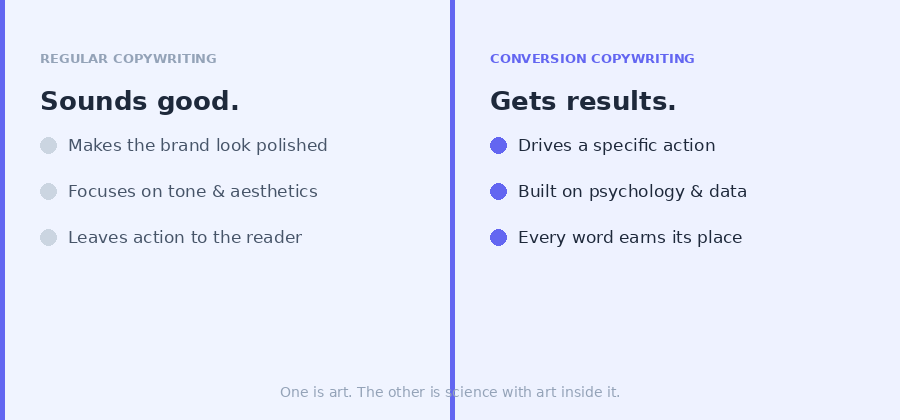
Conversion copywriting vs. regular copywriting: the core differences.
I like to think of it this way. Regular copywriting asks people to feel something. Conversion copywriting asks people to do something.
Both have value. But in the world of digital marketing, conversion copywriting is the one that pays the bills.
The Definition of Conversion Copywriting in Plain Terms
Let me give you a working definition that I actually use myself.
Conversion copywriting is strategic writing that uses psychology, research, and structure to guide a reader toward one specific action.
Three things stand out in that definition. Strategy. Psychology. Structure.
It is strategic because it is written with a goal in mind. Not just to fill a page. Not just to sound good. Every line is placed intentionally.
It is rooted in psychology because it speaks to how people actually think and feel. It uses principles like social proof, scarcity, curiosity, and authority to connect with the reader on a deeper level.
And it has structure because even the most psychologically sharp copy falls flat without a framework to guide the reader through it.
How Conversion Copywriting Differs From Content Marketing
This is a question I get asked often. And it is a fair one because the two overlap more than people realize.
Content marketing is about creating valuable material that builds trust over time. Blog posts. Videos. Podcasts. Social media. The goal is to attract an audience, nurture it, and eventually convert it.
Conversion copywriting is usually the moment of conversion. The landing page. The email campaign. The ad. The product description. The checkout page.
But here is what most people miss. The best content marketing is also conversion copywriting. Every piece of content should be written with a clear next step. Even a blog post should guide the reader toward something. A related article. A lead magnet. A newsletter subscription.
When I write content for my clients, I treat every sentence as an opportunity to deepen engagement or prompt action. That is the conversion copywriting mindset applied to content strategy.
Secondary Keywords in Practice
If you are building a content marketing strategy, understanding conversion copy is non-negotiable. Content marketing examples that perform best are almost always anchored in strong conversion copywriting principles. Whether it is digital content marketing or a long-form blog post, the content marketing definition should always include the element of guiding action.
The Psychology Behind Copy That Converts
Let me pull back the curtain on something. Conversion copywriting is not magic. It is applied behavioral psychology.
When I write a high-converting page, I am not just typing words. I am mapping out what the reader thinks, feels, fears, and wants at each stage of reading.
1. The Problem-Aware Reader
Most readers arrive knowing they have a problem. They just do not know if you have the solution. Your job is to name the problem accurately, make the reader feel understood, and then introduce your solution as the logical next step.
2. The Skeptical Reader
People are cynical. They have been burned by promises before. This is why social proof works. Testimonials, case studies, data, and reviews all say the same thing. Other people like you trusted this, and it worked.
3. The Distracted Reader
Nobody reads everything. They skim. They scan. They jump around. This is why headers, bullet points, bolded text, and short paragraphs matter so much. You need to make the most important ideas pop out even for the reader who gives you thirty seconds.
4. The Motivated Reader
When someone lands on your page at the right moment, they are ready to act. Do not get in their way. Make the CTA obvious, the value crystal clear, and the next step frictionless.
The AIDA Framework: The Backbone of Conversion Copy
If you are new to conversion copywriting, start with AIDA. It is the most widely used framework in the industry. And for good reason. It works.
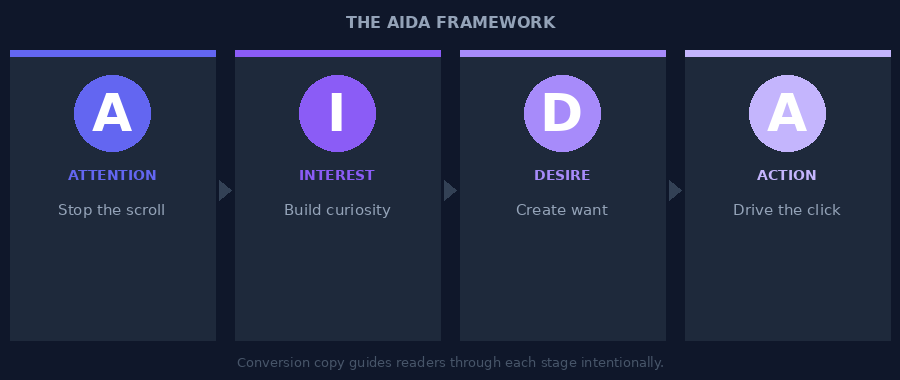
The AIDA framework: how great conversion copy moves readers from awareness to action.
AIDA stands for Attention, Interest, Desire, and Action. Let me walk you through what each stage means in practice.
- Attention: Your headline does this job. If the headline fails, nothing else matters. It has to stop the scroll and create a reason to keep reading.
- Interest: This is where you hook the reader into the subject. You raise questions they want answered. You build curiosity. You introduce a tension that pulls them forward.
- Desire: Here you shift from what this is to why they want it. Features tell. Benefits sell. Show the reader their life after using your product or service.
- Action: This is your call to action. One clear, specific, low-friction step. Not three options. Not vague instructions. One next move.
I use this framework for landing pages, email sequences, product descriptions, and even social media ads. It is the closest thing to a universal template in conversion copywriting.
The Key Elements of High-Converting Copy
Over the years I have noticed that the highest-converting pages share a handful of common elements. Here is what they all have.
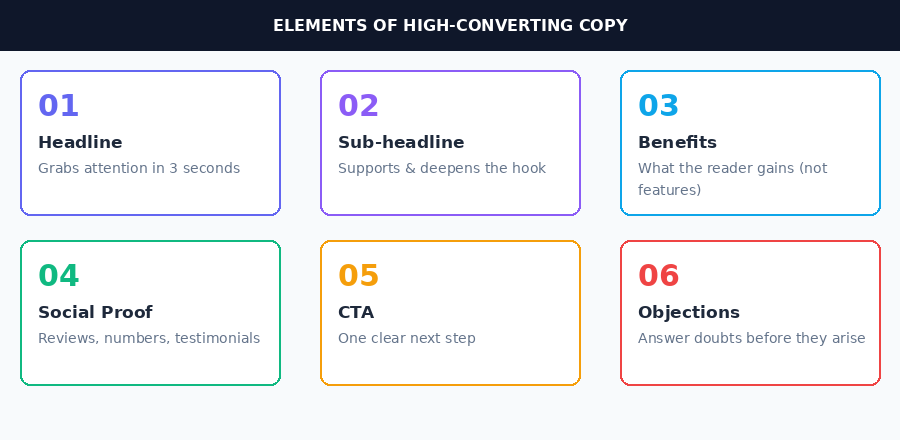
Six core elements that appear in almost every high-converting piece of copy.
A Headline That Does Heavy Lifting
Your headline is your first impression. Readers decide whether to keep going in about three seconds. A great conversion headline does one or more of these things. It promises a specific benefit. It creates urgency. It targets the exact reader. Or it raises a question the reader desperately wants answered.
Copy That Speaks to Benefits, Not Features
Features describe what something is. Benefits describe what it does for the reader. The classic example is a drill. The feature is a quarter-inch drill bit. The benefit is a quarter-inch hole. What the reader actually wants is a picture hung on their wall.
I train myself to ask one question after every feature I write. So what does this mean for the reader? The answer is usually the benefit.
Social Proof That Builds Instant Trust
Trust is the currency of conversion. People trust other people more than they trust brands. This is why testimonials, reviews, case study numbers, and client logos work so well.
When I write a landing page, I never leave social proof as an afterthought. I treat it as one of the most important sections on the page.
A Clear, Singular Call to Action
Every piece of conversion copy needs one clear CTA. One. Not three. Decision fatigue is real. When readers see multiple options, they often choose none.
The best CTAs are specific, action-oriented, and low-friction. ‘Start Your Free Trial’ beats ‘Submit’. ‘Get My Free Guide’ beats ‘Click Here’.
Objection Handling Built Into the Copy
Readers always have doubts. What if it does not work? Is it worth the price? What if I am locked into a contract? Good conversion copy anticipates these objections and addresses them before the reader has to ask.
Where Conversion Copywriting Gets Used
Conversion copywriting appears almost everywhere in digital marketing. Here are the most common places I write it.
- Landing pages and sales pages
- Email marketing campaigns and sequences
- Paid advertising (Google Ads, Meta Ads, LinkedIn)
- Product descriptions and e-commerce pages
- Homepage and website copy
- Opt-in forms and pop-up messages
- Video scripts for product demos or explainer videos
- Social media bios and posts with CTAs
- Webinar registration pages
- Checkout pages and upsell copy
Each of these placements has its own rules, length considerations, and reader expectations. But the underlying principles remain the same. Clarity. Psychology. Action.
5 Common Mistakes That Kill Conversions
I have made all of these mistakes. Learning to recognize them is what separates average copy from copy that actually converts.
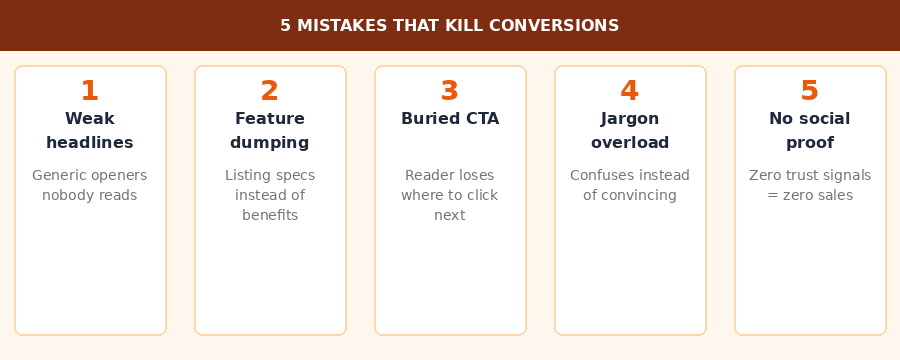
Common conversion copywriting mistakes to avoid at all stages of the writing process.
Mistake 1: Writing for Yourself Instead of the Reader
This is the most common trap. You fall in love with how something sounds instead of asking whether it speaks to the reader. Conversion copy is not about self-expression. It is about communication. If your copy makes you sound impressive but does not help the reader understand what is in it for them, it has failed.
Mistake 2: Using Too Much Jargon
I have worked with tech companies, healthcare brands, and financial services. Every industry has its jargon. And almost every client initially wants their copy full of it. I always push back.
The reader does not care about your technical vocabulary. They care about solving their problem. Simple language builds trust. Complex language creates friction.
Mistake 3: Burying the CTA
If the reader has to hunt for the next step, you have already lost them. CTAs should be visible, clear, and repeated throughout longer pages. Above the fold. In the middle. At the bottom. Do not make the reader work to convert.
Mistake 4: No Social Proof
Writing copy without social proof is like asking someone to trust a stranger. You need evidence. Numbers, testimonials, and authority signals are not optional extras. They are essential components.
Mistake 5: Weak or Generic Headlines
‘Welcome to our website.’ ‘We are a leading provider of…’ ‘Introducing our new product.’
These headlines have killed more conversions than any bad ad campaign. If your headline could apply to any business in your category, rewrite it. Specificity always beats generality.
How to Start Thinking Like a Conversion Copywriter
You do not need a course or a certification to start applying conversion copywriting principles. You need a shift in mindset.
Here is the framework I use before writing anything.
Step 1: Know Who You Are Writing For
Before a single word goes on the page, I need to understand the reader. Their biggest pain point. Their language. Their doubts. Their dream outcome. I collect this from customer reviews, support tickets, forums, and interviews.
Step 2: Know the One Action You Want Them to Take
Every piece of copy has one goal. Define it before you start writing. If you do not know what action you are guiding the reader toward, neither will they.
Step 3: Write the Headline Last
I know this sounds counterintuitive. But I write the body first, then come back to the headline. By the time I finish the piece, I know exactly what the core promise is. The headline becomes obvious.
Step 4: Read It Out Loud
If it sounds awkward when you read it aloud, it will feel awkward when someone reads it silently. Reading out loud catches clunky phrasing, run-on sentences, and moments where the logic breaks down.
Step 5: Test and Iterate
No conversion copy is perfect on the first draft. The best copywriters in the world run A/B tests constantly. Change one element at a time. Track what happens. Improve from the data.
Is Conversion Copywriting Worth Learning in 2025?
Absolutely yes. And here is why.
AI can generate text at scale. Content is cheaper to produce than ever. But most of what gets generated is generic, forgettable, and unconvincing.
The one thing AI consistently struggles with is genuine reader empathy. Understanding the specific emotional state of a real human at a precise moment in their buying journey. That is a human skill.
Marketers and writers who understand conversion copywriting at a strategic level will always have a seat at the table. Because at the end of the day, every business needs words that work.
AI can create content. But conversion copywriting requires understanding a real human at a specific moment. That is still a deeply human craft.
If you are in content marketing and you want to sharpen your skills, start by studying landing pages. Not just reading them. Dissecting them. Ask why each element is placed where it is. What psychology is it leveraging? What action is it moving toward?
That kind of analytical reading is how I developed most of what I know about conversion copywriting. Not from courses. From obsessive attention to copy that worked.
Wrapping Up: What Conversion Copywriting Taught Me
Looking back, learning conversion copywriting was the single biggest turning point in my writing career.
It gave me a way to measure my work. A framework for making decisions. And a clear answer to the question every client eventually asks. Will this actually drive results?
It is not a shortcut. It requires research, empathy, structured thinking, and a willingness to rewrite. But the payoff is real. Copy that converts is copy that earns.
Whether you are writing for a startup, managing a content marketing strategy for an enterprise brand, or freelancing, conversion copywriting is the skill that will make everything you write more valuable.
Start small. Pick one piece of copy you have written recently. Look at it through the lens of this article. What is the one action you want the reader to take? Is the headline specific and compelling? Does the copy speak to benefits? Is there social proof? Is the CTA clear?
Make those changes. Then measure what happens.
That is how you start.
Frequently Asked Questions
1. What is the difference between copywriting and conversion copywriting?
Regular copywriting covers a wide range of writing including brand storytelling, advertising, and content creation. Conversion copywriting is a specific type focused on prompting a defined action from the reader. It is measurable, strategic, and built around behavioral psychology. All conversion copywriting is copywriting, but not all copywriting is conversion copywriting.
2. Do I need to be a trained writer to learn conversion copywriting?
No. Conversion copywriting is a learnable skill. Many of the best conversion writers came from backgrounds in psychology, marketing, sales, or business rather than creative writing. What matters more than writing talent is the ability to understand your audience deeply, structure arguments logically, and test your work against real data.
3. How long should conversion copy be?
It depends entirely on the complexity of what you are selling and the awareness level of your audience. Short-form copy works for low-friction actions like ad clicks and opt-ins. Long-form copy is better suited for high-ticket products, unfamiliar solutions, or skeptical audiences. The rule I follow is this: make it as long as it needs to be and not one word longer.
4. Can conversion copywriting work for B2B brands?
Yes, absolutely. Many people assume conversion copywriting is only for e-commerce or consumer brands. In reality, B2B buyers are still human beings who respond to the same psychological principles. Clear value propositions, specific benefits, social proof, and direct calls to action work just as well in B2B contexts. The tone may be more professional, but the structure is the same.
5. How do I know if my conversion copy is actually working?
You measure it. The most important metrics depend on your goal. For landing pages, look at conversion rate, bounce rate, and time on page. For emails, track open rate and click-through rate. For ads, look at click-through rate and cost per conversion. Always run A/B tests when you make changes so you can isolate what is improving your results. Good conversion copy is never finished. It is always being refined.