I was editing a blog post for a client and something felt off. The tone was fine. The grammar was clean. The information was accurate. But it didn’t sound like the brand.
Then I realised why. Three different writers had contributed to that blog over the previous two months. Each one was good at their job. Each one had their own voice, their own preferences, their own instincts about what sounded right. And none of them had a shared reference point to work from.
The result was a content archive that felt like it had multiple personalities. Some posts used “utilise.” Others said “use.” Some opened with questions. Others opened with data. Some posts used the Oxford comma consistently. Others switched mid-article.
That was the day I started building my first content style guide. And it changed how I work completely.
- What is a content style guide?
- Why most teams skip it and why that is a mistake
- What goes inside a content style guide
- The voice and tone section deserves more time than you think
- What happens without one: the before and after
- How to build one from scratch
- The sections that trip people up most
- How to get your team to actually use it
- What a style guide is not
- Final thoughts
What is a content style guide?
A content style guide is a documented set of rules and guidelines that defines how your brand communicates in writing. It covers everything from grammar preferences and word choices to tone of voice and content structure.
The goal is consistency. When a reader moves from your blog to your email to your social media, the writing should feel like it comes from the same source. The same voice. The same values. The same standards.
Without a style guide, that consistency is purely accidental.
Why most teams skip it and why that is a mistake
I get why teams put this off. Building a style guide takes time. It feels abstract. And in the short term, content still gets published without one.
But the cost shows up later. I have seen it happen in teams of all sizes.
When a new writer joins, onboarding takes weeks longer than it should because there is no shared standard. Every piece needs heavier editing. Feedback becomes subjective rather than concrete. Writers feel like they are constantly guessing what the editor wants.
The editor, meanwhile, is making the same corrections on every draft. Changing “leverage” to “use.” Shortening sentences that are too long. Fixing capitalisation that varies post to post.
A style guide makes all of those corrections happen once, at the document level, instead of a hundred times across a hundred drafts. That is where the real time savings come from.
I once tracked how long I spent editing a month of content without a style guide versus with one. The difference was about 40 percent. Not because the writers got better. Because the decisions were already made.
What goes inside a content style guide
A good style guide does not try to cover everything. It covers the decisions that come up repeatedly and cause inconsistency when left unresolved.
In my experience, every solid guide needs at least these core sections.
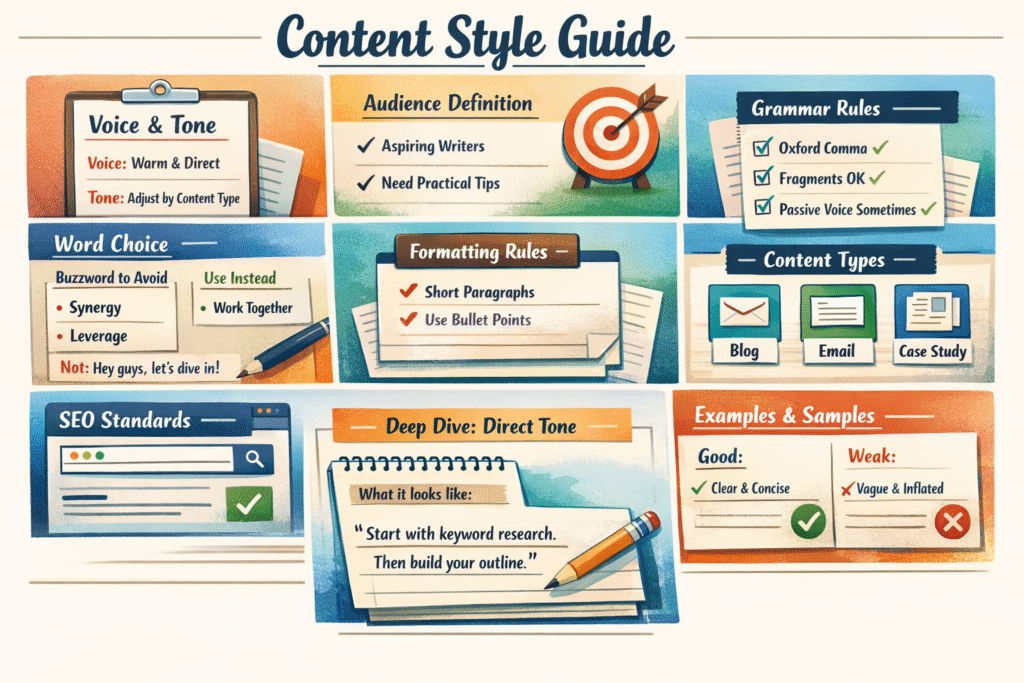
Voice and tone. This is the heart of the whole document. Voice is who you are as a brand. Tone is how you adjust that voice depending on context. A guide needs to define both. It should also give examples, not just adjectives. Saying your brand is “warm and direct” means nothing without a sentence that shows what warm and direct actually looks like on the page.
Audience definition. Every style guide should answer: who exactly are we writing for? Not in demographic terms, but in real-world terms. What do they already know? What do they need help understanding? How do they talk about the problems your content addresses? This shapes every other decision in the guide.
Grammar rules. These are the decisions that cause the most arguments in editing. Oxford comma or not. Sentence fragments: acceptable or not. Passive voice: always avoided or sometimes fine. Contractions: yes in blog posts, no in white papers? Document your decisions once and reference them forever.
Word choice. This section should include a list of words and phrases the brand avoids, and what to use instead. Every brand has its list. For some it is buzzwords like “synergy” and “leverage.” For others it is overly casual language that undercuts credibility. Write yours down.
Formatting rules. How long should paragraphs be? When should you use bullet points versus prose? What does the heading hierarchy look like? Should numbers under ten be spelled out? These decisions seem small until you are editing a piece where they are wrong in twelve different places.
Content types. Different formats need different treatment. A style guide should define the structural conventions for each content type the brand produces. Blog posts, emails, social captions, product descriptions and case studies all have their own rhythms. Capture those.
SEO standards. If your content is published online, your style guide needs a section on SEO conventions. Meta title format. Meta description length. How to handle keyword usage without stuffing. Internal linking guidance. These are not just good habits. They are standards every writer on your team should follow by default.
Examples and samples. This is the section most guides skip and it is the most important one. Real examples of approved copy, side-by-side comparisons of good and bad writing, and reference articles that represent the brand at its best. Rules without examples are just opinions. Examples make the rules real.
The voice and tone section deserves more time than you think
I have helped build style guides for brands ranging from fintech companies to lifestyle blogs. The voice and tone section is always where the most important work happens. And it is always the section that people want to rush through.
The mistake is treating voice as a list of personality adjectives. “We are friendly, professional, and approachable.” Okay. But what does that actually mean when a writer sits down to draft a 1,500-word article?
The way I approach it now is different. I pick three to five specific tone adjectives. Then for each one, I write three things: what it means, what it looks like in practice, and what it does not mean.
For example, if a brand is “direct,” that means getting to the point quickly and avoiding padding. It looks like short introductions, clear topic sentences, no filler phrases like “in today’s fast-paced world.” It does not mean being blunt or cutting context that genuinely helps the reader.
That level of specificity is what makes a style guide actually useful. It gives writers something they can apply, not just aspire to.
I also include a tone-by-content-type breakdown. The same brand writes differently in an email subject line than in a white paper. A style guide should acknowledge that and give writers permission to shift tone without losing voice.
What happens without one: the before and after
The difference a style guide makes is not always dramatic in any single piece. It shows up at scale, across a body of work, when you look at 30 articles instead of one.
I worked with a content team that had six writers and no style guide. When I audited their blog, I found five different ways they referred to their own product. Some posts used the formal product name. Some abbreviated it. Some used a nickname that had evolved internally. Some called it “the platform.” One post used all four in the same article.
That kind of inconsistency erodes trust. Not immediately and not obviously. But it signals to readers that the brand is not fully put together. It suggests a lack of internal coordination. And in competitive niches, that costs you.
After we built their style guide, that specific problem disappeared within two weeks. Every writer knew what to call the product. Every editor had a reference to point to. The argument was over.
How to build one from scratch
The most common mistake people make when building a style guide is trying to build a perfect one. They spend months deliberating over every rule, designing a beautiful document, debating edge cases. By the time it is done, the team has already developed new bad habits.
Here is the process that actually works.
Start with a content audit. Pull 20 to 30 pieces of existing content, ideally your best-performing ones. Read them back to back and note two things: what they have in common, and where they diverge. The common elements become your standards. The divergences become your decisions.
Write the audience profile first. Before any rules about grammar or tone, spend time defining exactly who you are writing for. Not demographics but real behaviour. What does your reader search for? What do they already know? What frustrates them about bad content in your niche? This section should be written in plain language, like a description of a real person.
Define voice before grammar. I always build the voice and tone section before anything else. Grammar rules exist to serve the voice, not the other way around. If you know you want to sound conversational and direct, your grammar decisions follow naturally. Shorter sentences. Contractions allowed. Active voice preferred.
Capture the decisions that keep coming up. The fastest way to build your grammar and word choice sections is to pay attention to your editing. For one month, every time you make a correction on a draft, log it. After four weeks, you have a list of your most common edits. Those are the decisions your guide needs to document.
Write real examples for every rule. This is non-negotiable. Every rule in your guide should have at least one example showing the rule applied correctly and ideally one showing what to avoid. Without examples, the rules are just your interpretation. With examples, they become shared standards.
Test it on real content before you call it done. Have one writer use only the guide to produce a full piece without any verbal guidance from you. Review the output. Every place the guide failed to give clear direction is a gap you need to fill. This process usually uncovers 20 to 30 percent more decisions that need documenting.
Release version one and commit to updating it. I call my first version “the working draft” deliberately. It signals that the document is live and functional but not finished. Style guides evolve. New content types emerge. Your brand voice shifts as you learn what resonates. Build a habit of reviewing and updating the guide every six months.
The sections that trip people up most
I want to be honest about the parts that are harder than they look.
The word list. Building a banned words list sounds simple until you realise how subjective it is. The word “leverage” might be banned in copy but fine in a technical white paper. Your guide needs to acknowledge those exceptions or writers will stop trusting it when they hit an edge case that the rules do not account for.
The tone in different contexts. Most guides say something like “we adjust our tone depending on the channel.” But they never define what that adjustment actually looks like. Your social media voice and your long-form essay voice should both be recognisably the same brand. Document where the differences are and why.
The boundary between rule and preference. Some things in a style guide are non-negotiable standards. Others are just preferences that can flex depending on the piece. If writers cannot tell the difference, they will either over-conform and lose their individual voice entirely, or under-conform and ignore the guide when it feels too restrictive. Be explicit about which rules are firm and which are guidance.
How to get your team to actually use it
Building a style guide and getting people to use it are two different problems.
I have seen carefully built guides sit in a shared drive for six months without being opened. That is not a content problem. It is a communication and workflow problem.
The guide needs to be part of the process, not a separate document writers consult occasionally. The practical way to do that is to make it impossible to start a piece of content without referencing it. Some teams add a checklist at the top of their content brief that references the guide directly. Others build key rules into their editorial template.
Onboarding is the other high-leverage moment. When a new writer joins, the style guide should be one of the first three things they read. Walk them through it. Ask them to edit an old piece using only the guide. Check how they interpreted it. That exercise almost always reveals gaps in the document and gives the new writer real ownership of the standards.
I also run a style guide review quarterly with any team I work with. Not to change things constantly but to add new decisions as they come up. If the same question comes up twice in an editing session, it belongs in the guide. When writers see their questions get answered by updates to the document, they trust it more and use it more.
What a style guide is not
Before I close this out, I want to clear up a common misunderstanding.
A style guide is not a creativity killer. I hear this concern every time I propose building one. Writers worry that documented rules will make their work feel formulaic.
The opposite is true. When the foundational decisions are already made, writers spend less mental energy on grammar debates and word choice anxiety. They spend more energy on ideas, structure, and argument. The rules free them up, not down.
A style guide is also not a substitute for good editing. It handles the repeatable decisions. The subjective judgments still need a human editor. What the guide does is raise the floor so that the editor is spending time on the things that genuinely require judgment, not correcting the same six mistakes on every draft.
And finally, a style guide is not finished. The moment you treat it as a completed document rather than a living one, it starts to become irrelevant. The best guides I have worked with are slightly messy, regularly updated, and clearly used. They have tracked changes, added notes, and crossed-out sections. That wear shows that people are actually reading them.
Final thoughts
I have built style guides from scratch, inherited ones that needed rebuilding, and worked with teams that resisted the whole concept.
The resistance almost always comes from the same place. Writers feel like rules constrain them. Editors feel like the guide will replace their judgment. And managers feel like it is a time investment that competes with publishing.
But after the first month of actually using one, the conversation changes. Editing gets faster. Onboarding gets cleaner. Content feels more cohesive. The arguments that used to eat meeting time just stop happening because there is a document to point to.
A content style guide is not glamorous work. Building one is slower and less visible than writing the next article. But it is the kind of work that makes everything else better, quietly and permanently.
Start with whatever you have. Audit your existing content. Write down the decisions you keep making. Give writers a reference point. Then update it as you learn.
That is all version one needs to be.