A Complete Guide for Beginners and Practitioners
I have been writing content for over a decade. And if there is one thing I have learned, it is this: people do not buy from brands they do not trust. They buy from brands they know. And content marketing is the most reliable way to build that trust.
When I first heard the term “content marketing,” I thought it was just another fancy phrase for blogging. I was wrong. Content marketing is a complete business strategy. It shapes how companies communicate, how they attract customers, and how they grow over time.
In this article, I want to break down everything you need to know about content marketing. I will explain what it is, why it works, how to build a strategy, and share real examples that will help you understand the concept clearly. Whether you are a small business owner, a startup founder, or a marketing professional, this guide is for you.
1. Content Marketing Definition
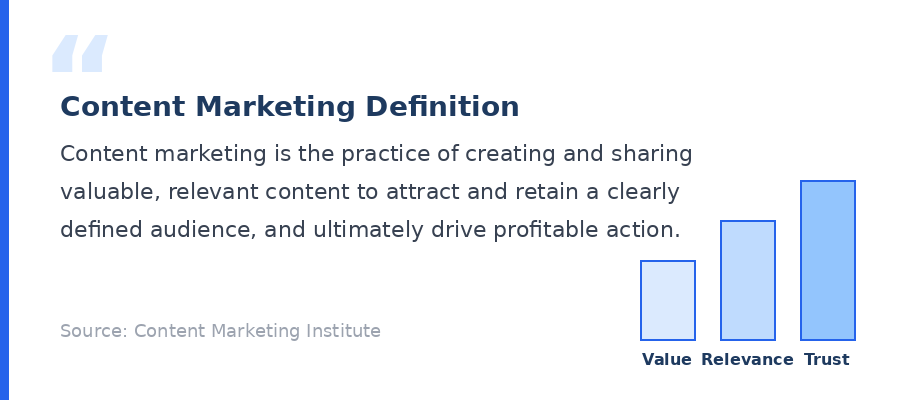
Content marketing builds trust through value
Let me start with the basics. The content marketing definition, as put forward by the Content Marketing Institute, is simple: it is the practice of creating and distributing valuable, relevant, and consistent content to attract and retain a clearly defined audience and ultimately to drive profitable customer action.
In plain language: instead of interrupting people with ads, you give them something useful. You help them solve a problem. You answer their questions. You educate them. And over time, they begin to trust you. When they are ready to buy, they come to you first.
That is the core idea. Content marketing is not about selling. It is about serving. The selling happens as a natural result of being genuinely helpful.
| Key InsightContent marketing works because it puts the audience first. When you solve someone’s problem before asking for anything in return, you earn their trust. That trust is the foundation of every sale. |
2. Why Content Marketing Matters
I have seen businesses spend thousands of dollars on paid ads every month. The moment they stop paying, the traffic stops. That is the fundamental weakness of traditional advertising. It is rented attention.
Content marketing, on the other hand, builds owned attention. A well-written blog post can drive traffic for years. A helpful video on YouTube can bring in new subscribers every single day without any additional investment. This is what makes content marketing one of the most powerful long-term strategies in digital marketing.
Here are some reasons why content marketing matters more than ever today:
- Consumers are smarter. They research before they buy. Content helps you show up during that research phase.
- Ad fatigue is real. People actively ignore or skip ads. But they actively seek out helpful content.
- Search engines reward quality. Google and other search engines prioritize content that genuinely helps users. Good content equals better rankings.
- Content compounds. Unlike a paid ad that stops the moment your budget runs out, content keeps delivering value over time.
- It builds community. Great content creates loyal readers, viewers, and followers who become brand ambassadors.
I remember working with a small software startup. They had almost no ad budget. Instead of running paid campaigns, they invested in a content-first strategy. Within 18 months, their blog was generating more qualified leads than their paid ads ever did. That experience changed how I think about marketing entirely.
3. Content Marketing vs Traditional Marketing
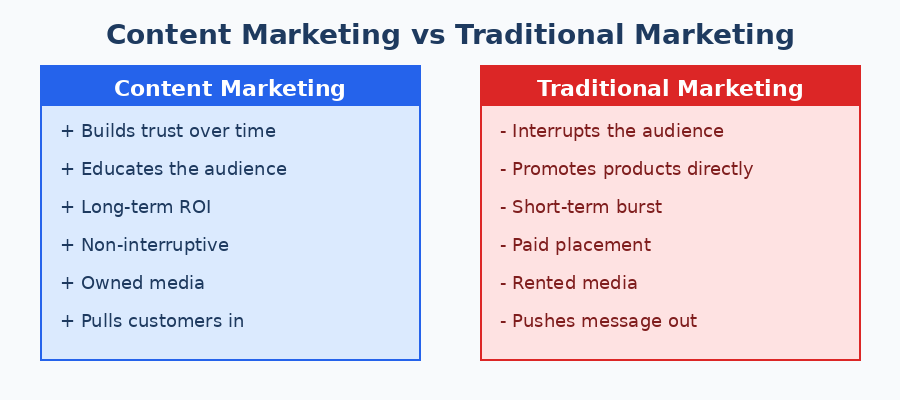
Content marketing pulls customers in; traditional marketing pushes messages out
One of the best ways to understand content marketing is to compare it with traditional marketing. Traditional marketing is interruptive. It pushes a message at you whether you want it or not. Think of TV commercials, cold calls, pop-up ads, and direct mail.
Content marketing is the opposite. It pulls people in by offering something they actually want: information, entertainment, or value. You are not chasing the customer. You are creating a reason for them to come to you.
Traditional Marketing
- Buys attention through ads
- Interrupts the audience
- Short-term results
- Focuses on the product
- Paid media dependent
Content Marketing
- Earns attention through value
- Invites the audience in
- Long-term compounding results
- Focuses on the audience’s needs
- Builds owned and earned media
I am not saying traditional marketing is dead. For certain goals, paid advertising works well. But for building a brand, establishing authority, and generating sustainable leads, content marketing delivers far superior results over time.
4. Types of Content Marketing
One thing that excited me early in my content marketing journey was realizing how many different formats existed. You are not limited to just writing articles. Digital content marketing spans a wide range of formats, each with its own strengths.
- 4.1 Blog Posts and Articles
- 4.2 Video Content
- 4.3 Infographics
- 4.4 Podcasts
- 4.5 Email Newsletters
- 4.6 Social Media Content
- 4.7 Case Studies and Whitepapers
- Step 1: Define Your Goals
- Step 2: Know Your Audience
- Step 3: Conduct Keyword and Topic Research
- Step 4: Create a Content Calendar
- Step 5: Create High-Quality Content
- Step 6: Distribute and Promote
- Step 7: Measure and Optimize
- HubSpot’s Blog and Free Tools
- Red Bull’s Media Empire
- Glossier’s Community-First Content
- Shopify’s Guides and Resources
- Content Management Systems (CMS)
- SEO and Analytics Tools
- Email Marketing Platforms
- Social Media Scheduling Tools
- AI-Assisted Content Creation
- Traffic Metrics
- Engagement Metrics
- Conversion Metrics
4.1 Blog Posts and Articles
This is where most people start, and for good reason. Blog posts are one of the most cost-effective forms of content marketing. They help you rank on search engines, establish authority in your niche, and give you shareable material for social media.
A well-written blog post answers a specific question your target audience is already asking. It provides real value and naturally leads readers toward your product or service. I have personally generated hundreds of leads for clients through nothing but consistent blog publishing.
4.2 Video Content
Video is arguably the most engaging format available today. Platforms like YouTube, Instagram, and TikTok have made video content accessible for everyone. A simple explainer video can communicate in two minutes what might take ten minutes to read.
The beauty of video is that it builds a personal connection. When your audience can see and hear you, trust builds faster. Many of the most successful brands today use video as the cornerstone of their digital content marketing strategy.
4.3 Infographics
Infographics are visual representations of data or information. They are extremely shareable and work well for explaining complex topics quickly. When I work with clients in technical industries, infographics often become their most-shared content pieces on social media.
4.4 Podcasts
Podcasting has exploded in the last few years. It is content marketing for people on the move. Listeners commute, exercise, and cook while tuning in to their favorite podcasts. For brands, podcasting is a way to reach a highly engaged audience with in-depth, conversational content.
4.5 Email Newsletters
Email marketing remains one of the highest-return channels in all of digital marketing. A well-crafted newsletter brings your best content directly to your audience’s inbox. It builds a direct line of communication that no algorithm can take away from you.
I always tell my clients: your email list is the one audience you truly own. Social platforms change their algorithms. Ad costs go up. But your email list is yours.
4.6 Social Media Content
Social media content marketing is about creating short, engaging pieces of content that fit naturally into the platforms where your audience spends time. This includes posts, stories, reels, threads, and more. Social media is great for building brand awareness and fostering real-time engagement.
4.7 Case Studies and Whitepapers
For B2B companies, case studies and whitepapers are extremely valuable. They demonstrate real-world results and provide deep-dive analysis on relevant topics. Decision-makers trust data and proof. Case studies give them exactly that.
5. Content Marketing Strategy: How to Build One
Having a strategy is what separates content marketing that works from content marketing that wastes time and money. Over the years, I have helped dozens of brands build their content marketing strategy from the ground up. Here is the framework I use.
Step 1: Define Your Goals
Before you create a single piece of content, you need to know what you want to achieve. Are you trying to grow website traffic? Generate leads? Build brand awareness? Retain existing customers?
Your goals will determine the type of content you create, the platforms you publish on, and how you measure success. I always start every strategy engagement by getting absolute clarity on this.
Step 2: Know Your Audience
This is the most important step in any content marketing strategy. You need to understand who you are creating content for. What problems do they have? What questions are they asking? What format do they prefer?
Build what marketers call a “buyer persona” or “audience profile.” This is a semi-fictional representation of your ideal customer based on research and data. The more specific you are, the more relevant your content will be.
Step 3: Conduct Keyword and Topic Research
For your content to be found online, it needs to match the words and phrases your audience is already searching for. This is where keyword research comes in. Use tools like Google Keyword Planner, Ahrefs, or SEMrush to find the topics and search terms relevant to your business.
I approach keyword research as a way to find the exact questions my audience is asking and then create content that answers those questions better than anyone else online.
Step 4: Create a Content Calendar
Consistency is one of the most critical factors in content marketing. A content calendar helps you plan what you will publish, when you will publish it, and on which platforms. It keeps you organized and prevents the all-too-common trap of publishing content in bursts followed by long gaps of silence.
Even a simple spreadsheet works well as a content calendar when you are just getting started.
Step 5: Create High-Quality Content
This is where the real work begins. Focus on creating content that is genuinely useful, well-researched, and clearly written. Do not write for search engines. Write for people. Search engines have become sophisticated enough to reward content that truly serves the reader.
I have a personal rule: if a piece of content does not make someone smarter, happier, or more capable, it does not get published.
Step 6: Distribute and Promote
Creating great content is only half the job. You also need to get it in front of the right people. Share your content on social media, include it in your email newsletter, repurpose it into different formats, and build backlinks from other websites.
The most successful content marketers spend as much time promoting content as creating it.
Step 7: Measure and Optimize
Use analytics tools to track how your content is performing. Key metrics to watch include organic traffic, time on page, bounce rate, email open rates, social shares, and most importantly, conversions.
Review your data regularly. Double down on what is working. Improve or retire what is not. Content marketing is an iterative process. The strategies that work best for you will emerge over time through testing and refinement.
6. Content Marketing Examples
Nothing clarifies a concept better than real-world examples. Let me share some content marketing examples that I find genuinely instructive.
HubSpot’s Blog and Free Tools
HubSpot built a billion-dollar company largely on the back of content marketing. Their blog publishes hundreds of in-depth articles every year on topics related to marketing, sales, and customer service. They also offer free tools like website graders and email signature generators. Every piece of content serves a purpose: to attract potential customers who eventually try HubSpot’s software.
Red Bull’s Media Empire
Red Bull does not just sell energy drinks. It produces world-class content around extreme sports, music, and adventure. Their YouTube channel has millions of subscribers. Their events are covered globally. They have built an entire media company around content. The product almost becomes secondary to the lifestyle they represent.
Glossier’s Community-First Content
Glossier, the beauty brand, built its entire brand through user-generated content and community engagement. They encouraged real customers to share their experiences, republished those stories, and built a loyal following before they even had a full product line. This is a perfect example of audience-first content marketing.
Shopify’s Guides and Resources
Shopify produces an enormous library of free educational content for entrepreneurs. Guides on starting a business, running an online store, and marketing products. All of it free, all of it valuable. This content attracts the exact people who are most likely to become Shopify customers.
What all these content marketing examples share is a commitment to genuinely serving the audience. The brands that do content marketing best are the ones that think like publishers, not advertisers.
7. Common Content Marketing Mistakes to Avoid
I have made my share of content marketing mistakes over the years. Here are the ones I see most often, and how to avoid them.
- Publishing without a strategy. Content without direction rarely achieves results. Always start with a clear goal and audience.
- Focusing on quantity over quality. Twenty mediocre blog posts will not outperform one exceptional one. Put your energy into depth and usefulness.
- Ignoring SEO. Great content that nobody finds is wasted effort. Learn the basics of search engine optimization and apply them to every piece you create.
- Not promoting your content. If you build it, they will not necessarily come. Share, distribute, and amplify every piece of content you publish.
- Giving up too soon. Content marketing is a long game. Most brands see significant results only after six to twelve months of consistent effort. Patience is essential.
- Failing to track results. If you are not measuring, you are guessing. Set clear KPIs and review them regularly.
8. Digital Content Marketing: The Role of Technology
Digital content marketing has been transformed by technology. Today, tools exist for every step of the content marketing process, from planning and creation to distribution and analytics.
Content Management Systems (CMS)
Platforms like WordPress, Webflow, and HubSpot CMS make it easy to publish and manage your content without needing technical expertise. A good CMS is the foundation of any digital content marketing operation.
SEO and Analytics Tools
Tools like Google Analytics, Google Search Console, Ahrefs, and SEMrush give you visibility into how your content is performing. They help you understand what is driving traffic, what keywords you rank for, and where there are opportunities to improve.
Email Marketing Platforms
Platforms like Mailchimp, ConvertKit, and ActiveCampaign let you build email lists, design newsletters, and automate content delivery. Email remains one of the most effective distribution channels in digital content marketing.
Social Media Scheduling Tools
Tools like Buffer, Hootsuite, and Sprout Social let you plan and schedule social media posts across multiple platforms. Consistent social media publishing is much easier when it is automated.
AI-Assisted Content Creation
Artificial intelligence tools are increasingly being used to support content creation. They can help with research, drafts, ideation, and editing. While AI does not replace the human insight and creativity that makes great content, it can significantly accelerate the process.
9. How to Measure Content Marketing Success
One of the questions I get asked most often is: how do I know if my content marketing is working? The answer depends on your goals, but here are the key metrics I track across most content strategies.
Traffic Metrics
- Organic traffic: visitors who find your content through search engines
- Direct traffic: people who come directly to your website
- Referral traffic: visitors from other websites linking to your content
Engagement Metrics
- Average time on page: how long people spend reading your content
- Pages per session: how many pages a visitor views in one visit
- Bounce rate: the percentage of visitors who leave after viewing only one page
- Social shares and comments: indicators of how resonant your content is
Conversion Metrics
- Lead generation: how many new leads your content produces
- Email sign-ups: growth of your subscriber list from content
- Sales attributed to content: direct revenue generated through content-driven journeys
When I review content performance with clients, I always focus on conversion metrics above all else. Traffic is nice. Engagement is valuable. But revenue is the real measure of success.
10. Getting Started with Content Marketing
If you are new to content marketing, the volume of information out there can feel overwhelming. Here is my honest advice based on years of experience: start simple and stay consistent.
You do not need a massive team or a huge budget to do content marketing well. Some of the most effective content marketing strategies I have seen were built by solo founders with nothing more than a laptop and a genuine desire to help their audience.
Start with one platform. Pick the format that suits you best, whether that is writing, video, or audio. Commit to a publishing schedule you can realistically maintain. Focus relentlessly on creating content that genuinely helps your audience. Track your results. Learn. Improve. Repeat.
Over time, you will build a body of content that drives consistent traffic, builds meaningful trust, and generates real business results. That is the promise of content marketing. And in my experience, it always delivers for those who are willing to see it through.
Frequently Asked Questions (FAQs)
1. What is the difference between content marketing and social media marketing?
Content marketing is a broad strategy that involves creating and distributing valuable content across multiple channels, including blogs, videos, email, podcasts, and more. Social media marketing is one channel within that broader strategy. You use social media to distribute and amplify your content, but content marketing includes everything from your blog to your email newsletter to your YouTube channel.
2. How long does it take to see results from content marketing?
Content marketing is a long-term strategy. Most businesses start to see meaningful results after 6 to 12 months of consistent effort. SEO-driven content can take 3 to 6 months to rank on search engines. However, the results are cumulative. Content you publish today can continue to drive traffic and generate leads for years. The key is to stay consistent and trust the process.
3. How much does content marketing cost?
The cost of content marketing varies widely depending on your goals and approach. At a minimum, it requires your time. If you are creating content yourself, the cost can be very low. If you hire writers, videographers, or a content agency, costs will increase. However, compared to paid advertising, content marketing typically delivers a much higher return on investment over the long term because the results continue to build over time rather than stopping when you stop paying.
4. Can small businesses benefit from content marketing?
Absolutely. In fact, content marketing is one of the most powerful tools available to small businesses precisely because it levels the playing field. A small business with deep expertise in its field can create content that outperforms much larger competitors. You do not need a big budget. You need a genuine desire to help your audience and the consistency to keep showing up with valuable content.
5. What is the most important element of a content marketing strategy?
Knowing your audience. Everything else, including the format you choose, the platforms you publish on, and the topics you cover, flows from a deep understanding of who you are trying to serve. When you truly know your audience, their problems, their language, and their goals, creating content that resonates becomes much easier and your results will be far stronger.