Writing content that speaks directly to your buyer persona is the difference between content that converts and content that gets ignored.
I have written thousands of pieces of content in my career. Blog posts, landing pages, email sequences, whitepapers, social media copy. And the single biggest lesson I have learned is this: writing for everyone means reaching no one.
When I first started out, I thought good writing was good writing. Clear sentences. Strong verbs. No fluff. That was enough, right?
It was not.
I kept seeing the same pattern. A piece I wrote for one client would get incredible engagement. A very similar piece for another client would fall flat. Same quality. Same effort. Completely different results.
The difference was not the writing itself. It was who the writing was aimed at.
That is when I started taking buyer personas seriously. Not as a marketing buzzword. Not as a checkbox in a content brief. But as the actual foundation of every single piece of content I produce.
In this article, I am going to walk you through exactly how I approach writing content for different buyer personas. You will see real buyer persona examples, understand how to shift your tone and language for different readers, and leave with a system you can actually use.
- What Is a Buyer Persona and Why Does It Change Everything?
- Why Most Content Fails to Connect With the Right Reader
- Buyer Persona Examples: The Four Types I Write For Most Often
- How to Tailor Your Target Audience Content: My Step-by-Step Approach
- The Language Shifts That Make Persona-Based Writing Work
- Common Mistakes I See Writers Make With Buyer Personas
- Building a Persona-Content Matrix to Stay Consistent
- How I Use This When Writing Across Multiple Channels
- Frequently Asked Questions
What Is a Buyer Persona and Why Does It Change Everything?
A buyer persona is a semi-fictional profile of your ideal customer. It is built from real data and educated assumptions about who that person is, what they care about, and how they make decisions.
But here is the thing. Most people treat buyer personas like a one-time exercise. They fill out a template, give the persona a made-up name like “Marketing Mary” or “Executive Eric,” and then forget about it.
That is not how I use them. I treat each persona as a living, breathing reader sitting across from me as I write. Every word I put on the page has to serve that specific reader.
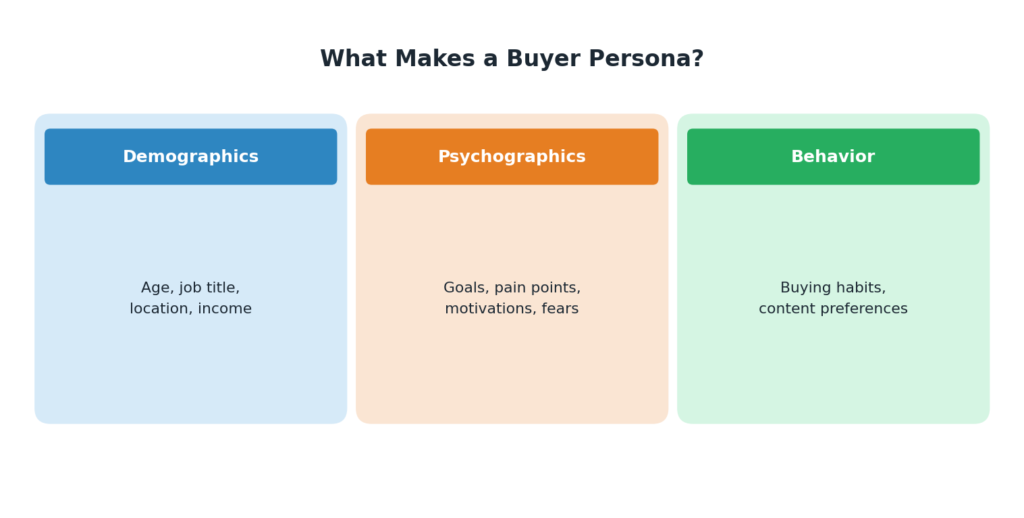
The three core pillars of a well-built buyer persona: who they are, what drives them, and how they behave.
A useful buyer persona captures three layers of information. The first is demographics. This is the surface level. Age, job title, industry, income bracket, location. It tells you who they are in a practical sense.
The second layer is psychographics. This is where things get interesting. What keeps them up at night? What goals are they chasing? What do they fear getting wrong? This layer tells you what they care about.
The third layer is behavior. How do they consume content? Do they read long articles or do they skim? Do they trust experts or do they prefer peer recommendations? This tells you how to reach them.
When you understand all three layers, you stop writing content and start writing conversations. That shift changes everything about your results.
Why Most Content Fails to Connect With the Right Reader
Before we get into the tactics, I want to explain something I see constantly. Most content fails not because the writing is bad. It fails because the writer made assumptions about who they were writing for.
They assumed the reader had the same background. The same vocabulary. The same urgency. The same level of trust in the brand.
None of those assumptions are safe to make.
A senior decision-maker reading your content wants numbers, outcomes, and proof. A junior analyst reading the same content wants to understand concepts and learn. A long-time customer wants to deepen their relationship with your brand. A first-time visitor wants to know if you can even be trusted.
Writing one piece that tries to serve all of these readers equally will serve none of them well. That is the trap. And it is easy to fall into because it feels efficient.
The truth is that targeted content, written for a specific buyer persona, always outperforms generic content. Not just by a little. By a lot.
Buyer Persona Examples: The Four Types I Write For Most Often
Over the years, I have noticed that most audiences fall into a handful of recognizable types. These buyer persona examples are broad, but they are grounded in real behavioral patterns I have seen across dozens of industries and client projects.
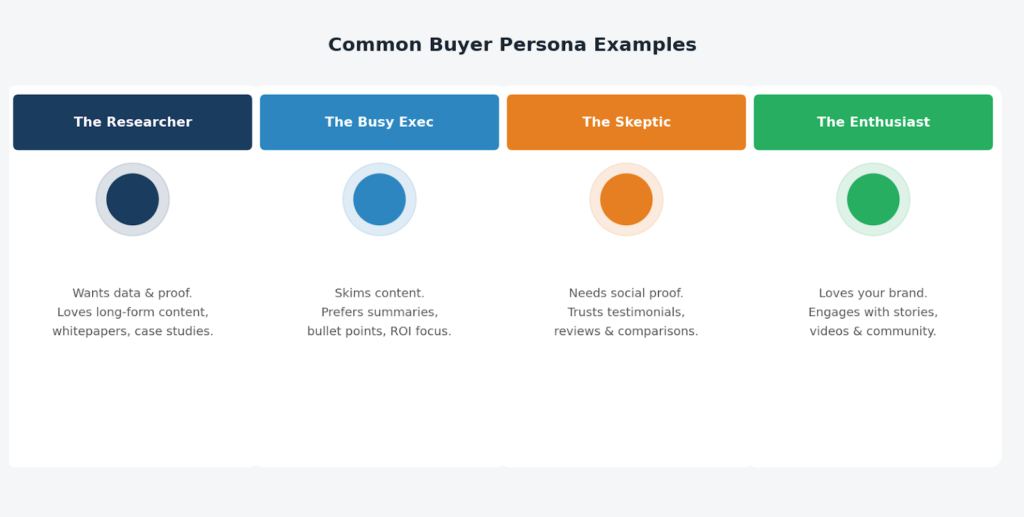
Four common buyer persona examples and the content styles that resonate with each one.
The Researcher
This persona wants to know everything before they make a decision. They are detail-oriented, skeptical of marketing speak, and hungry for evidence. They will read a 3,000-word article and still click to the next one.
When I write for Researchers, I go deep. I include data, cite sources, and give them frameworks they can take away and apply. I never oversimplify. I never cut corners on accuracy. They will notice.
Content formats that work best for Researchers include in-depth blog posts, whitepapers, case studies, and comparison articles. They want to feel like they did their homework before making a choice.
The Busy Executive
This persona has no time. They are skimming your content between meetings. They want the answer, the business impact, and the recommended action. They do not want your backstory.
When I write for Busy Executives, I put the most important information first. I use short paragraphs, bold key phrases, and avoid any kind of preamble. The headline has to do most of the work.
Content formats that work here include executive summaries, short-form emails, one-page briefs, and ROI-focused landing pages. If the point is not in the first three sentences, it is gone.
The Skeptic
This persona has been burned before. Maybe by a competitor. Maybe by a product that overpromised. They are careful, they ask hard questions, and they are very sensitive to anything that smells like sales pressure.
When I write for Skeptics, I lead with empathy. I acknowledge the doubt. I do not pretend the problem does not exist. Then I let proof do the heavy lifting. Customer testimonials, third-party reviews, before-and-after results. Nothing I say about myself matters as much as what others say about me.
Content formats that work for Skeptics include comparison guides, review roundups, detailed FAQ pages, and case studies that focus on measurable results rather than feel-good stories.
The Enthusiast
This persona already loves what you do. They are engaged, they follow you on social media, and they get excited about new releases. They want to feel like an insider.
When I write for Enthusiasts, I lean into warmth and community. I can be more casual. I can reference shared experiences. I can reward their loyalty with early access, behind-the-scenes content, or exclusive insights.
Content formats that work here include email newsletters, community posts, brand storytelling, and interactive content like polls, quizzes, and Q&A sessions.
How to Tailor Your Target Audience Content: My Step-by-Step Approach
Now let me show you the actual process I follow when I sit down to write for a specific buyer persona. This is not theoretical. I use this on every project.
A five-step process for creating content that speaks directly to your target audience.
Step 1: Define the Persona Before You Write a Single Word
I never start writing without a clear persona brief in front of me. At minimum, I need to know the job title, the main goal this person is trying to achieve, the biggest obstacle in their way, and how they typically consume content.
If a client cannot give me that information, I do a short discovery session before I write anything. Skipping this step is what causes most of the mediocre content that clutters the internet.
Step 2: Map the Persona to a Stage in Their Journey
The same persona needs different content depending on where they are in their journey. A Researcher at the awareness stage needs educational content. The same Researcher at the decision stage needs detailed comparisons and proof.
I always ask: does this person know they have a problem? Do they know a solution exists? Are they comparing options? Or are they ready to act? The answer shapes everything from the headline to the call to action.
Step 3: Choose the Right Format for That Persona and Stage
Format is not just aesthetic. It is a communication decision. Long-form works for deep-thinkers at the awareness stage. Short, punchy copy works for decision-stage executives. Visual explainers work for visual learners who are just getting started.
I match the format to the persona and the journey stage together. Not separately.
Step 4: Adjust Tone and Language to Match the Reader
Tone is the voice I use. Language is the words I choose. Both have to match the reader, not my preferences.
I might be a naturally conversational writer. But when I am writing for a regulatory compliance officer at a healthcare company, I dial it back. I am still clear. I am still readable. But I am more precise, more formal, and more careful with every claim I make.
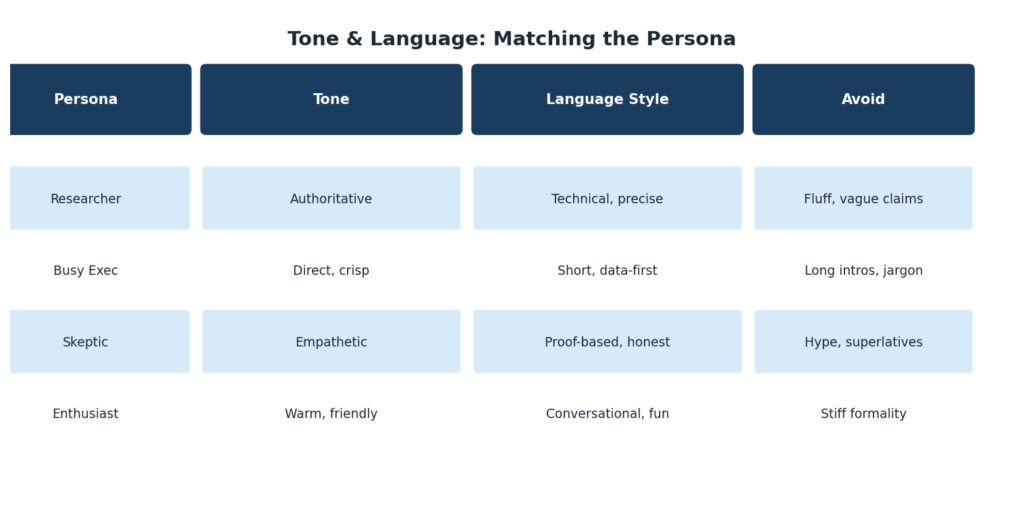
Matching tone and language style to each buyer persona prevents misalignment and increases trust.
Step 5: Measure What Actually Lands and Refine
After publishing, I look at the data. Not just traffic. Engagement metrics. Time on page. Scroll depth. Click-through rate on the call to action. Comments. Social shares.
If a piece underperforms, I go back and audit it against the persona. Nine times out of ten, I find that somewhere along the way, I slipped out of that persona and started writing for myself.
The Language Shifts That Make Persona-Based Writing Work
One of the most practical skills I have developed is the ability to shift my language based on who I am writing for. This is not about dumbing things down or dressing them up. It is about speaking the reader’s actual language.
Here is how I think about it in practice.
- With Researchers, I use precise vocabulary. I do not fear technical terms when they are accurate. I write longer sentences when complexity demands it. I back every claim with a source or a reasoned explanation.
- With Busy Executives, I cut ruthlessly. No sentence survives unless it earns its place. I use the active voice. I lead with the outcome, not the process. I answer “so what?” before they even ask it.
- With Skeptics, I avoid hyperbole at all costs. Words like “revolutionary,” “game-changing,” or “best-in-class” trigger their alarm bells. I use measured language. I let facts and customer voices do the persuading.
- With Enthusiasts, I am allowed to be playful. I can use insider language. I can reference shared history. I can be a little more experimental with structure because this reader trusts me enough to come along for the ride.
The best persona-based writers are not the ones with the biggest vocabulary. They are the ones who know which words to use for which reader, and when to use them.
Common Mistakes I See Writers Make With Buyer Personas
Even experienced writers get this wrong. I have made all of these mistakes myself at some point.
Writing for the Persona You Wish You Had
Sometimes a client will describe their ideal customer in aspirational terms. “We want to reach C-suite executives.” But the actual audience engaging with their content is mid-level managers. Writing for the C-suite when your real readers are managers creates content that misses everyone.
I always validate the persona against actual data before writing for it. Website analytics, customer interviews, sales call recordings. The real audience is always in the data.
Forgetting That One Persona Can Have Multiple Segments
Not all Researchers are the same. A technical Researcher at a startup has very different needs than a technical Researcher at a Fortune 500 company. The same persona can have sub-segments, and sometimes those sub-segments need their own content.
I watch for moments when content feels like it is trying to serve too many slightly-different readers at once. That is usually a sign that one persona has splintered into two.
Letting Your Own Voice Overpower the Persona
This is the most common mistake I see among writers who are also strong brand voices. Their writing is great, but it is always theirs. The persona gets lost inside the writer’s style.
I keep a simple checklist taped near my desk. Every time I finish a draft, I read it back and ask: “Is this how my persona thinks, or is this how I think?” If the answer is the latter, I revise.
Building a Persona-Content Matrix to Stay Consistent
One of the most useful systems I have developed over the years is what I call a persona-content matrix. It is simple. On one axis, I list my buyer personas. On the other, I list content formats and funnel stages.
Each cell in the matrix answers: what content does this persona need at this stage of their journey? What tone does it use? What question does it answer?
This matrix becomes the editorial backbone for every content strategy I build. It stops content from being created on gut feel and gives the whole team a shared language for discussing what to create and why.
You do not need fancy software to build it. A spreadsheet works fine. The goal is not complexity. The goal is alignment. Every piece of content should be able to point back to a specific persona at a specific stage.
A persona-content matrix takes about two hours to build. It saves hundreds of hours of misaligned content over the course of a year. I have never met a content team that regretted making one.
How I Use This When Writing Across Multiple Channels
Persona-based writing is not just for blog posts. I apply the same principles across every channel I write for.
Email Marketing
Email is where persona-based writing pays off the most. The subject line, the preview text, the opening sentence, and the call to action all have to speak directly to one reader. When I write email sequences, I often write separate tracks for different personas. The Researcher gets a value-dense sequence with links to deep content. The Busy Executive gets a three-sentence summary with one clear next step.
Social Media
Social content lives or dies based on how well it matches the platform and the persona that inhabits it. LinkedIn audiences skew toward professionals who want to look smart and informed. They respond to insight, data, and nuanced takes. A Skeptic persona on LinkedIn needs proof before engagement. An Enthusiast persona is more likely to share and comment on the same platform.
Landing Pages
A landing page written for a Researcher needs a long-form structure with multiple sections, objection handling, and detailed proof. A landing page written for a Busy Executive needs a bold headline, three bullet points, and a large call-to-action button. I have tested both approaches. The persona-matched version almost always wins.
Video Scripts
Even when I am writing scripts for video, I am thinking about the persona. Pacing, vocabulary, whether to use a talking head or a screencast, whether to include captions, whether the tone should feel like a lecture or a conversation. All of these decisions trace back to who is watching.
Frequently Asked Questions
1. How many buyer personas should I create for my content strategy?
In my experience, three to five personas is the right range for most businesses. Fewer than three and you are probably being too broad. More than five and you risk creating so many variations that your content team struggles to stay consistent. Start with the personas that represent your highest-value customers and your largest segments, then add more as your strategy matures.
2. What is the difference between a buyer persona and a target audience?
Target audience content is written for a broad group of people who share common characteristics. A buyer persona is a specific, detailed profile within that audience. Think of your target audience as the whole pond and your buyer personas as the individual fish you are trying to catch. The target audience gives you boundaries. The persona gives you depth.
3. How do I know if my content is actually matching the persona I intended?
I use a few signals. First, I look at qualitative feedback. Are the comments, replies, and customer conversations using the same language I used in the content? That is a sign of resonance. Second, I look at engagement metrics relative to other pieces. Third, I audit the piece against the persona brief. Does every section speak to the persona’s goals and pain points, or did I drift somewhere in the middle?
4. Can I write one piece of content that serves multiple buyer personas?
Yes, but with care. The way I approach this is to write for the primary persona and then make sure the content does not actively exclude the secondary persona. I think of it as designing for one reader while remaining accessible to others. The mistake is writing for two personas equally. That usually means you have written for neither of them fully.
5. How often should I update my buyer personas?
I recommend revisiting personas at least once every six months, and immediately after any significant shift in your market, product, or customer base. Personas are built on data and assumptions. Both of those things change. A persona you built two or three years ago might no longer reflect who is actually reading and buying from you. Regular audits keep your content strategy grounded in reality rather than outdated assumptions.
Final Thoughts
Writing for different buyer personas is not about being a different writer for every audience. It is about being a more aware one.
The core skills stay the same. Clarity. Structure. Strong sentences. Specific details. But the application of those skills shifts depending on who is reading, what they need, and where they are in their journey.
The writers who figure this out early do not just produce better content. They build better relationships with their readers. They earn trust faster. They convert more effectively. And they stop writing content that disappears into the void.
Start with one persona. Build a clear picture of who that person is, what they want, and how they think. Then write one piece of content entirely for them. Not for your boss. Not for the algorithm. For that one specific reader.
See what happens. I think you will be surprised.