How does article writing differ from blog writing?
If you spend any time online reading content, you have probably come across both articles and blogs.
At first glance, they may look similar because both are written pieces published on websites, magazines, or platforms.
However, the difference between an article and a blog goes deeper than just where they appear.

I often see many beginners in content writing confuse these two terms.
When I first started learning about digital publishing, I also assumed that an article and a blog post were basically the same thing. Over time, I realized that while they share some similarities, their purpose, tone, structure, and writing style can be quite different.
In this guide, I will explain the article vs blog debate in a clear and practical way. By the end of this article, you will understand what each format means, how they differ, and when to use one over the other.
What Is an Article?
An article is a piece of writing, usually nonfiction, that focuses on a specific topic and presents information in a clear, structured, and informative way.
Articles are commonly published in:
- Newspapers
- Magazines
- Academic journals
- Professional publications
- News websites
- Educational platforms
The main goal of an article is usually to inform, educate, or report. Because of this, articles tend to follow a more formal and objective writing style.
When I write an article, I usually focus on delivering accurate information backed by research, facts, and expert insights. The tone is often neutral because the purpose is to provide readers with reliable knowledge rather than personal opinions.
Key Characteristics of an Article
Here are some common characteristics I usually associate with articles:
1. Informational Purpose
Most articles are written to explain something, report on a topic, or provide in-depth knowledge.
2. Formal Tone
Articles generally use professional language and avoid overly casual expressions.
3. Structured Format
Many articles follow a clear structure, such as:
- Introduction
- Background information
- Detailed explanation
- Evidence or examples
- Conclusion
Journalistic articles sometimes follow the inverted pyramid style, where the most important information appears first.
4. Evidence-Based Writing
Articles often rely on:
- Statistics
- Expert quotes
- Research studies
- Verified sources
This makes them more authoritative and trustworthy.
5. Professional Authorship
Articles are often written by:
- Journalists
- Subject matter experts
- Researchers
- Professional writers
Because of their credibility requirements, many publications carefully review articles before publishing them.
Example of an Article
Some common examples of articles include:
- A newspaper report about climate change
- A magazine article about productivity
- A research article in an academic journal
- An educational article explaining technical writing
These pieces are designed primarily to deliver valuable information to readers.
What Is a Blog?
A blog (short for “weblog”) is a type of website or online platform where content is published regularly in the form of posts.
Unlike traditional articles, blog posts are usually more personal, conversational, and flexible in style. Blogs are often managed by individuals, businesses, or small teams who want to share ideas, experiences, or insights with their audience.
When I write a blog post, I usually imagine I am talking directly to the reader. This allows the writing style to feel more relaxed and engaging.
Blogs can cover almost any topic, including:
- Personal experiences
- Tutorials and how-to guides
- Industry insights
- Product reviews
- Opinions and commentary
- Educational content
Because blogs are part of websites, they are often updated frequently and consistently.
Key Characteristics of a Blog
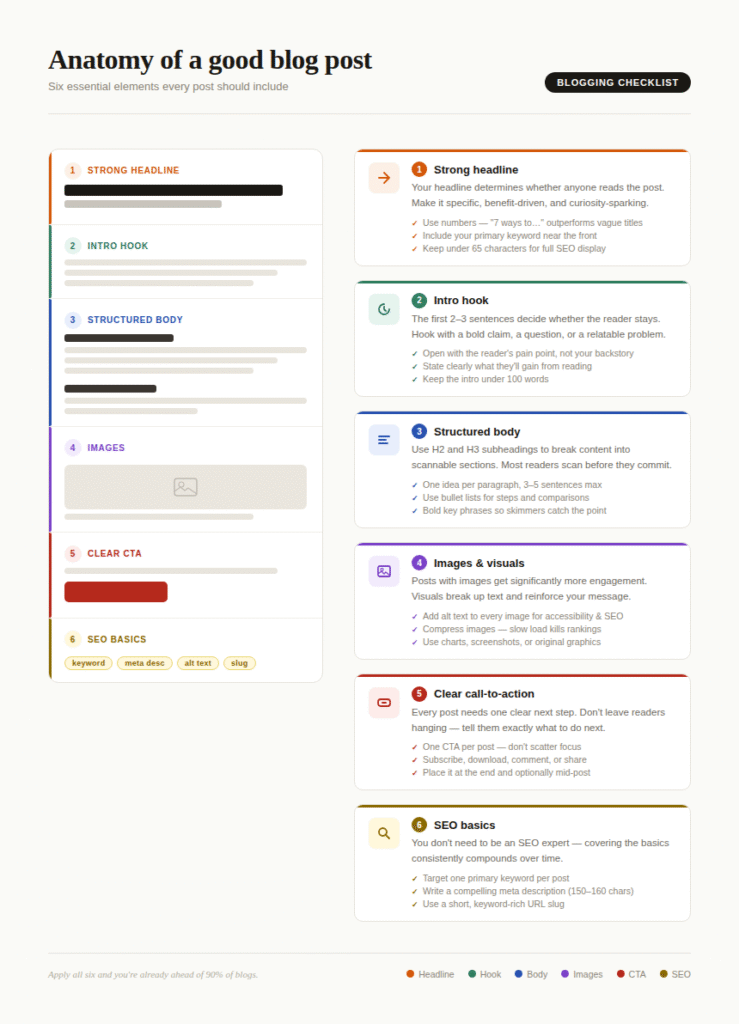
Here are the features that I commonly see in blog posts:
1. Conversational Tone
Blog posts usually sound more natural and friendly. Writers often use first-person language like “I,” “we,” or “you.”
2. Flexible Structure
Unlike traditional articles, blogs can take many forms such as:
- Lists
- Tutorials
- Opinion pieces
- Stories
- Guides
There is more freedom in how the content is organized.
3. Regular Publishing
Blogs are typically updated frequently. Many websites publish blog posts weekly or even daily.
4. Personal Voice
One thing I enjoy about blogging is that it allows writers to show their personality and perspective.
5. Reader Interaction
Most blogs allow readers to:
- Leave comments
- Share posts on social media
- Engage in discussions
This interaction helps build a community around the content.
Example of a Blog Post
Some examples of blog posts include:
- A travel blogger sharing their trip experience
- A marketing blog explaining SEO tips
- A writer discussing productivity techniques
- A company blog sharing industry insights
Blog posts are designed not just to inform but also to connect with readers.
Article vs Blog: Key Differences
Although both articles and blogs provide information, their purpose and approach are quite different. Below is a clear comparison to help understand the differences.
Purpose
Articles are typically written to inform, educate, or report facts.
Blogs often aim to share opinions, experiences, or insights while engaging readers.
Tone
Articles usually use a formal and objective tone.
Blogs often use a casual, conversational tone.
Length
Articles are often longer and more detailed.
Blog posts can range widely in length, from short posts to long guides.
Structure
Articles usually follow a structured format similar to journalistic or academic writing.
Blogs allow more flexibility in structure, including lists, storytelling, or tutorials.
Evidence and Sources
Articles rely heavily on research, statistics, and verified sources.
Blogs may include research but can also rely on personal experience or opinion.
Author Identity
Articles are often written by journalists, experts, or professional writers.
Blogs are usually written by individual creators, bloggers, or company teams.
Publishing Platforms
Articles are commonly published in newspapers, magazines, journals, and news websites.
Blogs appear on personal websites, company blogs, and blogging platforms.
Frequency of Publishing
Articles are usually published less frequently.
Blogs are typically published more regularly.
Reader Interaction
Articles traditionally have limited reader interaction.
Blogs encourage comments, discussions, and social sharing.
Similarities Between Articles and Blogs
Despite their differences, articles and blogs share several similarities.
Both Provide Information
Whether it is an article or a blog post, the main goal is often to deliver useful content to readers.
Both Can Be Published Online
In today’s digital world, both articles and blog posts commonly appear on websites.
Many online publications blur the line between the two formats.
Both Can Be Optimized for SEO
Search engine optimization (SEO) is important for both articles and blogs. Writers often include:
- Keywords
- Clear headings
- Internal links
- Engaging content
This helps content rank better in search results.
Both Can Use Visual Elements
Both formats may include:
- Images
- Charts
- Infographics
- Videos
Visual elements improve readability and help explain complex ideas.
When Should You Write an Article?
In my experience, writing an article is a better choice when the goal is to provide authoritative, well-researched information.
You might choose to write an article when:
- Explaining a complex topic
- Reporting news or events
- Publishing research findings
- Writing for magazines or professional publications
Articles work well when credibility and structured information are important.
When Should You Write a Blog Post?
A blog post is usually the better option when the goal is to engage readers, share ideas, or build an online presence.
You might write a blog post when:
- Sharing personal insights
- Teaching a skill through tutorials
- Writing opinion pieces
- Creating regular website content
Blogs are especially useful for building an audience and maintaining consistent communication.
Article vs Blog in Modern Content Marketing
Interestingly, the line between article vs blog has become less clear in modern digital publishing.
Many websites publish blog posts that look like articles, especially long-form educational guides.
For example, a blog post about content writing might:
- Include research
- Use structured headings
- Provide detailed explanations
At the same time, it still appears on a blog page and uses a conversational tone.
This hybrid format is very common in content marketing and SEO writing.
As a result, the difference between an article and a blog often depends more on style and purpose than strict rules.
Why Understanding Article vs Blog Matters
Understanding the difference between article vs blog is important for writers, marketers, and website owners.
Here are a few reasons why it matters.
Choosing the Right Format
Knowing the differences helps writers choose the right format for their goals.
Improving Content Strategy
Businesses often use blogs to attract traffic and articles to build authority.
Writing for the Right Audience
Different audiences expect different writing styles.
For example:
- Professionals may prefer formal articles.
- Online readers may prefer conversational blog posts.
Developing Writing Skills
Learning both styles helps writers become more versatile.
I personally believe that mastering both article writing and blog writing makes a writer much more adaptable in the digital content world.
Frequently Asked Questions
1. What is the main difference between an article and a blog?
The main difference between article vs blog is their purpose and tone. Articles usually focus on delivering researched, factual information in a formal style, while blogs often share opinions, experiences, or insights in a conversational style.
2. What is the typical length of an article vs a blog post?
Articles are often longer and more detailed, usually starting around 500 words and sometimes exceeding several thousand words. Blog posts can range from short pieces of around 300 words to long-form guides of 2000 words or more.
3. Who writes articles and blogs?
Articles are often written by journalists, researchers, or subject matter experts. Blogs are usually written by individuals, bloggers, content creators, or company teams.
4. Where can I find articles and blogs?
Articles can be found in newspapers, magazines, journals, and professional websites. Blogs are commonly found on personal websites, company blogs, and blogging platforms.
5. How can I tell if something is an article or a blog?
You can often identify the difference by looking at the tone, structure, and purpose. Articles tend to be more formal and research-focused, while blogs usually have a conversational style and may include personal insights.
Final Thoughts
The debate around article vs blog is common among writers and content creators, but the distinction becomes easier to understand once you look at their purpose and writing style.
Articles are typically formal, structured, and research-driven, while blogs are conversational, flexible, and often personal.
In modern digital publishing, the lines between the two formats often overlap. Many blog posts now include in-depth research, while some articles adopt a more engaging tone.
From my perspective, both formats are valuable tools for writers. Understanding how they work allows you to choose the right approach depending on your goals, audience, and platform.
Whether you are writing an informative article or an engaging blog post, the most important thing is to deliver valuable content that helps your readers learn something new.