I have spent over a decade working with content writing services, both as a buyer and as someone who has hired dozens of freelance writers for clients across different industries.
In that time, I have made expensive mistakes. I have also discovered what actually works. This guide is the resource I wish I had when I started.
Whether you are a business owner trying to scale your blog, a marketer looking for a reliable content partner, or a freelance writer trying to figure out what to charge, I have covered every angle here. I will walk you through how these services work, what to look for, how much to budget, and which red flags to avoid.
Content writing services are not one-size-fits-all. The best service for your needs depends on your goals, your budget, and the type of content you need.
What Are Content Writing Services?
Content writing services are businesses or platforms that connect you with professional writers who create written content on your behalf.
They cover a wide range of formats. Think blog posts, website copy, email campaigns, social media captions, white papers, product descriptions, press releases, and more.
The service model varies. Some platforms are marketplaces where you post a job and freelancers bid. Others are managed services where an account manager handles everything. Some are agencies with in-house teams. Each has its own structure, pricing, and quality level.
Understanding the difference between these models is the first step to making a smart buying decision.
- The Main Types of Content Writing Services
- Pricing by Word Count
- Pricing by Hour
- Pricing by Project or Article
- Start With Your Income Goal
- Know Your Niche Value
- Common Rate Structures for Freelance Writers
- Step 1: Define What You Actually Need
- Step 2: Evaluate the Quality Process
- Step 3: Review Samples and Run a Test
- Step 4: Check Communication and Responsiveness
- The Content Writing Craft
- Upwork
- Fiverr
- Textbroker
- Contently
- WriterAccess
- Write a Strong Content Brief
- Build a Style Guide
- Give Specific Feedback
- Treat Writers Like Partners
The Main Types of Content Writing Services
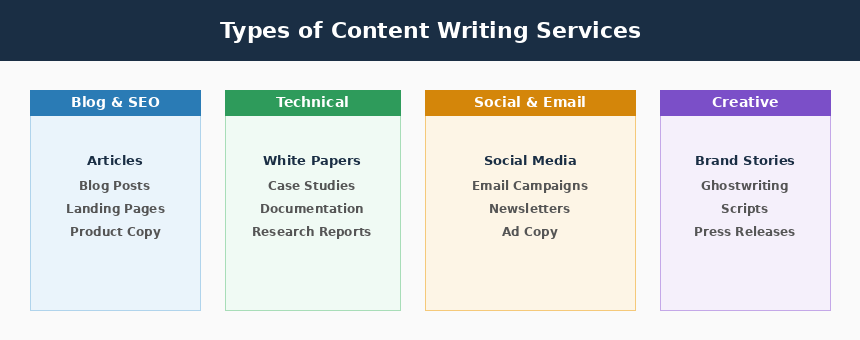
Four major categories of content writing services
1. Freelance Marketplaces
Platforms like Upwork, Fiverr, and Freelancer.com let you browse individual writers and hire directly. You get full control over who you work with. The quality range is massive, from beginners charging a few dollars per article to seasoned professionals with strong track records and niche expertise.
This model works well if you have time to vet writers and want a long-term working relationship with someone you trust.
2. Content Mill Platforms
Services like Textbroker, iWriter, and WriterAccess work on a rating system. Writers are ranked by quality level, and you pay more for higher-rated writers. You submit a brief, and a writer picks it up.
These platforms are fast and affordable. They are good for high-volume, lower-stakes content like thin product descriptions or simple blog posts. But they are not my first choice for thought leadership or niche technical content.
3. Managed Content Agencies
Agencies like Brafton, ClearVoice, and Contently sit at the premium end. They pair you with a dedicated account manager who sources writers, manages editing, and ensures quality control.
If you have a serious content marketing budget and need consistent, high-quality output, this is where I would look. But expect to pay significantly more per piece.
4. Direct Freelance Writers
Sometimes the best solution is simply hiring a freelance writer directly. You find them on LinkedIn, through referrals, or via writer communities. You negotiate a rate, build a brief, and work one-on-one.
This takes more upfront effort but often delivers the best results. A writer who truly understands your niche and voice is hard to replace.
Content Writing Rates: What You Should Actually Pay
Let me be direct. Content writing rates vary wildly, and that variation reflects real differences in quality, experience, and value delivered.
I have paid as little as a few dollars per article and as much as over a thousand dollars for a single long-form piece. Both extremes taught me something. Cheap content rarely delivers ROI, and expensive content is not automatically worth the price.
Here is how freelance writer rates typically break down.
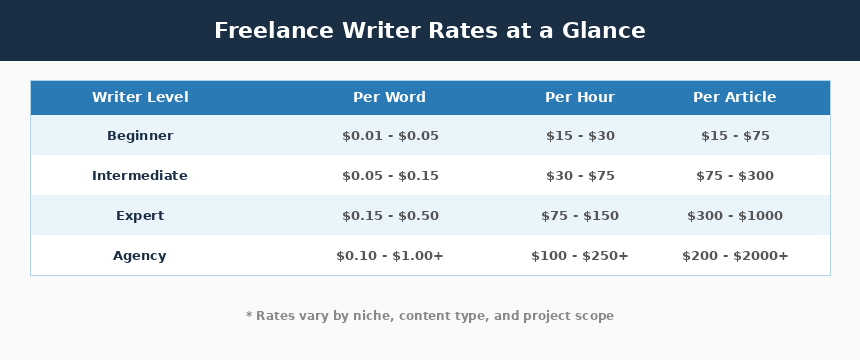
Freelance writer rates by experience level
Pricing by Word Count
Per-word pricing is the most common model in content writing. It is transparent and easy to calculate. Here is what the market looks like.
- Beginner writers: $0.01 to $0.05 per word. These are writers who are new to the field. Content can be usable, but expect to spend time editing.
- Intermediate writers: $0.05 to $0.15 per word. Writers with some experience, decent command of SEO basics, and a track record. This range often offers the best value.
- Expert writers: $0.15 to $0.50 per word. Experienced professionals with niche expertise, strong portfolios, and the ability to write without much hand-holding.
- Top-tier specialists: $0.50 to $1.00+ per word. Medical writers, legal writers, finance experts. Deep subject knowledge commands a premium.
Pricing by Hour
Some writers prefer hourly billing, especially for projects that involve research, interviews, or strategy work.
- Entry level: $15 to $30 per hour
- Mid-level: $30 to $75 per hour
- Senior or specialist: $75 to $150+ per hour
I personally prefer per-project or per-word pricing for most content work. Hourly billing can be hard to predict, and the best writers tend to work fast, which can actually penalize them for efficiency.
Pricing by Project or Article
For blog posts, articles, and other defined formats, per-piece pricing is clean and predictable.
- Short blog post (500 to 700 words): $50 to $200
- Standard blog post (1,000 to 1,500 words): $100 to $500
- Long-form article (2,000 to 3,000 words): $200 to $1,000
- White paper or research report: $500 to $3,000+
- Website homepage copy: $300 to $1,500+
These ranges reflect the market reality. Where your project falls depends on the writer’s experience and your content’s complexity.
Pro tip: Do not benchmark quality by price alone. A $300 article from the right writer will consistently outperform a $30 article from the wrong one. Think in terms of ROI, not just cost.
How Much to Charge for Content Writing: Advice for Writers
If you are a writer trying to figure out your rates, this section is for you.
I have coached dozens of freelance writers, and the most common mistake I see is undercharging. Writers default to low rates because they are afraid of losing clients. But low rates attract the wrong clients and burn you out fast.
Start With Your Income Goal
Work backwards. Decide what you want to earn per month. Factor in taxes, benefits, and the fact that you will not bill every working hour. A freelance writer realistically bills about 50 to 60 percent of their working time.
If you want to earn $5,000 per month and you bill 80 hours at $75 per hour, your math works out. If you charge $20 per hour, you need to bill 250 hours, which is not sustainable.
Know Your Niche Value
Generalist content writing is a commodity. Niche expertise is not. If you write about cybersecurity, fintech, healthcare, or law, you can charge significantly more than a general lifestyle blogger.
I always advise writers to specialize as soon as possible. Pick one or two industries, build a portfolio in those areas, and raise your rates accordingly. The market rewards specificity.
Common Rate Structures for Freelance Writers
- Per word: Simple, transparent, and easy for clients to understand. Start at $0.08 to $0.12 per word and raise it as your portfolio grows.
- Per project: Better for complex work where research and strategy are involved. Price based on scope, not just word count.
- Monthly retainer: Ideal for ongoing clients. Offers predictable income for you and consistent output for them. Typically a discounted rate in exchange for guaranteed work.
- Per hour: Use with caution. Good for strategy calls, editing, or consulting. Less ideal for writing, where speed should benefit you, not penalize you.
Never accept content mill rates as your long-term baseline. They are a learning ground, not a career ceiling. Raise your rates every six months until you find your true market value.
How to Choose the Right Content Writing Service

Three steps to choosing the right content writing service
Choosing a content writing service is not just about finding the cheapest or fastest option. It is about finding the right fit for your goals, your audience, and your brand voice.
Here is the process I use when evaluating a new service or writer.
Step 1: Define What You Actually Need
Before you look at a single service, get clear on your requirements. Answer these questions for yourself.
- What type of content do you need? Blog posts, web copy, email sequences, or something else?
- What is your publishing cadence? One article a week, ten articles a month, or an occasional one-off?
- Do you need writers with specific niche knowledge, or is the topic general enough for any skilled writer?
- Do you need SEO-optimized content, or is this purely for brand awareness or lead nurturing?
The answers shape everything else. A startup that needs two blog posts a month has completely different needs than an ecommerce brand producing 50 product descriptions a week.
Step 2: Evaluate the Quality Process
Every service claims to deliver high-quality content. Very few can actually prove it. Here is what I look for.
- Writer vetting process: How does the service recruit and screen its writers? Do they test for grammar, subject knowledge, and writing style?
- Editing and QA: Is there a human editor reviewing content before it reaches you, or does it go straight from writer to client?
- Revision policy: How many revisions are included? Are they free? Is there a limit?
- Plagiarism checks: Does the service run content through plagiarism detection tools before delivery?
- Turnaround time: What is the standard delivery window, and is there a rush option?
A service that cannot clearly answer these questions is one I would avoid.
Step 3: Review Samples and Run a Test
Portfolio samples are table stakes. Any serious content service should have them. But I never rely on samples alone. I always run a paid test piece before committing to a long-term contract.
A test article reveals things that samples cannot. It shows you how the writer interprets a brief, how closely they follow your guidelines, how they handle tone, and whether the quality holds up when the brief is real and specific.
Spend $100 to $300 on a test. It is cheap insurance against wasting thousands on the wrong partner.
Step 4: Check Communication and Responsiveness
Content production is a collaborative process. A great writer who is hard to reach, slow to respond, or bad at taking feedback will cost you more in time and frustration than a slightly less polished writer who communicates well.
I look for responsiveness during the sales or inquiry stage. If it takes a service three days to reply to an initial query, that is a preview of what working with them will feel like.
Red Flags to Watch Out For
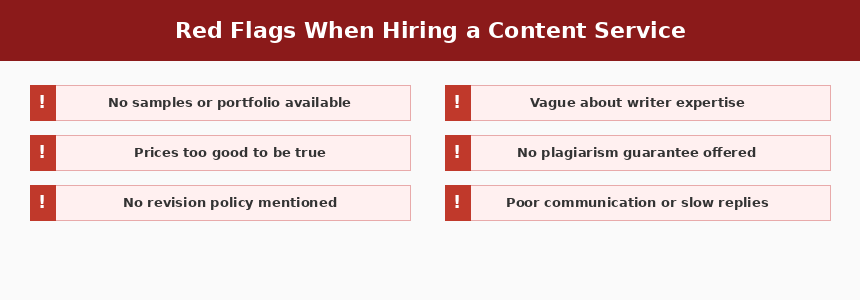
Common red flags when hiring content writing services
After working with dozens of content services and freelance writers, I have learned to spot the warning signs early.
- No portfolio or samples: Any professional writer or service should have work to show. If they cannot, move on.
- Suspiciously low rates: Content that costs $5 per 1,000 words is almost certainly not original, well-researched, or useful for your audience.
- No clear revision policy: Revision terms should be spelled out before you start. Avoid services that are vague about what happens when you are not happy with the output.
- Vague writer qualifications: If a service cannot tell you who is writing your content, what their background is, or how they were vetted, that is a red flag.
- No plagiarism guarantee: Original content should be a baseline expectation, not a premium add-on.
- Slow or poor communication: As I mentioned earlier, communication quality is a reliable proxy for overall service quality.
- One-size-fits-all pricing with no customization: Good content services recognize that different projects have different requirements. Flat pricing with no flexibility often signals a content mill in disguise.
Top Content Writing Platforms: My Honest Assessment
I have personally used or evaluated each of these platforms. Here is my take.
Note: I’ve also included our own platform in this list for transparency. While I may be biased, I’ve evaluated it using the same criteria as the others.
The Content Writing Craft
This is a platform we built with a clear goal in mind: to give writers a space to showcase their work and connect directly with real clients. Unlike crowded marketplaces, the focus here is on quality over quantity.
From my perspective, one of the biggest advantages is simplicity. Writers can present their portfolio without competing against hundreds of low-quality profiles, and businesses can discover talent without sorting through endless proposals.
Of course, like any growing platform, it is still evolving. But if you are looking for a more focused and less saturated environment, this is something worth exploring.
Best for: Writers who want visibility and businesses that prefer a curated pool of talent.
Upwork
Upwork is my go-to for finding skilled individual writers. The talent range is huge, from students looking for their first gig to senior specialists with impressive portfolios.
The platform has its challenges. Finding the right writer takes time and effort. You need to write a strong job post, review proposals carefully, and often run a short paid test. But when you find a great writer on Upwork, that relationship can be tremendously valuable over the long term.
Best for: Businesses willing to invest time in finding and building relationships with specific writers.
Fiverr
Fiverr has matured significantly as a platform. The quality ceiling has risen, and you can now find genuinely skilled writers in the higher-priced tiers.
The gig model makes it easy to order content quickly, but I find it less suited for complex or ongoing content needs. It works well for defined, repeatable tasks like social media bios, product descriptions, or short blog posts.
Best for: One-off content tasks and businesses with clear, repeatable briefs.
Textbroker
Textbroker is a classic content mill. The quality is predictable within each rating tier, and the turnaround is fast. You will not get brilliant writing here, but you will get serviceable content at a reasonable price.
I use Textbroker-type services when volume matters more than voice. Think large ecommerce sites with thousands of product descriptions that need decent copy quickly.
Best for: High-volume, low-stakes content with straightforward briefs.
Contently
Contently sits at the premium end. It connects brands with vetted, experienced journalists and content strategists. The platform focuses on enterprise clients and comes with a price tag to match.
If you are running a serious content marketing program and need brand-level quality, Contently is worth exploring. It is not for small budgets.
Best for: Enterprise brands with significant content marketing budgets and a need for editorial quality.
WriterAccess
WriterAccess is a middle-ground managed marketplace. It has a solid writer vetting process and a quality rating system that makes it easier to find reliable talent than on open marketplaces.
I appreciate that WriterAccess allows you to invite writers back and build a preferred roster. Over time, that roster becomes genuinely valuable.
Best for: Businesses that want a managed experience without going full-agency.
Getting the Most Out of Any Content Writing Service
The service is only half the equation. Your processes determine whether that service delivers value.
Write a Strong Content Brief
The single biggest factor in content quality is the brief. A vague brief produces vague content. Every brief should include the following.
- The target audience and what they care about
- The goal of the piece (traffic, conversions, brand awareness)
- Primary keyword and any secondary keywords to address
- Tone and voice guidelines with examples if possible
- Outline or key sections you want covered
- Word count range and any formatting preferences
- Links to reference material, competitors, or research sources
A thorough brief takes 20 minutes to write. It saves hours of revision and back-and-forth.
Build a Style Guide
If you work with multiple writers or over a long period, a style guide is essential. It documents your brand voice, preferred terminology, formatting rules, tone, and any specific dos and don’ts.
Even a two-page style guide dramatically improves consistency. Writers want guidance. Give it to them.
Give Specific Feedback
When you request revisions, be specific. “This does not sound right” is not useful feedback. “The opening paragraph is too formal for our audience. We speak conversationally, like a trusted advisor rather than a textbook” gives the writer something to work with.
Specific feedback also trains your writer over time. By the third or fourth piece, a good writer will have internalized your preferences and require minimal correction.
Treat Writers Like Partners
The writers who consistently deliver the best work for my clients are the ones who feel genuinely valued. I share results when articles perform well. I ask for their input on topics and angles. I pay on time without being chased.
Good writers have options. Treat them well and they will prioritize your work. Treat them as interchangeable vendors and they will write to the minimum acceptable standard.
Frequently Asked Questions
1. What is the average cost of content writing services?
The cost varies widely depending on the type of service, the writer’s experience, and the content format. For a standard 1,000-word blog post, you can expect to pay anywhere from $50 for basic content mill output to $500 or more for an experienced specialist. Managed agency services tend to charge a premium, often bundling strategy, editing, and project management into the price. Always evaluate cost in terms of value delivered, not just the upfront price.
2. How do I know if a content writing service is reliable?
Look for a clear writer vetting process, a transparent revision policy, samples or portfolio work you can review, and responsive communication. Run a paid test before committing to any ongoing contract. A reliable service will have no problem with this. Also check for independent reviews on platforms like G2, Clutch, or Trustpilot to get unbiased perspectives from past clients.
3. How much should I charge for content writing as a freelancer?
Start by setting an income goal and working backwards from there. If you are new to freelancing, $0.05 to $0.10 per word is a reasonable starting point as you build your portfolio. As you gain experience and niche expertise, push towards $0.15 to $0.30 per word. Specialists in fields like finance, healthcare, or technology can command $0.50 per word or more. Never stay at low rates indefinitely. Review and raise your rates regularly.
4. Is it better to hire a content agency or a freelance writer?
It depends on your needs and budget. Agencies offer consistency, editorial oversight, and a managed experience, but at a higher cost. Freelance writers offer flexibility, direct communication, and often a more personalized voice, but require more management from your side. For businesses that need high-volume, consistent content, an agency or managed platform often makes sense. For brands looking for a specific voice or niche expertise, a dedicated freelance writer is often the better choice.
5. What types of content do writing services typically produce?
Most content writing services can produce blog posts, articles, website copy, product descriptions, email campaigns, social media content, press releases, white papers, case studies, and ghostwritten pieces. More specialized services also offer technical writing, research reports, scripts, and long-form guides. Always confirm that the service you choose has writers with experience in your specific content format and industry before committing.
Final Thoughts
Finding the right content writing service is not about finding the cheapest option or the most well-known platform. It is about matching the right solution to your specific goals, budget, and quality standards.
I have seen businesses transform their online visibility by investing in consistent, high-quality content. I have also seen money wasted on cheap content that damaged brand credibility and delivered zero results.
The difference almost always comes down to clarity. Clear goals, clear briefs, clear feedback, and clear expectations from both sides.
Use this guide as your starting point. Evaluate your options honestly, run tests before committing, and build relationships with writers who genuinely understand your audience.
The right content writing service will not just produce words. It will produce results. That is the standard worth holding out for.