I had been writing blog posts for two years before I ever came across the word copywriting.
I was reading an article about freelance writing, and there it was. Copywriting. The article listed it as one of the highest-paying writing skills available. And I had no idea what it meant.
My first thought was that it had something to do with copyright law. The legal kind. You know, the circle-C symbol you see on books and albums.
I was completely wrong.
Copywriting is something different entirely. It is a specific kind of writing, one of the most useful and in-demand forms of writing in the world, and most people have never been taught what it actually is.
This guide is for people who are starting from zero. You do not need a writing background. You do not need to know any industry terms. I am going to explain everything as plainly as I can, the way I wish someone had explained it to me.
By the end, you will know exactly what copywriting is, where it shows up in everyday life, how it is different from other kinds of writing, and what you can do to start learning it.
- What is Copywriting?
- The Copywriting Definition, Broken Down
- Where Does Copywriting Show Up?
- The Main Types of Copywriting
- Copywriting vs Content Writing: A Deep Comparison
- What is SEO Copywriting?
- What Makes Good Copywriting? The Core Principles
- How to Start Learning Copywriting From Scratch
- Common Copywriting Mistakes Beginners Make
- Simple Tools That Help Copywriters
- Is Copywriting Worth Learning?
- Quick Summary: Everything We Covered
What is Copywriting?
Copywriting is writing that is designed to make someone do something.
That is the simplest and most honest definition I can give you.
The writing might be trying to get you to buy a product, sign up for a newsletter, click a link, book a call, download an app, or follow an account. Whatever the goal is, the words were chosen and arranged specifically to move you toward it.
The text that a copywriter produces is called copy. You encounter it every single day, even if you have never noticed it as such.
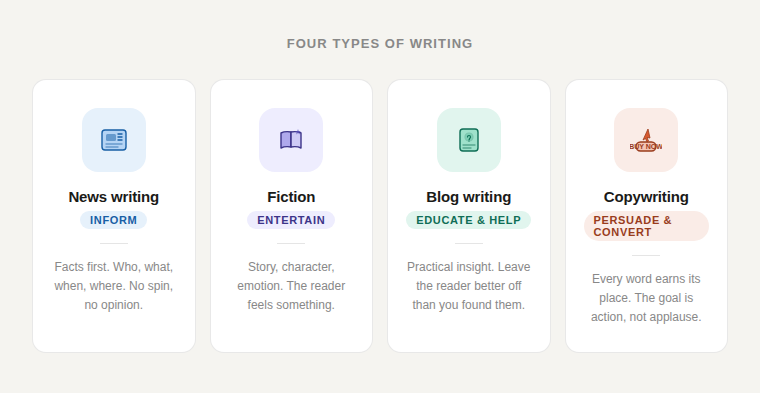
- The headline on a brand’s homepage that pulls you in
- The subject line of a marketing email that makes you open it
- The caption on a paid ad that stops you mid-scroll
- The product description on a shopping page that makes something sound appealing
- The button that says “Start Your Free Trial” instead of just “Submit”
- The text on a billboard you pass on your commute
- The script of a television or radio commercial
All of that is copy. Someone wrote every word of it on purpose, with a specific outcome in mind.
That is what copywriting is. Writing with intent. Writing that is designed to work.
The Copywriting Definition, Broken Down
Let me make the copywriting definition even clearer by looking at what makes it different from other writing you have seen.
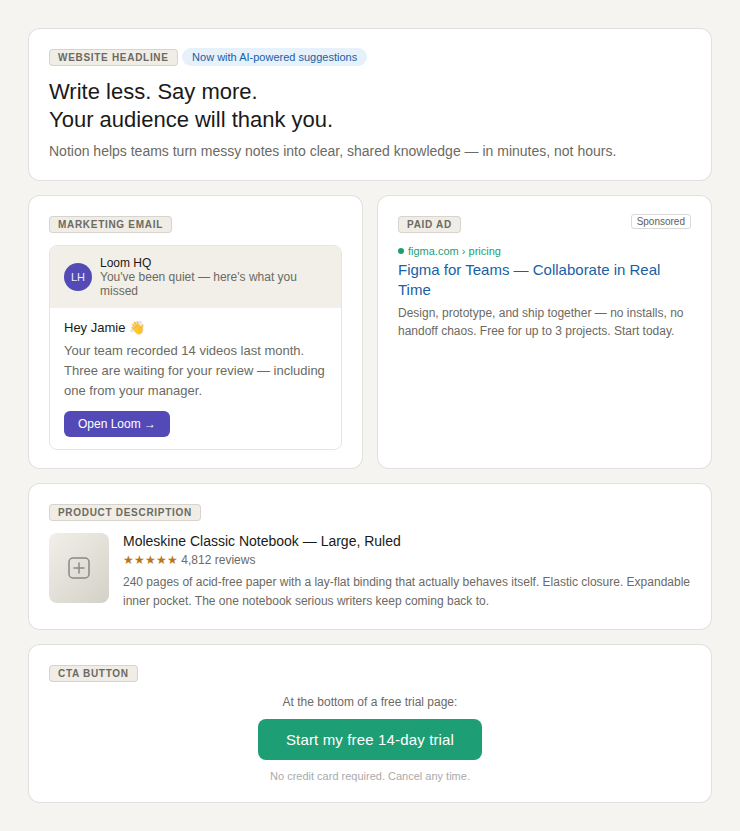
When you read a news article, the goal is to inform you. The writer is trying to give you accurate information about something that happened. There is no particular action they want you to take after reading.
When you read a novel, the goal is to engage and entertain you. The writer wants you to enjoy the experience of reading. Again, no specific action required from you.
When you read a blog post, the goal is usually to help you understand or do something. A how-to guide. A list of tips. An explanation of a topic. The writer wants to be useful to you.
Copywriting is different from all of these. When you read copy, the writer has one specific action in mind. They want you to take that action. Everything in the writing, the words chosen, the structure of the piece, the examples used, the emotion it creates, is working toward that one outcome.
That is why copywriting requires a different set of skills from other kinds of writing. It is not just about being clear or interesting. It is about being persuasive in a specific, purposeful way.
Where Does Copywriting Show Up?
Once you know what copywriting is, you start seeing it everywhere. It lives in places you look at every single day without thinking about it.
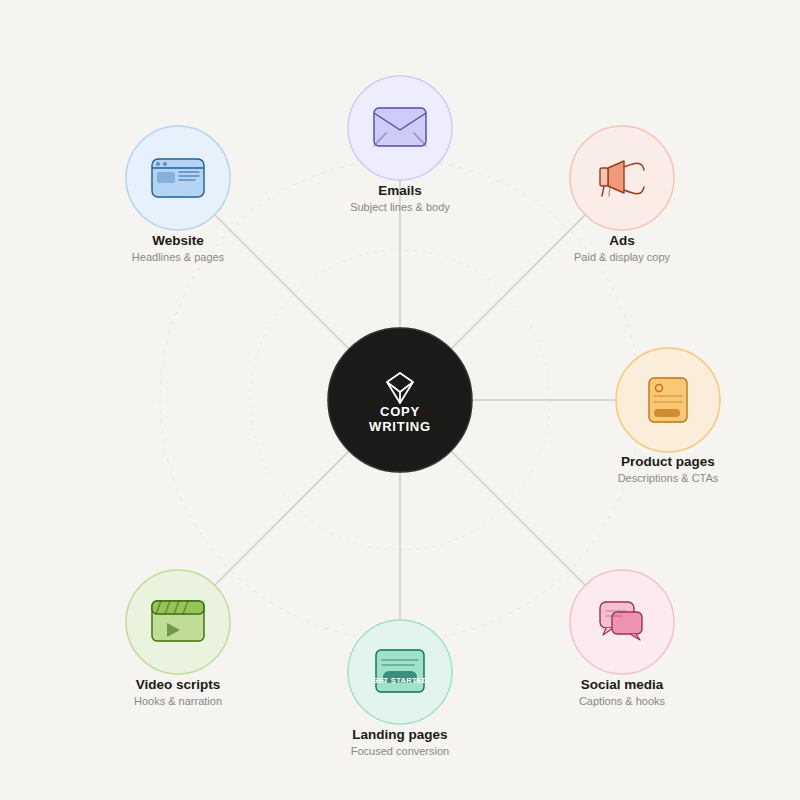
On websites
Almost every word on a business website was written by a copywriter or should have been. The homepage headline. The “About Us” page. The service descriptions. The FAQ section. The footer. All of it is copy, designed to help the visitor understand what the business offers and to move them toward contacting or buying.
In emails
Marketing emails are pure copywriting. Subject lines are written to get you to open the email. The body of the email is written to get you to click a link. The link takes you to more copy. Every word is doing a job.
In paid advertisements
Every ad you see, whether it is on Google, Instagram, YouTube, or a billboard, required someone to write the words. That person is a copywriter. The headline, the short description, the call to action button. All copy.
On product pages
When you are shopping online and you read a description that makes a product sound appealing, that is copywriting. A strong product description does not just list features. It explains what those features mean for the person buying, and it makes you feel something about owning the thing.
In social media posts
Brand accounts on social media do not just post randomly. Every caption, every post, every story is written to achieve something. To grow the audience. To build trust. To drive traffic. To sell. That is copy.
On landing pages
A landing page is a standalone web page built for one purpose only. To get you to take one specific action. Sign up. Buy. Download. Register. The entire page, sometimes thousands of words long, is copywriting.
In scripts
Commercials, explainer videos, podcast ads, YouTube pre-roll ads. All of them are scripted by copywriters who know how to hold attention and prompt action in a short amount of time.
The Main Types of Copywriting
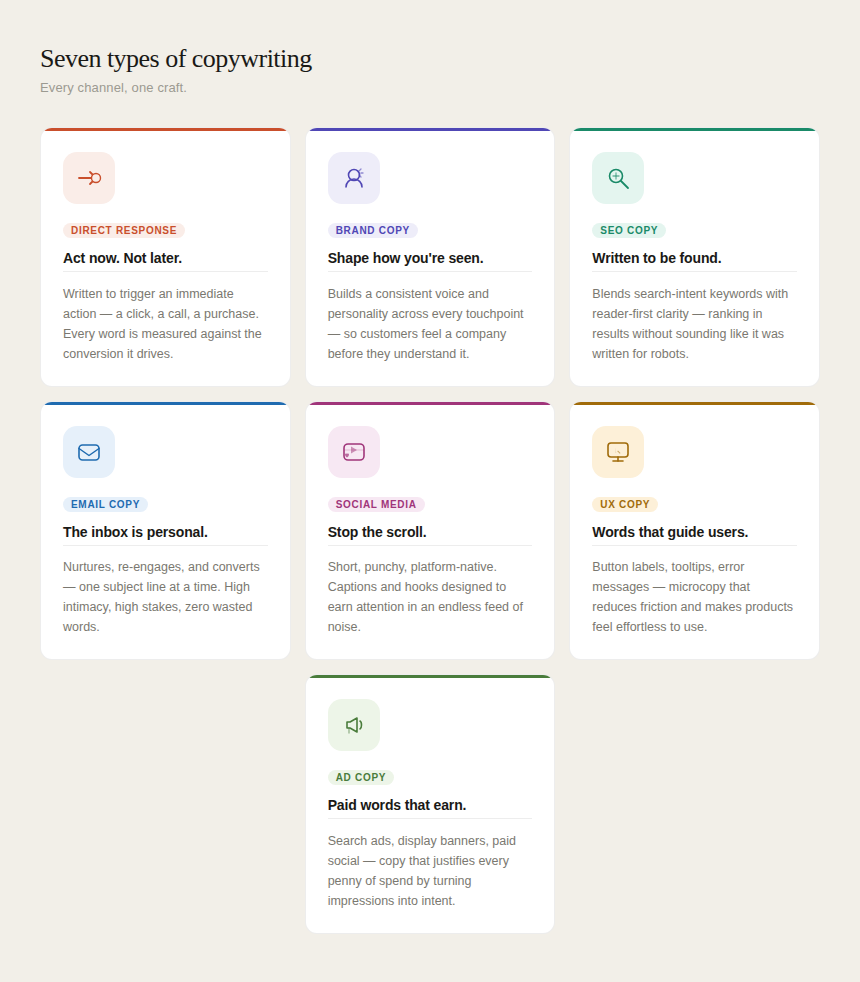
Copywriting is not one single thing. It breaks down into several distinct types, each with its own format, purpose, and set of skills. Here is what you need to know about each one.
Direct Response Copywriting
This is the form most people think of when they hear the word copywriting. Direct response copy is designed to get an immediate action from the reader. A long sales page. An email asking you to buy something today. An ad with a Buy Now button.
It is called direct response because the goal is a direct, measurable response. Either the reader took the action or they did not. You can see the numbers. That makes it one of the most instructive forms of copy to learn because the feedback is immediate and clear.
Brand Copywriting
Brand copy is less about getting an immediate click and more about how a company sounds and feels over time. The tagline on a logo. The voice across all social media posts. The story a company tells about itself. This kind of copy shapes how people perceive and remember a brand.
It works slowly. But it matters a lot. The brands people feel loyal to are usually the ones whose copy made them feel something over a long period of time.
SEO Copywriting
SEO stands for search engine optimisation. SEO copywriting is written to show up in search results on Google or other search engines, and to convert the people who find it.
This type of copy has to serve two audiences at once: the search engine and the human reader. The search engine needs to understand what the page is about. The human reader needs to find the page useful and be moved to take action. Balancing those two things is the skill.
Email Copywriting
Email remains one of the most effective marketing channels available. Email copywriting covers the subject lines that determine whether an email gets opened, the body of the email that holds the reader’s attention, and the call to action that drives a click.
Good email copy reads like it came from a real person. It does not feel like a mass message. It feels personal, even when it reaches thousands of people.
Social Media Copywriting
Every brand post, caption, and ad on social media is copy. Social copy has to work fast. You have a fraction of a second to stop someone from scrolling past. That requires short, specific, punchy writing. Vague language does not survive on social media.
UX Copywriting
UX stands for user experience. UX copy is the small text inside apps and websites that guides you through using a product. Button labels. Error messages. Onboarding instructions. Empty state messages. These words are easy to overlook, but they directly affect how comfortable and confident someone feels using a product.
Ad Copywriting
Paid ads on Google, Facebook, Instagram, and other platforms need concise, effective copy. A headline, a short body, a call to action. Three elements, very little space. The words have to be precise enough to attract the right people and persuade them to click.
Copywriting vs Content Writing: A Deep Comparison
This is the question I get asked more than any other when I explain what I do. And it is one of the most important things to understand if you are new to writing in any professional context.
On the surface, copywriting and content writing look the same. Both involve producing written text. Both live online. Both require clear, readable writing. Both serve a brand or business in some way.
But they are built on different intentions. And that changes almost everything about how you approach the work.
What Content Writing Is
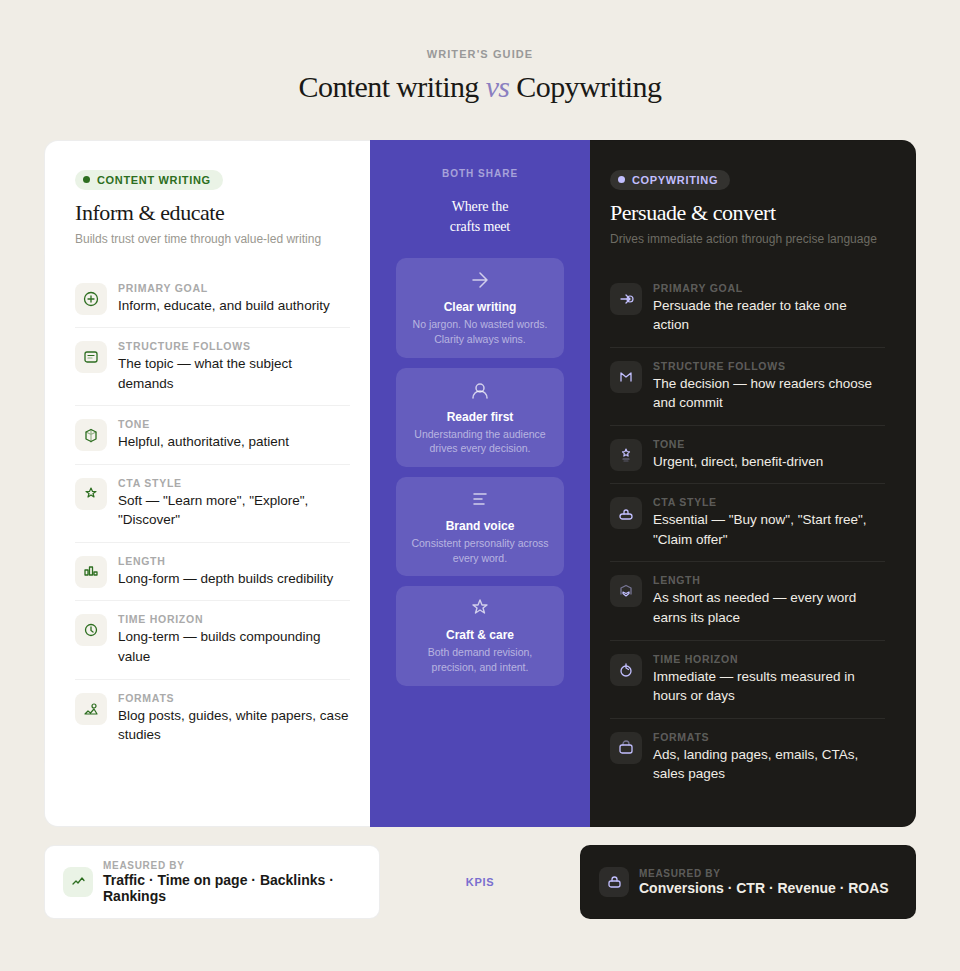
Content writing is writing that is primarily designed to inform, educate, or entertain. A blog post that teaches you how to do something. A guide that explains a concept. An article that helps you understand an industry. A story that builds a connection between a brand and its audience.
The goal of content writing is to provide value and build trust over time. The reader comes away knowing something they did not know before, or feeling more connected to the source. The conversion, if there is one, is soft and secondary. Subscribe to the newsletter. Read another post. Come back next week.
I spent two years writing this kind of content before I understood copywriting. Every post I wrote was trying to be genuinely useful. I wanted people to read it, learn something, and return. The payoff was slow and cumulative.
What Copywriting Is
Copywriting is writing that is designed to prompt a specific action right now. The entire piece exists to move the reader toward one outcome. Buy this product. Sign up for this service. Click this link. Book this call.
Every decision in the writing, what to lead with, what examples to use, how to handle objections, how to close, is made in service of that single action. Copywriting uses persuasion techniques that content writing typically does not: urgency, scarcity, social proof, emotional triggers, before-and-after framing.
It is not manipulative when done well. It is just a different kind of writing with a different job.
The Four Key Differences
1. Intent. Content writing informs. Copywriting converts. This is the root difference. Everything else follows from it.
2. Structure. Content writing follows the structure of a topic, organised to help the reader understand something. Copywriting follows the structure of a decision, organised to take the reader from awareness to action.
3. The call to action. In content writing, a call to action is optional and usually soft. In copywriting, it is essential and specific. Without a clear call to action, copy has failed at its job.
4. How you measure success. Content writing is measured by things like traffic, time on page, shares, and return visits. Copywriting is measured by conversions: how many people took the specific action the copy was written to produce.
Where They Overlap
Here is where it gets interesting, and where a lot of confusion comes from.
Modern marketing often uses both at the same time. A blog post that teaches something genuinely useful (content writing) but ends with a well-crafted pitch for a product (copywriting) is both. An email sequence that educates a reader over several weeks (content) but moves them steadily toward a purchase decision (copy) is both.
SEO articles that rank for a search term and then convert the reader who finds them are doing both jobs at once. This is why SEO copywriting has become such a specific and valued skill.
The most effective brands do not choose between content writing and copywriting. They use content to build an audience and earn trust, then use copy to convert that trust into action.
Why This Matters If You Are a Beginner
If you have never written professionally before, this distinction matters because it tells you what skill you are actually trying to build.
If you want to write blog posts, guides, or educational articles, you are learning content writing. The skills are: research, clarity, structure, consistency, and writing in a way that genuinely helps someone.
If you want to write ads, sales pages, emails, or product descriptions, you are learning copywriting. The skills are: understanding the reader’s psychology, writing with persuasive intent, handling objections, and structuring words around a conversion goal.
The good news is that both start with the same foundation: writing clearly for a specific reader. If you learn that well, moving into either discipline becomes much more straightforward.
What is SEO Copywriting?
SEO copywriting is one of the most in-demand forms of writing in digital marketing right now, and it deserves its own explanation because it is often misunderstood even by people who are already familiar with SEO or copywriting separately.
SEO stands for search engine optimisation. When someone types a question or phrase into Google, Google works out which pages on the internet best answer that query and shows them in order of relevance and quality. SEO is the practice of writing and structuring your content so that Google considers it one of the best results.
SEO copywriting combines this goal with the persuasive intent of copywriting. The result is a piece of writing that ranks well in search results and also converts the people who find it.
Why both parts matter
Some websites focus only on ranking. They produce content optimised for keywords but written in a way that is mechanical and unhelpful. People find the page, realise it does not actually help them, and leave immediately. Google notices this and eventually stops ranking the page.
Other websites produce genuinely useful content but ignore how search engines find them. Their writing is excellent but nobody ever sees it because it does not appear in search results.
SEO copywriting tries to do both. Write something genuinely useful that a real person wants to read, and structure it in a way that search engines can understand and rank.
What SEO copywriting involves in practice
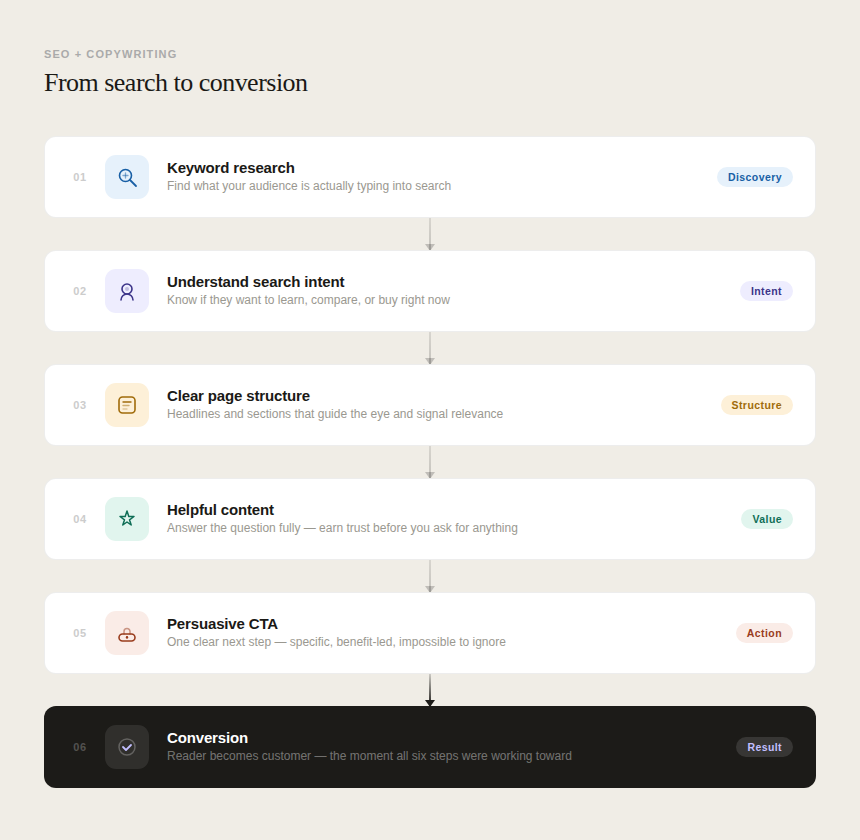
- Researching what terms people actually search for, and understanding the intent behind those searches
- Structuring the page with clear headings so search engines and readers can navigate it
- Covering the topic thoroughly enough to satisfy the reader’s question
- Writing naturally without forcing keywords in awkward ways
- Including a clear call to action so that people who find the page through search also take a meaningful next step
If you are starting from zero as a writer, SEO copywriting is a useful discipline to aim toward. It teaches you to write with the reader’s needs at the centre, and it gives you measurable feedback, where does the page rank, how many people visit it, how many of them take action. That feedback loop teaches you a lot, fast.
What Makes Good Copywriting? The Core Principles
I have read a lot of copy over the years. Some of it made me act. Most of it washed over me and I forgot it immediately. Here is what I have noticed separates the two.
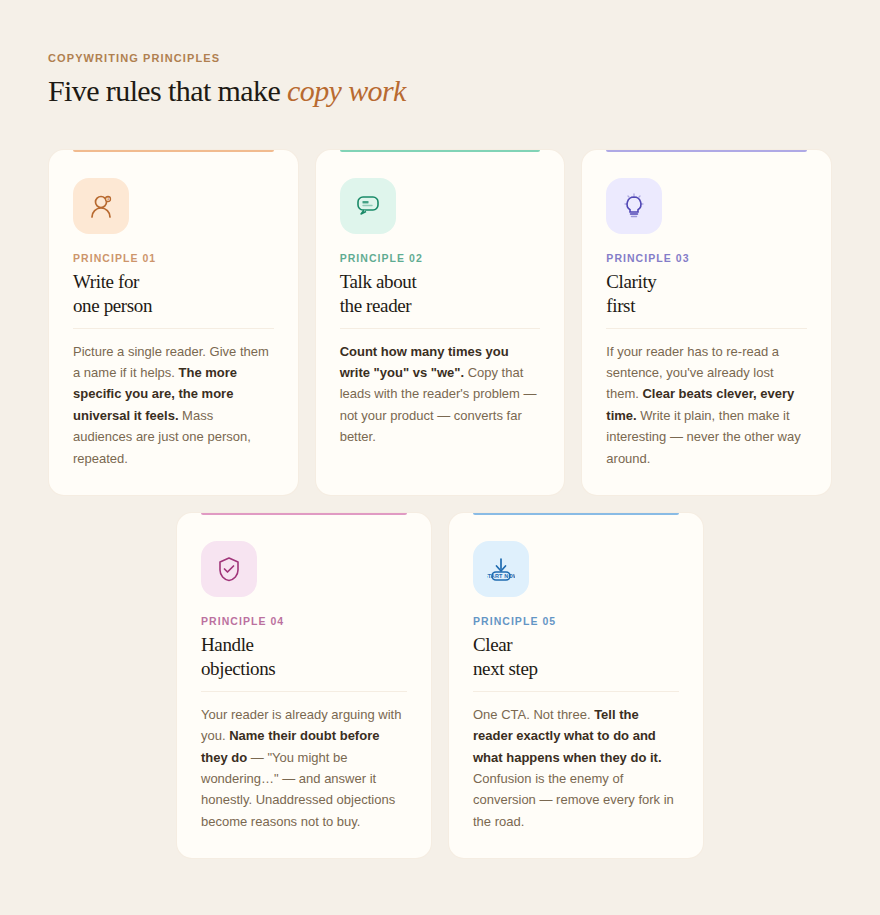
It is written for one specific person
The best copy feels like it was written for you personally. Not for a general audience. For you.
That is not an accident. Good copywriters spend real time understanding who they are writing for before they write anything. What does this person want? What are they afraid of? What have they already tried that did not work? What words do they use when they describe this problem?
When copy starts from that depth of understanding, it connects. The reader feels like the writer gets it. And that feeling is what makes someone willing to act.
It talks about the reader, not the product
Weak copy describes the product. Strong copy describes what the product means for the person reading.
Compare these two examples for the same product. First: “Our project management software includes 47 features and integrates with 200 tools.” Second: “Stop losing track of tasks and missing deadlines. Our software keeps your whole team organised without the chaos.”
Both describe the same product. But the second one talks about the reader’s problem and what changes when it is solved. That is the difference between weak and strong copy.
It is clear before it tries to be clever
New writers often try to make their copy creative or witty. But if someone has to work to understand what you are offering, they will leave. Every time.
Clarity first. Always. Once the reader knows exactly what they are being offered and why it matters to them, you can layer in personality. But not before.
It handles objections before the reader raises them
Every person who considers taking an action also has reasons not to. It costs too much. I am not sure it will work for me. I have tried things like this before and been disappointed. I will do it later.
Good copy brings those objections up and addresses them inside the writing, before the reader can use them as a reason to leave. That takes a genuine understanding of the reader and honest confidence in what is being offered.
It ends with a clear next step
Every piece of copy should tell the reader what to do next. Plainly. Specifically. A vague ending undoes everything that came before it.
“Learn more” is weak. “Get your free guide” is specific. “Start your 14-day free trial today” is specific and gives the reader a low-risk reason to act. The more clearly you name what happens when someone takes action, the more likely they are to do it.
How to Start Learning Copywriting From Scratch
Here is the honest version of how to begin. No expensive courses required to start. No experience needed. Just a set of habits that build real skill over time.
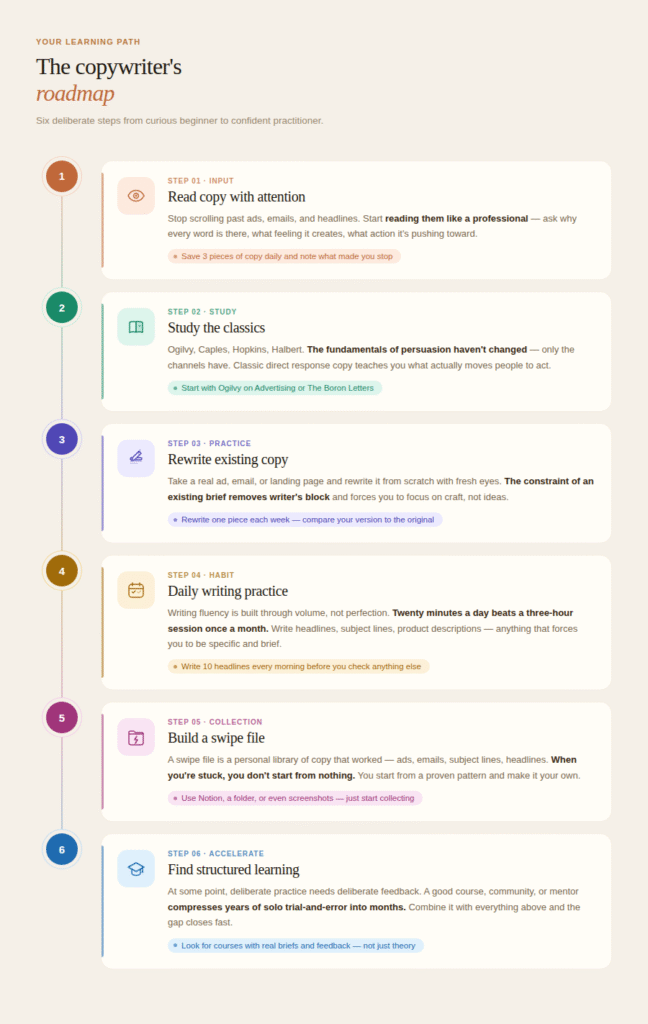
Start paying attention to copy around you
Most people encounter hundreds of pieces of copy every day and never notice them. Emails, ads, website headlines, app notifications, packaging.
Start reading them differently. When a subject line makes you open an email, ask yourself why. What did it say? What did it make you feel? When an ad stops your scroll, look at the words. What specifically grabbed you? When a product page makes something sound appealing, read it carefully and figure out how it worked on you.
This habit alone teaches you more than most structured resources. You are studying real copy that real writers wrote for real audiences, and you are developing an instinct for what works.
Read the people who shaped the craft
Copywriting has a history, and the people who built it wrote things worth reading. David Ogilvy wrote about advertising in a way that is still sharp and useful today. Claude Hopkins, who was writing in the early 1900s, understood persuasion in ways that modern writers still learn from. Eugene Schwartz’s work on understanding what a reader is ready to believe before they will act is one of the most practical frameworks in copywriting.
You do not need to read all of them before you start writing. But reading even one of these seriously will change how you think about words.
Practise by rewriting copy that already exists
Before you write original copy, take something that exists and make it better. Pick a real product page or email that you think is weak and rewrite it. Make it clearer. Make it more focused on the reader. Make the call to action more specific.
Compare your version to the original and think about what changed and why. This is one of the fastest ways to develop instinct because you are working with real examples and real constraints.
Write something every day, even for just a few minutes
Copywriting is a writing skill and writing skills improve with consistent practice. Even short sessions compound quickly over weeks and months.
Write five headlines for a product you like. Write an email subject line for something you bought recently. Write the first paragraph of a sales page for a service you use. You do not need to publish any of it at first. The point is to be writing purposefully and regularly.
Build a swipe file
A swipe file is a personal collection of copy you found effective or worth studying. Subject lines that made you open emails. Ads that caught your attention. Product pages that made you consider buying. Headlines that stopped you.
Save them somewhere. Come back to them when you need inspiration or when you want to understand how a particular piece was constructed. Most experienced copywriters keep an active swipe file throughout their careers.
Invest in learning the craft properly
At some point, practising on your own is not enough. You need guidance that is structured, specific, and built by people who understand what effective writing actually requires.
There is a real difference between learning to write and learning to write in a way that works on readers. That gap is where most beginners stay stuck longest. Resources like The Content Writing Craft are designed to close it. Not by teaching you tricks, but by building your understanding of how writing works at a fundamental level. That kind of foundation changes not just your copy but all your writing.
Common Copywriting Mistakes Beginners Make
I made most of these when I was starting. Every one of them is fixable once you know to look for it.
Writing about the product instead of the reader. This is the most common mistake beginners make. They describe features when they should be describing the change the reader experiences. Always ask: what does this mean for the person reading?
Underestimating the headline. The headline is the most important part of almost any piece of copy. It determines whether someone keeps reading. Beginners often write the headline last and spend the least time on it. Flip that. Spend more time on the headline than anything else.
A weak or vague call to action. “Click here” tells the reader nothing. “Download your free guide” tells them what they get. Be specific about what happens when someone takes action. Specificity reduces hesitation.
Trying to imitate a “copywriter voice.” There is a recognisable style some beginners copy because they have seen it in examples. Punchy. Dramatic. Full of sentence fragments for effect. If it does not sound natural to you, it will not read naturally either. Write in your own voice, just with more purpose and clarity.
Not reading the work out loud. Copy that looks clean on a screen often sounds clunky when you say it. Reading out loud exposes awkward phrasing, sentences that run too long, and rhythm that breaks down. It is one of the simplest and most effective editing techniques, and most beginners skip it.
Thinking longer is more persuasive. Copy should be exactly as long as it needs to be. Not a sentence longer. Every word that does not move the reader toward action should be cut.
Simple Tools That Help Copywriters
You do not need a lot of tools to start. But a few genuinely make the work cleaner and faster.
Hemingway Editor: Paste your copy in and it shows you where sentences are too long, where passive voice has crept in, and where the reading level is higher than it needs to be. Good for tightening drafts.
Grammarly: Catches spelling and grammar errors. Useful for a final pass. It should not replace careful reading, but it catches things tired eyes miss.
Google Docs: Simple, easy to share, easy to comment on. Most copywriters deliver work in Google Docs and it works well for collaborating with clients or editors.
A simple swipe file folder: Notion, a bookmarks folder, or even a physical notebook. Keep your best examples organised somewhere you can find them.
Google Search: One of the most underrated research tools for copywriters. Search the terms your reader would search. Read what ranks. Understand what already exists and how you can do it better.
Is Copywriting Worth Learning?
Yes. Genuinely.
I came to copywriting from content writing, and what surprised me most was not how different the two were but how much learning copywriting improved the content writing I was already doing.
Understanding that writing always has a purpose, that every piece exists to move a reader somewhere, changed how I approached every headline, every opening paragraph, every conclusion. Content writing that is informed by copywriting principles just works better. It holds attention longer. It leaves the reader with a clearer sense of what to do next. It connects.
If you are starting from zero as a writer, copywriting is one of the most practical skills you can build. It is in demand across almost every industry. Businesses need it constantly and most of them are not great at it themselves. Writers who understand how to produce copy that actually works are genuinely valued.
But beyond the practical and career side of it, learning copywriting teaches you something more fundamental. It teaches you to think about the reader. Every time. What do they know? What do they feel? What do they need to hear before they will trust you enough to act?
That question, asked honestly before every piece of writing, is the beginning of all good copy.
And it is the best place to start.
Quick Summary: Everything We Covered
- Copywriting is writing designed to make someone take a specific action: buy, sign up, click, book, download
- The text a copywriter produces is called copy, and it appears everywhere: websites, emails, ads, product pages, social media, scripts
- The main types are direct response, brand, SEO, email, social media, UX, and ad copywriting
- Content writing informs and builds trust over time. Copywriting converts that trust into action. Both matter and both overlap in modern marketing
- The four key differences: intent, structure, the call to action, and how success is measured
- SEO copywriting combines ranking in search results with converting the readers who find you
- Good copy is written for one specific person, focuses on the reader not the product, stays clear, handles objections, and ends with a specific next step
- To start learning: read copy with attention, study the people who shaped the craft, practise rewriting existing copy, write daily, build a swipe file
- Common beginner mistakes include focusing on the product instead of the reader, underestimating the headline, and writing weak calls to action
- Copywriting is a practical, in-demand skill that improves all your writing, not just the pieces explicitly designed to sell
The best time to start is before you feel ready.
You do not need a writing background. You do not need to finish a course first. You just need to start paying attention to the words around you and writing some of your own.
Pick a product you like. Write the headline. Write the first line. See what happens when you try to make someone care about it.
That is copywriting. And it starts the moment you try it.