Let Me Start With the Honest Truth
Most people think SEO writing is about stuffing keywords into a blog post and hoping Google notices.
It’s not.
I’ve written hundreds of pieces of SEO content. And the biggest lesson I’ve learned is this: Google doesn’t want optimized content. It wants useful content. The optimization is just how you communicate that usefulness to an algorithm.
When you get that distinction right, everything changes.
In this guide, I’ll walk you through what SEO writing actually is, how it works, what makes it different from regular content writing, and how to do it well.
- What is SEO Writing?
- Why SEO Writing Matters
- SEO Writing vs. Regular Content Writing
- The Core Elements of SEO Writing
- The SEO Writing Process (How I Actually Do It)
- What Makes SEO Writing Actually Good
- Common SEO Writing Mistakes I’ve Made (And You Should Avoid)
- SEO Writing and AI: Where I Stand
- How to Get Better at SEO Writing
- Is SEO Writing a Good Career?
- Final Thoughts
What is SEO Writing?
SEO writing also called SEO content writing or writing for SEO is the process of creating written content that’s designed to rank in search engines like Google.
But that’s only half the definition.
The full version is this: SEO writing is content that ranks in search engines AND genuinely helps the person reading it. Both parts matter. You can’t have one without the other not anymore, and not for long.
An SEO writer researches what people are searching for, understands why they’re searching for it, and then writes something that answers that need clearly and completely. Then they structure and format it in a way that Google can understand and reward.
That’s the whole job. It sounds simple. It’s not.
Why SEO Writing Matters
Here’s something I want you to sit with for a second.
Over 8.5 billion searches happen on Google every single day. Every one of those searches is a person looking for something: an answer, a product, a service, a solution to a problem.
When your content ranks for those searches, you get free, recurring traffic. Not from an ad you’re paying for. Not from a social post that disappears in 48 hours. From a piece of content that can sit at the top of Google for months or years.
That’s the value of SEO writing. It’s one of the few marketing investments that compounds over time.
I’ve written SEO articles that still drive traffic three years after they were published. That doesn’t happen with an Instagram post.
SEO Writing vs. Regular Content Writing
People ask me this a lot. What’s the difference between SEO content writing and just… writing content?
Here’s how I think about it.
Regular content writing starts with an idea or a message. You write what you want to say and hope the right people find it.
SEO writing starts with what people are already looking for. You find a real search demand, then create the best possible answer to that demand.
One is writing first, distribution second. The other flips that order.
Both are valid. But if your goal is organic search traffic, SEO writing is the approach you need.
The other difference is structure. SEO articles are written with search engines in mind which means clear headings, logical flow, specific keyword placement, and content that comprehensively covers a topic. Not because those things impress Google, but because they help readers navigate your content easily. And Google rewards what readers find useful.
The Core Elements of SEO Writing
Let me break down what actually goes into good SEO writing.
1. Keyword Research
Before I write a single word, I need to know what people are actually searching for.
Keyword research is the process of finding the specific phrases your target audience types into Google. These could be short phrases like “SEO writing” or longer, more specific ones like “how to write SEO content for beginners.”
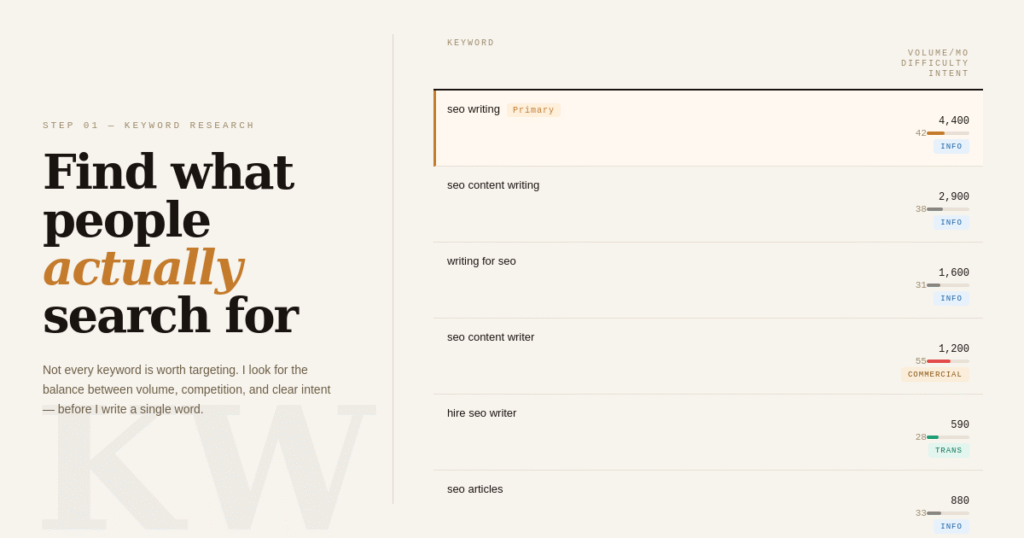
I use tools like Ahrefs, Semrush, or even Google’s free autocomplete to find these. But I’m not just looking for any keywords I’m looking for keywords that have:
- Real search volume (people are actually searching for it)
- Reasonable competition (I have a realistic shot at ranking)
- Clear intent (I know exactly what the person wants)
That last point is critical. Intent is everything in SEO writing.
2. Search Intent
Search intent is the reason behind a search. Why is someone typing this into Google? What do they actually want?
There are four main types:
Informational They want to learn something. “What is SEO writing?” is informational. The person wants an explanation.
Navigational They’re looking for a specific website. “Ahrefs login” is navigational. I’m not competing for these.
Commercial They’re researching before a purchase. “Best SEO tools 2026” is commercial. The person is comparing options.
Transactional They’re ready to buy or act. “Hire an SEO writer” is transactional. They want to take action now.
If I write a sales-heavy piece for an informational keyword, I’ll fail. Google knows what kind of content satisfies each type of search and it ranks accordingly.
3. Content Structure
SEO articles need a clear structure. Not because Google demands it, but because readers do.
I always use:
- A clear H1 title that includes my primary keyword
- H2 subheadings that break the content into logical sections
- H3s where I need to go deeper within a section
- Short paragraphs rarely more than 3 or 4 lines
- Bullet points and numbered lists where they genuinely help
This makes the content easy to scan. Most people don’t read articles top to bottom they scan for the section that answers their specific question. Good structure respects that.
4. On-Page SEO
This is the technical side of SEO writing. On-page SEO refers to the things I control directly within the content itself.
Title tag The headline that shows up in Google search results. It should include my primary keyword and be under 60 characters.
Meta description The short description under the title in search results. It doesn’t directly affect rankings, but it affects click-through rate. A good meta description makes people want to click.
URL structure Keep it short, clean, and keyword-focused. /seo-writing beats /what-is-seo-writing-complete-guide-2026-updated.
Image alt text Every image I use gets a descriptive alt text. It helps Google understand what the image shows and improves accessibility.
Internal links I link to other relevant content on my site. This helps Google understand my site’s structure and keeps readers engaged longer.
Primary keyword placement I include my main keyword in the title, the first 100 words, at least one subheading, and naturally throughout the body.
None of this is about gaming an algorithm. It’s about communicating clearly to both Google and the reader.
The SEO Writing Process (How I Actually Do It)
Let me walk you through how I approach an SEO writing project from start to finish.
Step 1: Pick the Right Keyword
I start with keyword research, but I’m strategic about which keyword I target.
I’m not chasing the highest search volume. I’m looking for the keyword that balances volume, competition, and relevance to the page I’m building.
A keyword with 500 monthly searches that I can realistically rank for is worth more than a keyword with 50,000 searches where I’m competing against Wikipedia and Forbes.
Step 2: Analyze the SERP
Before I write a word, I Google the keyword myself. I look at the top 5 results and ask:
- What type of content is ranking? (List posts? Long guides? Short answers?)
- How long are the top results?
- What topics and subtopics do they cover?
- What questions are people asking related to this keyword?
This tells me what Google has decided is the right format for this search and I take that seriously. If every result is a listicle, there’s probably a good reason. If every result is a long guide, I should write a long guide.
But I also look for what’s missing. What angle haven’t they taken? What question did they not answer? That’s my opportunity to write something better.
Step 3: Create an Outline
I never skip this step.
Once I know my keyword, my search intent, and what’s already ranking, I build an outline. I decide:
- What my H2 sections will be
- What subtopics each section covers
- What questions I need to answer
- Roughly how long each section should be
A good outline is half the work. It gives the writing direction and makes sure I don’t miss anything important.
Step 4: Write for the Reader First
Here’s something I’ve had to remind myself many times over the years.
I’m not writing for Google. I’m writing for the person who will read this.
Google is sophisticated enough now to tell the difference between content that genuinely helps people and content that just ticks SEO boxes. If I write something thin, obvious, and structured around keywords rather than ideas it might rank for a week. Then it disappears.
So I write like I’m explaining something to a smart person who doesn’t know this topic yet. I use real examples. I share my own experience. I tell them what I actually think, not just what sounds good.
That kind of writing ranks. And it stays ranked.
Step 5: Optimize After Writing
Once the first draft is done, I go back and optimize. In that order write first, optimize second.
I check:
- Is my primary keyword in the title and first paragraph?
- Do my subheadings reflect what each section covers?
- Have I included related keywords naturally throughout the piece?
- Are my internal links pointing to the right pages?
- Is my meta description compelling and under 160 characters?
- Are all images labeled with descriptive alt text?
I’m not stuffing keywords in at this stage. I’m making sure the piece communicates clearly to search engines what it’s actually about.
Step 6: Format for Readability
The last thing I do before publishing is a readability pass.
I break up long paragraphs. I add subheadings where the content shifts. I turn long lists into bullet points. I check that the intro hooks the reader fast and the conclusion wraps up cleanly.
SEO articles live or die by their readability. If someone clicks through from Google and immediately bounces because the writing is dense and hard to follow, that’s a signal to Google that the content wasn’t what they wanted.
High bounce rate = lower rankings over time.
What Makes SEO Writing Actually Good
This is where I see the biggest gap between writers who get results and those who don’t.
Good SEO writing isn’t just technically correct. It has qualities that go beyond keyword placement and structure.
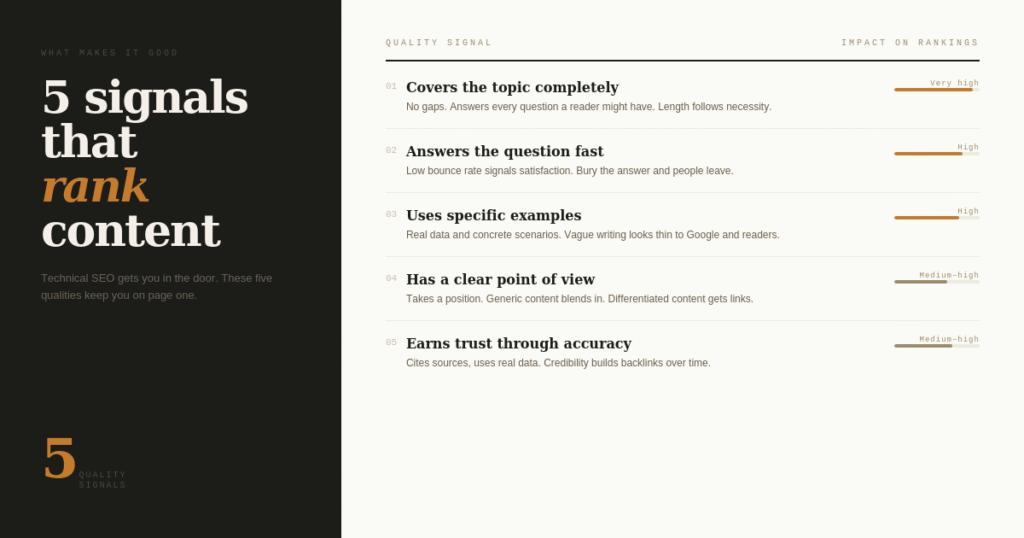
It covers the topic completely. Google rewards comprehensive content. That doesn’t mean long for the sake of long it means the piece answers all the questions a reader might have about the topic. If someone reads my article and still has to Google something related, I’ve left a gap.
It has a point of view. The best SEO content I’ve written takes a clear position. It says something. Generic, hedge-everything content might be safe, but it’s also forgettable. Google can’t distinguish your content from a thousand other pieces that say the same thing in the same way.
It uses specific examples. Vague writing doesn’t help anyone. “SEO writing is important” tells a reader nothing. “A well-optimized blog post targeting a 500-search-per-month keyword can generate 200+ organic visits per month within 6 months” that tells them something real.
It answers the question fast. I don’t bury the answer at the bottom after three paragraphs of introduction. I give people what they came for as early as possible. Then I build on it.
It earns trust. Good SEO writing cites real sources, uses accurate data, and doesn’t make claims it can’t back up. Readers and search engines both reward credibility.
Common SEO Writing Mistakes I’ve Made (And You Should Avoid)
I want to be honest here. I’ve made every one of these mistakes.
Targeting keywords I couldn’t rank for. Early on, I would target high-volume keywords without checking the competition. I’d spend hours writing a piece only to have it buried on page 8 forever. Now I always check difficulty before I commit to a keyword.
Writing for algorithms instead of people. I went through a phase where I was obsessed with keyword density and optimization scores. The writing was stiff, robotic, and nobody read it. Rankings suffered anyway.
Skipping the search intent analysis. I wrote a detailed, informative guide for a keyword that turned out to be transactional. Everyone searching it wanted to buy a service, not read a tutorial. The content didn’t match what they wanted, so it didn’t rank.
Ignoring existing content. I used to write without looking at what was already ranking. Rookie mistake. Understanding what Google has already decided works for a keyword is essential before you write a word.
Publishing and forgetting. SEO content isn’t a one-and-done job. I’ve gone back to articles 6 months later, updated them with new information, improved the structure, and watched them climb from page 2 to page 1. Content needs maintenance.
SEO Writing and AI: Where I Stand
I’d be ignoring reality if I didn’t address this.
AI writing tools are everywhere. A lot of SEO writers use them. I use them too, in specific ways.
But here’s my honest take: AI-generated SEO content, published as-is, is a problem. Not because Google will penalize it automatically it often won’t. But because AI content tends to be generic. It covers the obvious points. It doesn’t take a position. It doesn’t include real experience or specific insight. And over time, generic content loses to content that’s actually useful.
Where I find AI tools genuinely helpful is in the research phase generating outlines, identifying questions people ask, suggesting related topics. And in the editing phase catching unclear sentences, flagging repetition, tightening structure.
The actual writing? That’s where I add the value. The examples. The opinions. The experience. The things an AI can’t generate because it hasn’t lived them.
Use AI as a tool, not a replacement. That’s my position.
How to Get Better at SEO Writing
I’ll keep this practical.
Study the SERPs obsessively. Every time you search for something, notice what ranks and why. What’s the format? What’s the angle? What did the top result do better than the others? This habit alone will teach you more than most courses.
Read widely in your niche. The best SEO writers I know are also the most well-read. They bring depth of knowledge to their writing. That depth shows and it’s what makes content genuinely useful.
Write consistently. There’s no other way to improve. Every piece you write teaches you something about structure, tone, keyword usage, and reader behavior. Write more.
Learn basic SEO fundamentals. You don’t need to be a technical SEO expert. But understanding how search engines work, what they reward, and what they penalize will make every piece you write more effective.
Analyze your results. Use Google Search Console to see which articles are getting impressions and clicks. Which ones are ranking on page 2 and could be improved? Which keywords are you showing up for that you didn’t expect? Data tells you where to focus.
Update your content. I can’t stress this enough. Old content that’s updated regularly outperforms new content that’s abandoned. Set a schedule to revisit your top pieces every 6 to 12 months.
Is SEO Writing a Good Career?
Yes. Without hesitation.
Demand for skilled SEO writers is steady and growing. Every business that wants organic traffic needs content. That’s a huge market: startups, agencies, established brands, SaaS companies, e-commerce businesses, local service providers. All of them need people who can write content that ranks.
And here’s what I find particularly good about SEO writing as a career: it’s measurable. You can see the impact of your work in rankings, traffic, and conversions. That makes it easier to demonstrate your value, charge more, and build a track record that speaks for itself.
Specialization also pays well. An SEO writer who understands a specific niche legal, finance, health, SaaS can charge significantly more than a generalist. The more you know about a topic, the better your content, and the more you’re worth.
Final Thoughts
SEO writing, at its core, is problem-solving.
Someone has a question. I figure out exactly what they’re asking, why they’re asking it, and what would genuinely help them. Then I write that clearly, completely, and in a format that’s easy to read.
The SEO part is just making sure Google can find it, understand it, and show it to the right people.
I’ve been doing this long enough to know there are no shortcuts. Keyword stuffing doesn’t work. Thin content doesn’t last. Publishing and forgetting doesn’t scale.
What works is writing real, useful, well-structured content consistently, over time, with a clear understanding of what your audience is looking for.
Do that, and SEO writing will deliver results that compound for years.