I have spent years writing content for brands, blogs, and marketing campaigns. And if there is one thing I keep coming back to, it is this: the most persuasive content on the internet is not written by professionals. It is written by customers.
That is the power of user generated content, or UGC. It is raw, real, and refreshingly honest. And when you know how to find it, manage it, and use it strategically, it becomes one of the most valuable tools in any content creator’s or marketer’s toolkit.
In this article, I am going to walk you through everything you need to know about UGC. I will cover what it is, the different types of content it includes, where it lives, how brands use it, and most importantly, how you can start leveraging it today.
UGC is not a trend. It is a fundamental shift in how trust is built online.
- What Is User Generated Content?
- The Main Types of User Generated Content
- How UGC Works: The Trust Loop
- Where UGC Lives: Key Platforms
- How to Leverage UGC: A Practical Strategy
- Tools That Help You Work with UGC
- Legal Considerations You Cannot Ignore
- Why UGC Matters Specifically for Writers
- Frequently Asked Questions
- Final Thoughts
What Is User Generated Content?
User generated content is any content created by real people, not brands or paid professionals, that references or relates to a product, service, place, or experience.
Think about the last time you bought something online. Chances are, you scrolled through reviews, looked at photos uploaded by other customers, or watched an unboxing video on YouTube. That is all UGC.
It exists in many forms. It can be a five-star review on Amazon, a selfie tagged at a hotel, a Reddit thread dissecting a software product, or a TikTok video of someone showing off a new outfit. What ties all of it together is one thing: it was created voluntarily by a real user, not by a brand’s marketing team.
For writers and content strategists, UGC matters for two big reasons. First, it tells you what your audience actually thinks and says. Second, it gives you a content source you did not have to produce yourself.
The Main Types of User Generated Content
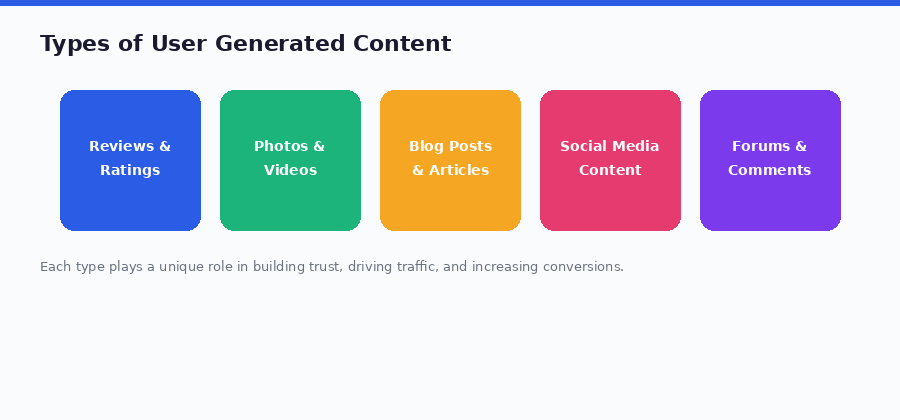
The five core types of UGC and where they show up across the web.
UGC is not one-size-fits-all. It shows up in very different formats depending on the platform, the audience, and the product. Here are the main types you need to know.
1. Reviews and Ratings
This is the most common and highest-impact type of UGC. When someone leaves a review on Google, Amazon, Yelp, Trustpilot, or a brand’s own website, they are giving other potential customers a shortcut to their buying decision.
As a writer, reviews are goldmines. They tell you exactly what language your customers use, what problems they were trying to solve, and what made them happy or disappointed. I mine reviews constantly when writing copy, because nothing beats real customer language for authenticity.
2. Photos and Videos
Customers sharing photos and videos of products in real-world use is incredibly powerful. A hotel photo taken by a real guest feels more trustworthy than a polished press image. A customer showing how a skincare product changed their skin in 30 days outperforms any brand video.
Platforms like Instagram, TikTok, and YouTube are entirely built on this type of UGC. For brands, this visual content can be repurposed across ads, landing pages, and social channels with proper permission.
3. Blog Posts and Long-Form Articles
Sometimes users go deeper. They write detailed tutorials, honest comparisons, or in-depth reviews in blog format. These often rank well in search engines because they are detailed, genuine, and answer real questions.
As a writer, this type of UGC is a signal. If someone is writing a 1,500-word post about a product or topic, there is clearly an audience hungry for that information. It is a cue to create something even better, more thorough, and more useful.
4. Social Media Posts and Threads
Tweets, Instagram captions, LinkedIn posts, Facebook groups, and Reddit threads are all forms of UGC. Social media content creation powered by users generates an enormous volume of organic conversation around brands every day.
These posts often feel more like word-of-mouth than advertising. A thread on Reddit where someone praises or critiques a product can influence thousands of purchasing decisions without the brand ever getting involved.
5. Forums, Comments, and Q&A
Quora answers, comment sections on YouTube videos, community forums, and platform-specific Q&A sections like Amazon’s customer questions, these are all UGC in a slightly less polished but equally valuable format.
This type of content is especially useful for content gap analysis. The questions people ask in forums are the exact keywords and topics your next article should address.
How UGC Works: The Trust Loop
UGC creates a self-reinforcing cycle of trust, reach, and conversions.
Understanding why UGC is so effective comes down to one word: trust.
According to multiple studies, consumers trust content from other consumers far more than they trust branded content. A review from a stranger is more believable than a polished ad. A candid photo beats a studio shoot. An honest YouTube review beats a brand explainer video.
Here is how the trust loop works in practice.
- A customer has a genuine experience with a product or service.
- They share that experience on a platform, through a review, a photo, or a post.
- The brand finds that content and, with permission, amplifies it.
- New potential customers see it, trust it because it is genuine, and make a purchase.
- Those new customers then create their own UGC, and the cycle repeats.
The most credible voice in your marketing is not yours. It belongs to the people who have already said yes to you.
For writers and content creators, this loop matters because it means your job is not always to create content from scratch. Sometimes your job is to identify, curate, and amplify the content that already exists.
Where UGC Lives: Key Platforms
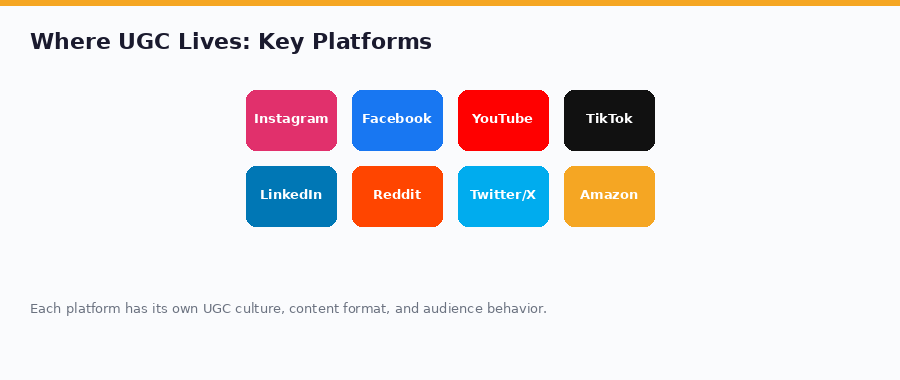
UGC spans dozens of platforms, each with its own format and audience behavior.
UGC does not live in one place. It is scattered across dozens of platforms, and understanding where your audience is creating it is the first step in leveraging it effectively.
Instagram is arguably the most UGC-rich platform in the world. Customers tag brands in photos, leave comments on posts, and share stories that mention products. The visual nature of the platform makes photo and video UGC especially powerful here.
For social media content creation, branded hashtag campaigns on Instagram are one of the most reliable ways to collect high-quality UGC at scale. Think of campaigns where a brand asks users to post their experience using a specific hashtag, and then the brand curates the best submissions.
TikTok
TikTok has accelerated the UGC economy dramatically. Products go viral not because of ads but because someone made a 30-second video showing a creative use or honest review. The platform’s algorithm rewards authenticity, which naturally favors UGC over polished branded content.
For writers, TikTok’s comment sections are incredible sources of unfiltered customer sentiment. The language people use in comments often translates directly into effective headline copy.
YouTube
Long-form video reviews, tutorials, and unboxings on YouTube are among the most trusted forms of UGC. A 10-minute review of a product from an ordinary person often carries more weight than an official product launch video.
YouTube is also a strong SEO asset. UGC videos rank in both YouTube search and Google search, making them part of the wider content ecosystem that content strategists need to understand.
Reddit is where UGC goes deep. Communities called subreddits exist for almost every niche imaginable. Conversations are detailed, honest, and often ruthlessly critical. For brands, Reddit can feel intimidating because users detect inauthenticity immediately.
For writers, Reddit is a research superpower. Searching for a topic within Reddit will surface the real questions, frustrations, and language patterns of your target audience faster than any keyword tool.
Amazon
Amazon reviews are pure, unfiltered UGC. They are often highly detailed, specific, and influential. Amazon’s question-and-answer feature is another form of UGC that content creators should study closely, because each question is a real content opportunity.
How to Leverage UGC: A Practical Strategy
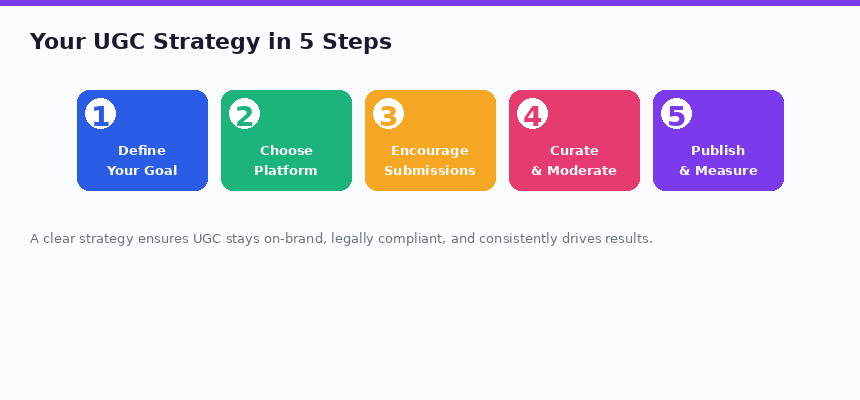
Five clear steps to build a UGC strategy that consistently delivers results.
Knowing what UGC is and knowing how to use it are two different things. Here is the practical strategy I recommend based on what has worked consistently in my experience.
Step 1: Define What You Want UGC to Do
Before you start collecting or sharing UGC, be clear about the goal. Are you trying to build trust on your product page? Drive engagement on social media? Fill your content calendar? Generate organic search traffic?
Each goal points to a different type of UGC and a different strategy. A trust-building goal calls for testimonials and reviews. A social media content creation goal calls for photos and short videos. An SEO goal points to forum content and long-form user posts.
Step 2: Choose the Right Platform
Go where your audience is already creating. If you sell physical products, Amazon and Instagram are natural starting points. If you are in software or tech, Reddit, GitHub discussions, and LinkedIn are strong options. If you target a younger audience, TikTok is essential.
Do not try to collect UGC from every platform simultaneously, especially when you are starting out. Pick one or two platforms, build a repeatable process, and then expand.
Step 3: Encourage and Incentivize Submissions
UGC happens organically, but you can dramatically increase its volume and quality by actively encouraging it. Here are proven tactics.
- Create a branded hashtag and promote it in your packaging, email newsletters, and social bios.
- Ask for reviews at the right moment, such as shortly after a purchase or after a customer has had time to use your product.
- Run contests or challenges that invite users to create content in exchange for recognition or rewards.
- Feature customer content on your channels, because people are more likely to create UGC when they know it might be showcased.
- Add a prompt inside your product or service, such as an insert card that says ‘Share your experience and tag us.’
Step 4: Curate and Moderate
Not all UGC is created equal, and not all of it should be shared. You need a curation process that keeps quality high and keeps your brand protected.
Always get explicit permission before sharing someone’s content. A direct message asking for permission is the minimum. For commercial use, consider a more formal release process.
Moderate for accuracy, appropriateness, and brand alignment. This does not mean hiding negative reviews. Negative reviews that are handled well actually increase trust. But you do not have to amplify content that is offensive, misleading, or off-brand.
Step 5: Publish, Track, and Optimise
Once you have a flow of curated UGC, start publishing it strategically. Embed reviews on product pages. Use customer photos in ad creative. Feature user stories in your email campaigns. Pull forum questions into your blog content calendar.
Track what works. UGC-based ads consistently outperform branded content in click-through and conversion rates. But the specific types of UGC that work best will vary by audience and channel. Test, measure, and double down on what performs.
Tools That Help You Work with UGC
Whether you want to collect, manage, or publish UGC, the right tools save enormous time. Here is an in-depth look at the most useful platforms for writers and content creators working with UGC.
Yotpo
Yotpo is one of the most comprehensive UGC platforms available, particularly for e-commerce writers and content teams. It specializes in collecting reviews, ratings, photos, and Q&A from customers and integrating them directly into product pages and marketing campaigns.
What makes Yotpo valuable for writers is its ability to automatically prompt customers for reviews at the right moment in the purchase journey. The platform also lets you display curated photo galleries on your site using real customer images.
From a content standpoint, Yotpo gives you a dashboard full of authentic customer language that you can use to sharpen your copy. I have used Yotpo-sourced reviews to rewrite product descriptions and seen significant improvements in conversion. The review analytics also tell you which product features matter most to customers, which is gold for content strategy.
It integrates well with Shopify, BigCommerce, and Salesforce, making it a practical choice for teams already using those platforms. The pricing is on the higher end for small teams, but the volume and quality of UGC it surfaces justifies the investment for established e-commerce operations.
TINT
TINT is a UGC aggregation and publishing platform that pulls content from Instagram, TikTok, Twitter, YouTube, Facebook, and more into a single dashboard. For social media content creation, it is exceptionally useful.
As a writer or content manager, TINT lets you monitor brand mentions and hashtags across platforms simultaneously. You can then curate the best content, request rights with built-in permission tools, and publish it to websites, email campaigns, and digital displays.
One feature I particularly appreciate is the rights management workflow. TINT allows you to send automated direct messages requesting content rights, track approvals, and store documentation. This is critical when you are using UGC in commercial settings where permissions matter legally.
TINT is well-suited for mid-sized to large brands running active social campaigns. It is not the cheapest option, but for teams managing UGC at scale across multiple channels, the centralized workflow saves significant time and reduces the risk of publishing content without proper rights clearance.
Bazaarvoice
Bazaarvoice is an enterprise-level UGC platform focused on reviews, ratings, and product questions. It is widely used by major retailers and brands to syndicate customer reviews across their own sites and retail partner sites.
For writers and content strategists working in retail or consumer goods, Bazaarvoice provides a uniquely powerful dataset. The platform’s sampling program lets brands send products to targeted consumers in exchange for honest reviews, which helps generate UGC for new or low-review products.
The content analytics within Bazaarvoice are particularly strong. You can filter reviews by sentiment, product attribute, geographic region, and more. For a content writer, this level of segmentation means you can understand exactly what customers in different demographics care about and write content that speaks directly to each group.
Bazaarvoice also has a strong syndication network, meaning reviews collected on one site can appear on partner retailer sites. This extends the reach of UGC beyond a single brand’s own platform. It is an enterprise tool with enterprise pricing, best suited for large consumer brands or agencies managing multiple accounts.
Sprout Social
While Sprout Social is primarily known as a social media management platform, its UGC capabilities are genuinely useful for content creators. The platform monitors brand mentions, hashtags, and tagged posts across major social networks, making it easy to identify UGC as it happens.
For writers managing social media content creation for clients or their own brands, Sprout Social’s content library feature lets you save, organize, and schedule UGC alongside original content. The tagging and categorization system helps you maintain a well-organized library of approved content.
Its analytics are particularly helpful for understanding how UGC performs compared to original branded content. I have used Sprout Social to run side-by-side comparisons of engagement rates and reach, and the data consistently shows UGC outperforming polished branded posts in most categories.
Sprout Social is priced for professional and business use. It is not the right tool if all you need is UGC collection, but if you are already using it for social media management, the UGC features add real value without requiring an additional tool.
Embed Social
Embed Social is a more accessible and affordable option compared to enterprise platforms. It focuses on pulling reviews and social media posts from platforms like Google, Facebook, Instagram, and Twitter, and turning them into embeddable widgets for websites.
For independent writers, bloggers, or small brand teams, Embed Social is often the most practical entry point into UGC management. You can create review widgets, social media feeds, and photo galleries that display real-time UGC directly on your website with minimal technical setup.
The review aggregation feature is particularly useful for writers managing personal brands or niche sites. You can pull Google Business reviews, Facebook recommendations, and social mentions into a single feed and embed it on your site to build credibility instantly.
Embed Social also offers a basic rights management feature that lets you request permission to use social media photos. While not as robust as TINT or Yotpo, it is sufficient for smaller-scale operations. The pricing tiers are transparent and accessible, making it the best starting point if you are new to working with UGC and want a low-risk way to test the approach before investing in enterprise tools.
Legal Considerations You Cannot Ignore
This is the section that most content guides skip, but it is one of the most important. Using UGC without proper permission can create serious legal and reputational problems.
Here is what you need to keep in mind.
Always get explicit permission. A tag or a mention does not give you the right to use someone’s content commercially. Contact the creator directly, explain how you want to use the content, and get a clear yes in writing.
Credit the creator. Even with permission, always credit the original creator. This is both good practice and, in many jurisdictions, a legal requirement related to moral rights.
Be careful with faces and names. Using someone’s photo, especially in advertising, can implicate right of publicity laws. When in doubt, consult a legal professional before using photos of identifiable individuals in paid campaigns.
Negative reviews are protected speech. Do not attempt to remove or suppress negative reviews unless they violate a platform’s terms of service. Attempting to silence legitimate criticism can backfire badly, both legally and in terms of public perception.
Store your permissions securely. Keep a record of every permission granted. Platforms like TINT and Bazaarvoice have built-in tools for this. If you manage smaller volumes manually, a simple spreadsheet tracking the creator, platform, content URL, and permission date works fine.
Why UGC Matters Specifically for Writers
I want to close this section by speaking directly to writers, because UGC changes your job in ways that are worth naming clearly.
UGC is a research tool. Before I write a single word for a product or brand, I spend time reading reviews, forum threads, and social comments. This tells me the vocabulary my audience uses, the problems they are trying to solve, and the objections I need to address. No keyword tool gives me this depth of insight.
UGC is a source of proof. The most effective sales and content writing is built on social proof. Weaving real customer quotes, statistics from reviews, and authentic stories into your writing makes it dramatically more persuasive. Readers do not fully trust you as a writer. They trust people like themselves.
UGC is a content gap detector. When I search Reddit or Quora for a topic and find dozens of unanswered questions, I have found my next article. UGC tells you what your audience wants to know and is not getting from existing content.
UGC makes your content calendar manageable. Instead of creating everything from scratch, a smart content strategy includes curating, summarizing, and commenting on UGC. This gives you a steady stream of content that is both useful and authentic without burning out your team.
Frequently Asked Questions
1. What is the difference between UGC and influencer content?
UGC is created voluntarily by real customers without payment, while influencer content is typically created under a paid or sponsored agreement. Both can be authentic, but UGC is generally perceived as more trustworthy because there is no commercial arrangement involved. Many brands now work with micro-creators who blur this line, creating content that feels like UGC but is lightly compensated.
2. Do I need to pay for user generated content?
In most cases, you do not pay for the original creation of UGC since it is created freely by users. However, if you want to use UGC in paid advertising or on commercial materials, you should obtain proper rights, which may involve compensating the creator. Simply reposting organic social content with credit is generally acceptable with permission, but paid ad usage is a different situation that typically requires a formal rights agreement.
3. How do I encourage more UGC for my brand or project?
The most reliable ways to increase UGC volume are to ask at the right moment, create a reason to share, and make sharing easy. This means sending review requests shortly after purchase, creating branded hashtags that give users a community to belong to, running content contests with clear prompts, and featuring customer content on your own channels so others know their submissions will be seen and appreciated.
4. Can UGC hurt my brand if it is negative?
Negative UGC exists whether you engage with it or not. Ignoring it is worse than responding. Brands that respond professionally to negative reviews and address legitimate complaints actually build more trust than brands with only perfect scores, because it signals transparency and accountability. The key is to monitor UGC consistently and respond thoughtfully rather than reactively.
5. Is UGC relevant for B2B content creators and writers?
Absolutely. In the B2B space, UGC appears as case studies, LinkedIn posts, peer reviews on platforms like G2 and Capterra, conference session content, and community forum discussions. For B2B writers, LinkedIn posts from real users discussing a tool or service, and detailed software reviews on G2, are among the most valuable research and credibility sources available. The UGC ecosystem is just as active in B2B, it simply operates on different platforms and in different formats than consumer UGC.
Final Thoughts
User generated content is not a shortcut. It is a strategy. And when you treat it as one, it becomes one of the most powerful assets in your content toolkit.
I have seen UGC transform product pages, fill content calendars, sharpen copy, and build communities that sustain brands through tough markets. The brands and writers who understand this do not see UGC as something that competes with their work. They see it as the foundation on which great content is built.
Start by listening. Read the reviews. Search the forums. Scroll the comments. Your audience is already telling you what they think, what they need, and what would make them trust you. The only question is whether you are paying attention.
The best content strategy is one that amplifies real voices, not one that drowns them out.