
Most writers think good writing is enough to rank on Google. It is not. Without a clear SEO strategy behind it, even excellent content stays invisible. Here is a complete guide to SEO writing that covers everything you need to know.
SEO Writing: TL;DR
You can rank your content on Google by aligning it with what people actually search for and optimizing every element of the page.
Here is what the process looks like:
- Research your keyword. Find a term your audience searches for, check its volume and difficulty, and confirm you can cover it better than what already ranks.
- Understand search intent. Look at the top-ranking pages for your keyword. Identify whether people want information, a comparison, or a product. Match that format.
- Plan your structure. Outline your H2 and H3 headings before you write. Cover every subtopic the reader would expect to find.
- Write for humans first. Use short sentences, plain language, and a clear flow. Make it easy to read and easy to skim.
- Optimize on-page elements. Place your primary keyword in the title tag, H1, first paragraph, and throughout the body where it fits naturally.
- Add internal links. Point to two to five related articles on your site using descriptive anchor text.
- Write your meta description. Keep it under 160 characters, include your keyword, and make it compelling enough to earn a click.
- Update regularly. Revisit your best articles every few months to keep them accurate and competitive.
What Is SEO Writing?
SEO writing, or SEO content writing, is the craft of producing written content that is optimized for search engines while being genuinely useful to readers.
It sits at the intersection of two disciplines: traditional writing and search engine optimization. You are not just writing an article. You are building something that answers a specific question, targets a specific keyword, and is structured in a way that Google can crawl, understand, and rank.
A good SEO writer is not someone who stuffs keywords into sentences until they stop making sense. That approach died a long time ago. Today, writing for SEO means understanding what your audience is looking for, writing content that fully satisfies that need, and organizing it so both users and search engines can navigate it easily.
I like to think of it this way: Google is trying to find the best possible answer to every search query. My job as an SEO content writer is to make sure my content is that answer.
Why SEO Writing Matters More Than Ever
Organic search is one of the most powerful traffic channels available. Unlike paid ads, content that ranks continues to bring in visitors for months or years after you publish it.
But the competition has never been more intense. Every niche has dozens or hundreds of websites publishing content regularly. If you are not writing with SEO in mind, you are producing content that may never be found.
The stakes are high. An article that ranks on page one can drive thousands of monthly visitors. An article buried on page five might as well not exist.
Beyond traffic, SEO content writing builds trust and authority. When your content consistently appears at the top of search results, readers start to associate your name or brand with expertise. That is hard to buy and impossible to fake over the long term.
Step 1: Keyword Research Done Right
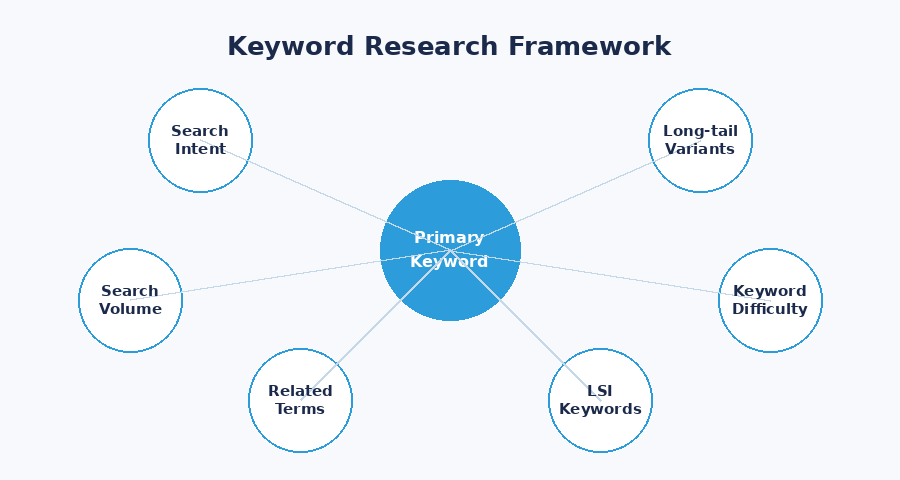
Everything in SEO writing starts with keyword research. Before I write a single sentence, I need to know what people are actually searching for.
Keyword research is the process of identifying the exact words and phrases your target audience types into search engines. It tells you what topics are worth writing about, how competitive those topics are, and how to frame your content.
How I Approach Keyword Research
I start broad. I think about the main topic I want to cover, then I use tools like Google Search Console, Ahrefs, SEMrush, or even Google’s autocomplete feature to find related searches.
From there, I look for three things:
- Search volume: How many people search for this term each month?
- Keyword difficulty: How hard will it be to rank for this term?
- Relevance: Does this keyword match what I can genuinely write about?
For most writers and websites that are not yet established, I recommend targeting long-tail keywords. These are longer, more specific phrases with lower search volume but also lower competition.
For example, instead of targeting “SEO writing” right out of the gate, a newer site might start with “how to write SEO-friendly blog posts for beginners.” Less competition, more specific, and often higher conversion because the person searching knows exactly what they want.
Primary vs. Secondary Keywords
Every article I write has one primary keyword. That is the main term the article is built around. Then I layer in secondary keywords, which are related terms and variations that naturally support the main topic.
In this article, the primary keyword is seo writing. Secondary keywords include seo content writing, seo content writer, seo writer, and writing for seo. These are not stuffed in randomly. They appear where they naturally fit.
Google is smart enough to understand semantic relationships between words. You do not need to repeat the exact same phrase twenty times. You need to cover the topic comprehensively.
Step 2: Understanding Search Intent
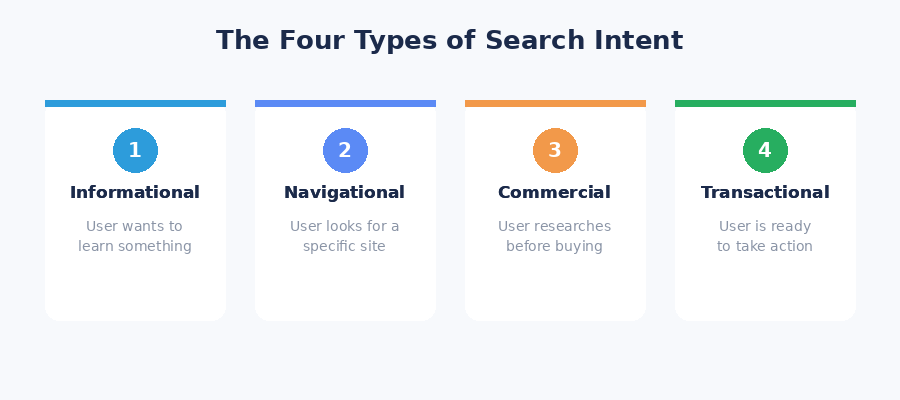
Keyword research tells you what people search for. Search intent tells you why they are searching for it.
This distinction is critical. If you write a transactional product page for someone who wanted an informational how-to guide, your content will not rank no matter how well-written it is. You are giving people the wrong thing.
There are four types of search intent. Understanding them changed how I write everything.
Informational Intent
The user wants to learn something. They are asking a question or trying to understand a concept. Articles, guides, tutorials, and explainers serve this intent. Most SEO content writing targets informational intent.
Example search: “what is SEO writing” or “how does keyword research work.”
Navigational Intent
The user is looking for a specific website or brand. They already know where they want to go. You cannot really compete for navigational searches unless your brand is what they are looking for.
Example search: “Ahrefs login” or “Moz blog.”
Commercial Intent
The user is in research mode. They are comparing options before making a decision. Comparison articles, reviews, and “best of” lists serve this intent well.
Example search: “best SEO tools for bloggers” or “Ahrefs vs SEMrush.”
Transactional Intent
The user is ready to take action, usually to buy something. Product pages, landing pages, and service pages serve this intent.
Example search: “buy SEO content writing service” or “hire SEO writer.”
How to Match Intent Before Writing
Before I start any article, I type my target keyword into Google and look at what ranks on page one. I ask: what format is it? Is it a listicle, a how-to guide, a definition piece, or a comparison article? What is the approximate length? Are there images and tables?
The top-ranking pages are the clearest signal of what Google believes best serves that keyword’s intent. I use that information to shape my own content.
Step 3: Structuring Your SEO Content
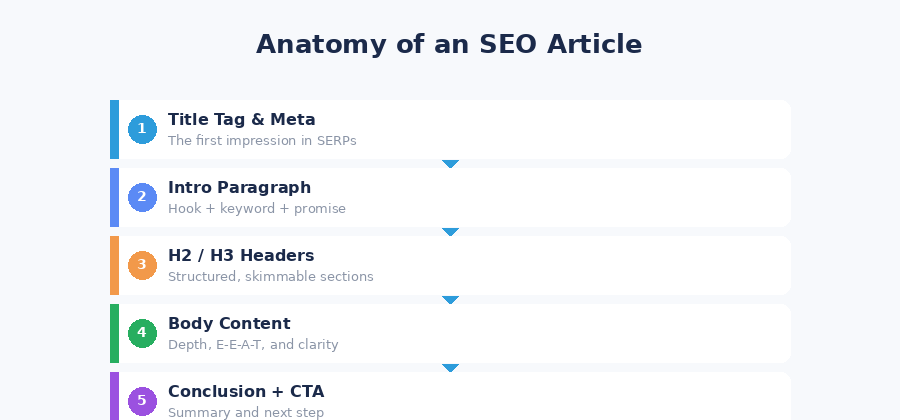
Good SEO content is structured for skimmability. Most readers do not read every word. They scan for the parts that are relevant to them. Your job is to make that easy.
When I structure an article, I think in layers. There is the outer shell that search engines and skimmers see first, and there is the inner body where engaged readers go deeper.
The Title Tag and H1
Your title tag is the clickable headline that appears in Google search results. Your H1 is the main heading at the top of your page. They should be closely related, though not necessarily identical.
The title tag should include your primary keyword and ideally appear near the beginning of the title. It should also be compelling enough to earn a click. You are competing with nine other results on the page.
Keep title tags between 50 and 60 characters. Anything longer risks being cut off in search results.
The Meta Description
The meta description does not directly affect your ranking, but it massively affects your click-through rate. It is the short paragraph below your title tag in search results.
Write it like an ad. What is the promise of this article? What will the reader get? Keep it between 150 and 160 characters and include your primary keyword naturally.
Headings: H2 and H3
I use H2 headings for major sections and H3 headings for subsections. This creates a logical hierarchy that makes the article easy to scan and helps Google understand the structure of your content.
Include keywords in headings where they make natural sense. Do not force it. A heading that reads awkwardly because you jammed a keyword in is worse than a clean heading with no keyword.
The Introduction
The first 100 to 150 words of your article are critical. They need to confirm to the reader that they are in the right place. Include your primary keyword in the first paragraph. Hook the reader fast. Tell them what they will get out of reading.
I always write my introduction last. Once I know everything the article covers, I can write a much better setup for it.
The Body
The body of your article is where you deliver on the promise of your title. Each section should answer one specific question or cover one specific subtopic.
Keep paragraphs short: two to four sentences maximum. Use bullet points and numbered lists where appropriate. Add visual breaks. Give the reader room to breathe.
The Conclusion
Wrap up the key takeaways clearly. You do not need to restate everything you wrote. Just give the reader a clean landing and, where appropriate, a next step or call to action.
Step 4: On-Page SEO Optimization
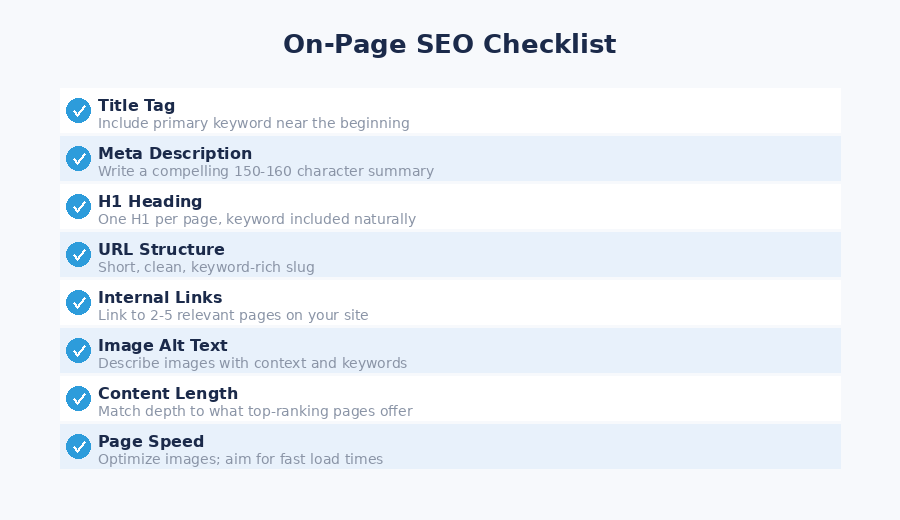
Writing great content is necessary but not sufficient. You also need to optimize the technical elements of your article so search engines can properly index and rank it.
On-page SEO is the practice of optimizing individual pages on your site. As an SEO content writer, these are the elements I pay close attention to every single time.
URL Structure
Keep URLs short, clean, and descriptive. Include your primary keyword. Avoid numbers, dates, and unnecessary words.
Good example: yoursite.com/seo-writing
Bad example: yoursite.com/blog/2024/03/15/what-is-seo-writing-and-why-does-it-matter
Keyword Placement
Include your primary keyword in the title tag, the H1, the first paragraph, at least one H2, and throughout the body where it fits naturally. Do not force it. Google will recognize keyword stuffing and it will hurt more than help.
Use secondary keywords and related terms naturally throughout the content. Think of them as supporting the main topic, not as boxes to check.
Internal Linking
Internal links point to other pages on your own site. They help search engines discover and understand your content, and they distribute ranking authority across your site.
Every article I write links to two to five other relevant pieces of content on the same site. I use descriptive anchor text that tells the reader and the search engine what the linked page is about.
Image Optimization
Every image needs an alt text that describes the image accurately. Include your keyword in at least one image’s alt text where it fits naturally.
Also compress your images before uploading. Large image files slow down your page, and page speed is a ranking factor.
Content Freshness
Search engines reward fresh, accurate content. For evergreen articles, I revisit and update them periodically. I correct outdated information, add new data, and expand sections that could use more depth.
An updated date signal can help an article compete in fast-moving niches.
Step 5: Writing for Humans First
This step might seem obvious, but it is the one most SEO writers neglect. All the keyword research and technical optimization in the world will not save a piece of content that is boring, confusing, or unhelpful.
Search engines are getting better every year at understanding what humans find valuable. Google’s algorithm updates consistently reward content that keeps readers engaged and penalize content that gets clicks but fails to deliver.
Write in Simple, Clear Sentences
I write the way I talk. Short sentences. Common words. Active voice.
If a sentence takes two reads to understand, it needs to be rewritten. Your reader is busy and has plenty of other options.
Read your draft out loud before you publish. If you stumble over a sentence, your reader will too.
Use the Inverted Pyramid
Journalists use a technique called the inverted pyramid: the most important information comes first, supporting details follow, and background context comes last.
This works perfectly for SEO content. Readers who only skim still get the essential information. Readers who are deeply engaged get everything.
Address the Reader Directly
Write in the second person. Use “you” and “your.” This creates a conversation rather than a lecture. Readers feel like the content is speaking to them specifically.
Back Up Claims with Data and Examples
Unsubstantiated claims feel weak. Whenever I make an assertion, I try to support it with a statistic, a study, a real example, or my own direct experience.
This is part of what Google calls E-E-A-T: Experience, Expertise, Authoritativeness, and Trustworthiness. Demonstrating that you have real knowledge and experience makes your content more credible to both readers and search engines.
Avoid Fluff and Filler
Every sentence should earn its place. If a paragraph is not adding information, context, or clarity, cut it.
“In today’s digital world, content is king.” That sentence says nothing. Do not write it.
E-E-A-T and Why It Matters for SEO Writers
E-E-A-T stands for Experience, Expertise, Authoritativeness, and Trustworthiness. It is a framework Google uses to evaluate the quality of content, particularly in sensitive niches like health, finance, and legal topics.
But E-E-A-T matters in every niche. Google wants to show users content written by people who actually know what they are talking about.
How to Demonstrate E-E-A-T in Your Writing
- Experience: Share personal examples. Tell readers what you have done, tested, or observed directly. This is what separates a good article from a generic one.
- Expertise: Write with depth. Cover the topic thoroughly. Do not just define terms. Explain concepts, address nuances, and anticipate follow-up questions.
- Authoritativeness: Cite credible sources. Link to research, studies, and well-known publications where relevant. Build a byline that demonstrates your background.
- Trustworthiness: Be accurate. Correct mistakes quickly. Write with integrity. Do not make claims you cannot support.
As an SEO content writer, building your reputation through consistently high-quality content is a long game. But it compounds over time.
How Long Should Your SEO Content Be?
This is one of the questions I get asked most often: is there a perfect word count for SEO?
The honest answer is no. Content length should be determined by what the topic requires and what the competition looks like, not by an arbitrary number.
That said, in-depth pillar articles and comprehensive guides typically range from 2,500 to 5,000 words because they need to cover a topic thoroughly enough to outcompete other resources.
For simpler queries with clear, quick answers, a 600-word article might be exactly right. Padding an article with filler just to hit a word count target will hurt you. Google does not reward length. It rewards relevance and completeness.
My Process for Determining Length
- Type your keyword into Google and look at the top five ranking articles.
- Estimate the approximate length of each.
- Identify any subtopics they cover that you have not planned for.
- Write until you have fully covered the topic, then stop.
| Pro Tip: Longer content tends to rank better not because of length itself, but because it tends to cover more subtopics, earn more backlinks, and keep readers on the page longer. Focus on depth, not word count. |
Common SEO Writing Mistakes I Made (And You Should Avoid)
Every experienced SEO writer has a graveyard of articles that never ranked. Here are the mistakes I see most often, including ones I made myself early on.
Writing for a Keyword Instead of a Topic
If your entire article is laser-focused on repeating one phrase, it will feel thin and unnatural. Google wants comprehensive coverage of a topic. Write for the topic. The keyword is just your entry point.
Ignoring Search Intent
Writing a long educational guide when the person searching wants a quick product comparison is a mismatch. Always check what type of content ranks before you start writing.
Thin Introductions
Many writers waste their introduction on vague platitudes. Get to the point fast. Confirm to the reader that they are in the right place. Hook them in the first thirty seconds.
No Internal Links
Every article exists within a larger website. Not linking to related content is a missed opportunity for both SEO and user experience.
Publishing and Forgetting
SEO content is not a one-and-done project. Search rankings change. Competitors publish new content. Facts become outdated. Go back and update your best articles regularly.
Tools Every SEO Writer Should Know
You do not need to spend a fortune on tools, but having the right ones makes a real difference. Here are the ones I use regularly.
- Google Search Console: Free. Shows you what keywords your site already ranks for, click-through rates, and where you are losing impressions.
- Ahrefs or SEMrush: Paid. Industry-standard tools for keyword research, competitor analysis, and content gap identification.
- Surfer SEO or Clearscope: Paid. These tools analyze the top-ranking pages for your keyword and give you a content brief with recommended terms to include.
- Google Trends: Free. Shows you whether a topic is growing or declining in interest over time.
- AnswerThePublic: Free tier available. Generates a visual map of questions people are asking around a topic. Excellent for finding subtopics and FAQ ideas.
- Hemingway Editor: Free. Highlights overly complex sentences, passive voice, and readability issues. I use it to simplify my drafts.
The Publishing Checklist: Before You Hit Publish
After years of publishing content, I have a checklist I run through every time. Here is my pre-publish routine for SEO content writing.
- Primary keyword is in the title tag, H1, first paragraph, at least one H2, and naturally throughout the body.
- Meta description is written, under 160 characters, and includes the primary keyword.
- URL is clean, short, and keyword-rich.
- All images have descriptive alt text.
- Internal links point to two to five relevant articles on the same site.
- All external links point to credible, authoritative sources.
- Headings create a logical hierarchy (H1 > H2 > H3).
- Content is proofread and free of factual errors.
- Page loads fast and looks good on mobile.
- The conclusion delivers a clear takeaway and, where appropriate, a next step.
Building a Career as an SEO Writer
If you are reading this as someone who wants to become an SEO content writer professionally, I want to be straight with you: it is a real and in-demand skill, and it takes genuine time to develop.
Every business with a website needs content. Every brand that does content marketing needs writers who understand SEO. The market for skilled SEO writers is large and growing.
How to Build Your Skills
- Start your own blog or website and practice on it. Real-world experience beats any course.
- Study the top-ranking content in niches that interest you. Reverse-engineer what makes it work.
- Learn to use at least one keyword research tool well. Ahrefs has excellent free educational resources.
- Practice writing in different formats: how-to guides, listicles, comparison articles, and long-form pillar pages.
- Get comfortable with Google Search Console data. Understanding performance metrics makes you a better writer.
Building a Portfolio
A portfolio is essential. Even if you have not had clients yet, create sample articles that demonstrate your SEO knowledge. Pick a niche, do the keyword research, write the article, and publish it.
When pitching to clients, the ability to say “here is a piece I wrote that ranks for this keyword” is worth more than any resume line.
Frequently Asked Questions
What is the difference between SEO writing and regular writing?
Regular writing focuses on communicating ideas clearly and engagingly. SEO writing does that too, but it also incorporates keyword research, search intent alignment, and on-page optimization elements like structured headings and meta tags. The goal of SEO content writing is to rank in search engines while still being genuinely useful to readers.
How long does it take for SEO content to rank?
It typically takes three to six months for a new article to reach its stable ranking position, though this varies significantly by competition level, domain authority, and how well the content matches search intent. Some articles rank within weeks on lower-competition keywords. Others take a year or more in highly competitive niches. Consistency and ongoing updates matter more than any single article.
How many keywords should I use in an SEO article?
Focus on one primary keyword per article and naturally include a handful of secondary keywords and related terms throughout. There is no magic number. Your goal is to cover the topic comprehensively, not to hit a keyword density percentage. If you are writing thorough, in-depth content on a topic, the right keywords will appear naturally.
Can I do SEO writing without paid tools?
Yes. Google Search Console, Google Trends, and Google’s autocomplete and People Also Ask features are all free and genuinely useful. AnswerThePublic has a free tier. You can build a solid foundation of SEO writing knowledge with free tools alone. Paid tools like Ahrefs or SEMrush give you a significant advantage in keyword research and competitor analysis, but they are not required to get started.
What is the most important factor in SEO content writing?
Matching search intent is the single most important factor. You can have perfect keyword placement and impeccable on-page SEO, but if your content does not give people what they are actually looking for, it will not rank and it will not convert. Understanding why someone is searching for a keyword, and then fully satisfying that need, is the foundation everything else is built on.
Final Thoughts
SEO writing is not a trick or a shortcut. It is a craft. It takes real work to understand what people are searching for, to write content that fully satisfies that need, and to optimize it so search engines can find and rank it.
But it is also one of the most rewarding things I do as a writer. There is something genuinely satisfying about publishing an article and watching it climb to the top of search results over the following months. Knowing that thousands of people are finding exactly what they were looking for, in something you created, is a powerful thing.
Start with keyword research. Understand the intent behind your target queries. Write with depth and clarity. Optimize the fundamentals. Update your content regularly.
Do those things consistently and you will build something that compounds over time. That is the real promise of SEO content writing, and it is entirely achievable with patience and the right approach.
Latest Posts On SEO Writing
- What is SEO Writing? The Complete Guide to Writing Content That Ranks
- SEO Marketing: The Complete Guide
- SEO Optimization in Content Marketing: The Key to Higher Rankings
- Keyword Research for SEO Writing: A Step-by-Step Guide
- Best SEO Tools for Content Optimization
- SEO Content Writing: How to Create High-Ranking Content in 2025
- SEO Content Checklist: Everything I Check Before I Hit Publish
- 10 Best AI Content Optimization Tools for SEO Marketers [Ranked]
- Steps to use Keyword Clusters to Improve Organic Traffic
- Online Search Trends For Businesses (2024)
- Build SEO Strategy with Rand Fishkin’s Whiteboard Friday Guide
- What Is Structured Data In SEO – Explained
- How to Optimize Your SEO Strategy for Voice Search
- How To Boost Your Website Conversion Rate with SEMrush
- Top Content Writing Practices During Google Algorithm Updates
- Boost Your Website Traffic With The Top SEO Techniques for 2024
- What Is Schema Markup & Why Is It Important For SEO?
- 10 Best SEO Writing Tools for 2024
