
I remember staring at a blank screen for two hours trying to write a product description for a blender. It was not a special blender. It did not have superpowers. But the client wanted people to feel something when they read about it.
That was my first real lesson in copywriting. The words you choose are not about the product. They are about the person reading them.
After years of writing sales pages, email campaigns, landing pages, ads, and product descriptions across dozens of industries, I have learned what works, what fails, and why most copy gets ignored.
This article is everything I know about copywriting, laid out in a way that actually makes sense.
What Copywriting Actually Is
Copywriting is the craft of writing text that gets a specific person to take a specific action.
That action could be clicking a button, signing up for a newsletter, buying a product, or simply picking up the phone and calling.
Notice I said a specific person and a specific action. That precision is what separates copywriting from general writing. A novelist writes to entertain a broad audience. A copywriter writes to move one type of person to do one thing.
Copywriting is strategy disguised as words. Every sentence has a job to do.
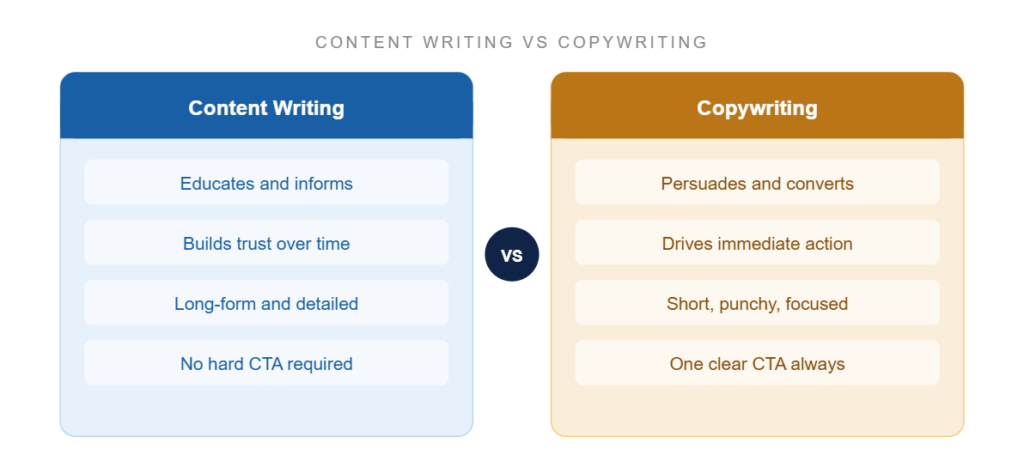
People often confuse copywriting with content writing. They are not the same thing. Content writing educates, informs, or entertains. Copywriting persuades. Both are valuable, but they work differently.
A blog post about how to clean your coffee machine is content. An ad that says your mornings are better when your machine actually works, click here to get the cleaning kit, is copy.
The Core Principle I Come Back to Every Single Time
Before I write a single word of copy, I ask myself one question.
What does this person want more than anything else right now, and how does this product or service give it to them?
That question is the foundation of all effective copywriting. Everything else flows from it.
People Do Not Buy Products. They Buy Outcomes.
When someone buys a gym membership, they are not buying access to treadmills. They are buying the version of themselves that fits into their old jeans.
When someone hires a copywriter, they are not buying sentences. They are buying more sales, more clicks, more customers.
Your copy must speak to the outcome, not the feature. Features describe what something does. Benefits describe how it changes someone’s life.
Feature: This blender has a 1200W motor.
Benefit: This blender powers through frozen fruit and tough greens in seconds so you can have your smoothie and leave the house on time.
One of those sentences makes someone lean forward. The other does not.
Understanding Your Reader Before You Write Anything
I have a rule I follow without exception. I spend at least as much time researching my reader as I do writing the copy.
This sounds slow. It saves enormous amounts of time.
When you know exactly who you are writing for, what they are afraid of, what they dream about, and what language they use when they talk to their friends, writing copy becomes surprisingly straightforward.
Where I Find This Information
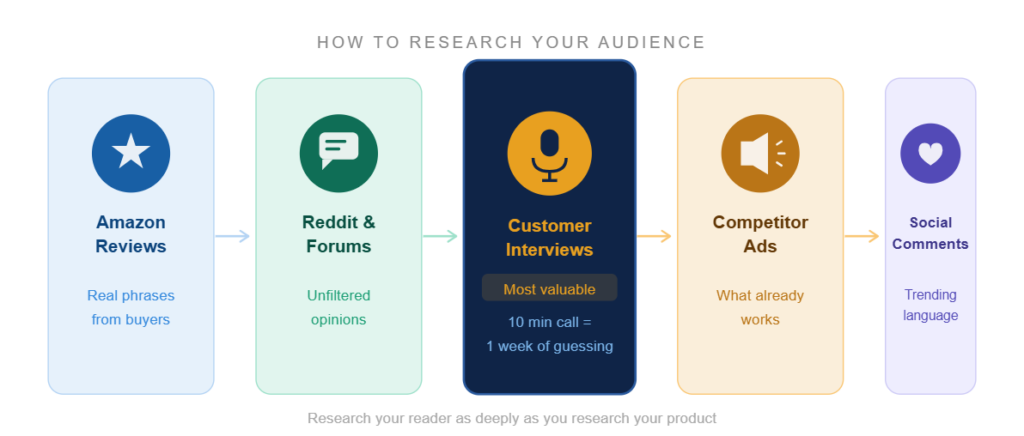
I read customer reviews on Amazon for products in the same category. I look for the exact phrases people use to describe their frustrations and their wins. Those phrases go directly into my copy.
I look at forums, Reddit threads, Facebook groups, and comment sections. Real people write with surprising honesty in those spaces.
I interview customers if I can. Ten minutes on the phone with a real buyer is worth more than a week of guessing.
The best copy is written in the language of the customer, not the language of the company.
When you use the words your reader already uses in their own head, they feel understood. And feeling understood is the first step toward trust.
The Anatomy of Copy That Actually Works
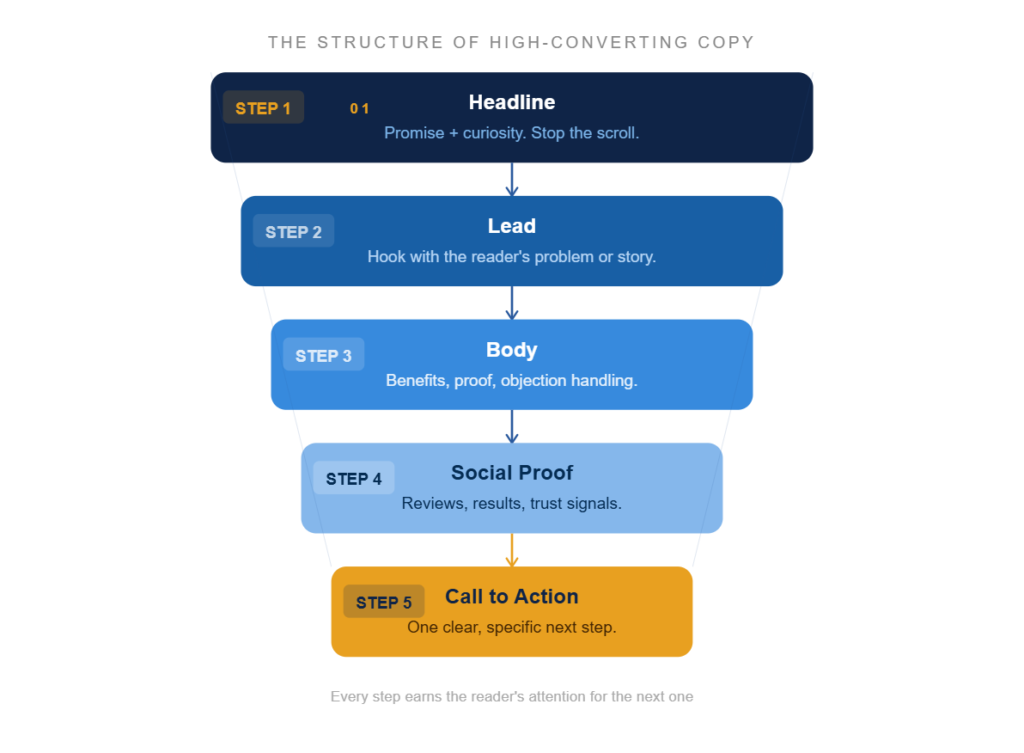
Over the years I have noticed a pattern in copy that converts well. It follows a structure, even when it does not look like it does.
The Headline Is Not Optional. It Is Everything.
Eight out of ten people read a headline. Only two out of ten read the rest. I learned this early and it changed how I approach every piece of copy I write.
Your headline has one job. Get the next line read.
The best headlines do one or more of these things:
- They make a specific promise with a believable outcome.
- They call out the exact reader they are written for.
- They open a gap that only the copy can close.
- They speak to a problem the reader is already thinking about.
Weak headline: New Weight Loss Supplement Available Now
Strong headline: How a 42-Year-Old Mom Lost 18 Pounds Without Giving Up the Foods She Loves
The second headline works because it is specific, it names a believable person, and it promises a desirable outcome without a painful sacrifice.
The Lead: Your First Paragraph Has to Earn Its Place
The lead is the opening section of your copy. Its job is to pull the reader in and keep them moving.
I almost always open with one of three approaches. I either speak directly to a pain the reader knows all too well. I share a surprising fact that changes how they see their problem. Or I tell a short story that mirrors their own experience.
The worst thing you can do in your lead is start talking about yourself or your company. Nobody cares yet. They care about their own problem.
The Body: Building the Case Without Being Boring
The body of your copy is where you build trust and make your case. This is where you explain how the product or service solves the problem, what makes it different, and why the reader should believe you.
Short paragraphs. Single ideas. One thought per sentence where possible.
I use subheadings to chunk the content so skimmers can still follow the argument even if they only read every third paragraph. Because many readers will do exactly that.
I use specific numbers whenever I can. Specific numbers are more believable than round ones. Saying clients saw a 37% increase in click rate is more credible than saying clients doubled their results.
I also address objections inside the body copy. Whatever reason the reader has for not buying, I bring it up myself and answer it before they leave the page.
Social Proof: The Most Persuasive Tool You Are Not Using Enough
We are wired to look at what other people do when we are not sure what to decide. This is basic human psychology and it shows up everywhere in buying decisions.
Testimonials, case studies, star ratings, the number of people who have bought something, logos of recognizable companies that use your product. These are all forms of social proof and they work.
The most effective testimonials are specific. A testimonial that says this product is amazing does nothing. A testimonial that says I used this email script on a cold prospect and booked a meeting within four hours does everything.
Specificity makes proof believable. Always push clients to give you numbers, timelines, and real situations.
The Call to Action: End With a Door, Not a Wall
A call to action is the moment you ask the reader to do the thing you have been building toward. Most bad CTAs say things like submit, click here, or learn more.
Good CTAs tell the reader exactly what they are getting and why they should want it right now.
Weak CTA: Submit
Strong CTA: Get My Free Audit Now
Stronger CTA: Yes, I Want My Free Revenue Audit
The strongest CTAs use first-person language, remove friction with the word free or a clear promise, and create a sense of mild urgency without fake pressure.
Copywriting Formulas That I Still Use Today
Formulas are training wheels that turn into tools. When I was starting out, they gave me a structure to follow. Now I use them consciously to speed up my process.
AIDA: The Classic That Still Works
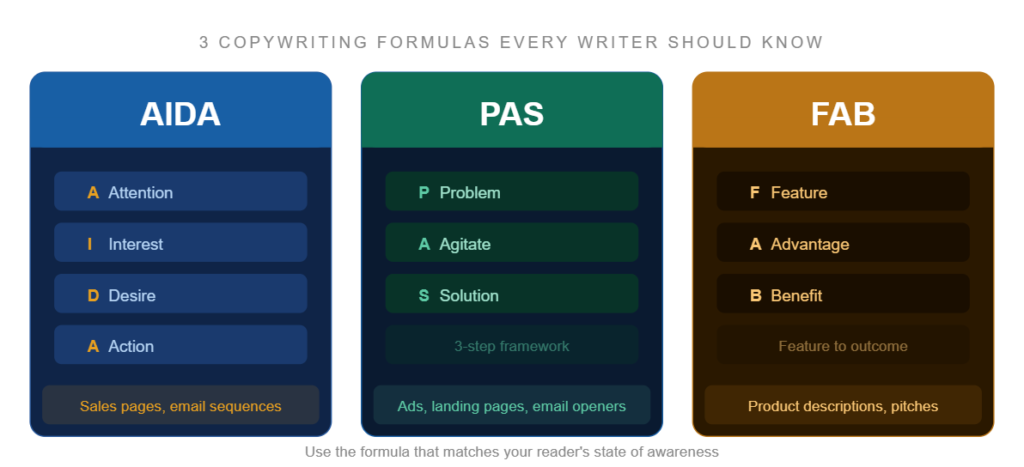
AIDA stands for Attention, Interest, Desire, Action. It is the backbone of most advertising and direct response copy.
- Attention: Stop the scroll. Grab the eye with a bold headline or opening statement.
- Interest: Give them a reason to keep reading. Connect to their situation.
- Desire: Make them want the outcome your product delivers.
- Action: Tell them exactly what to do next.
AIDA works because it mirrors the natural psychology of a buying decision. You cannot skip steps. You cannot open with the action before you have created desire.
PAS: The Formula for Problem-Heavy Copy
PAS stands for Problem, Agitate, Solution. I use this one more than AIDA these days because it connects emotionally before it sells.
- Problem: Name the exact pain the reader is experiencing right now.
- Agitate: Make that problem feel bigger, more urgent, more costly if ignored.
- Solution: Present your product or service as the clear fix.
PAS works especially well for ads, email subject lines, and landing page introductions. It creates emotional momentum before the pitch arrives.
FAB: Features, Advantages, Benefits
FAB helps me translate technical product details into reader-focused language. For every feature, I identify the advantage it creates, then the benefit that advantage delivers to the reader.
Feature: Our app auto-syncs every 60 seconds.
Advantage: Your data is always current.
Benefit: You never make a decision based on outdated information again.
Running product features through FAB before writing ensures every technical detail ends up serving the reader.
The Mistakes I See Most Often in Copywriting
I have reviewed hundreds of pieces of copy from students, clients, and brands. The same mistakes show up again and again.
Writing for Everyone and Reaching Nobody
When you try to write copy that works for any possible reader, you end up with copy that speaks to none of them. The more specific your reader, the stronger your copy will be.
Define your reader down to the smallest useful detail. Their age range, what they do, what they are stressed about, what they want their life to look like. Then write to that one person.
Leading With Features Instead of Benefits
Every first draft I write has too many features and not enough benefits. I catch them in the editing phase. Most writers never do this.
Go through your copy line by line. Every time you describe what a product does, ask yourself so what? The answer to that question is usually the real benefit you should be leading with.
Being Clever When You Should Be Clear
Clever headlines get appreciated. Clear headlines get clicked.
I made this mistake for years. I was so proud of a clever pun or a double meaning that I forgot the reader was not sitting there admiring my wordplay. They were scanning fast looking for relevance.
When clarity and cleverness compete, clarity wins. Always.
Weak or Missing Calls to Action
I have seen landing pages with no CTA at all. I have seen email campaigns that end with a question mark and no link. I have seen ads that do not tell the reader what to do next.
Every piece of copy must end with a clear, specific, single call to action. One action. Not three options. One door.
No Proof, No Credibility
Saying you are the best, the fastest, or the most trusted without any evidence is just noise. Readers have learned to ignore unsubstantiated claims.
Back up every important claim with a real number, a real result, or a real person’s experience. If you do not have proof yet, get it before you write the copy.
How I Approach Different Types of Copy
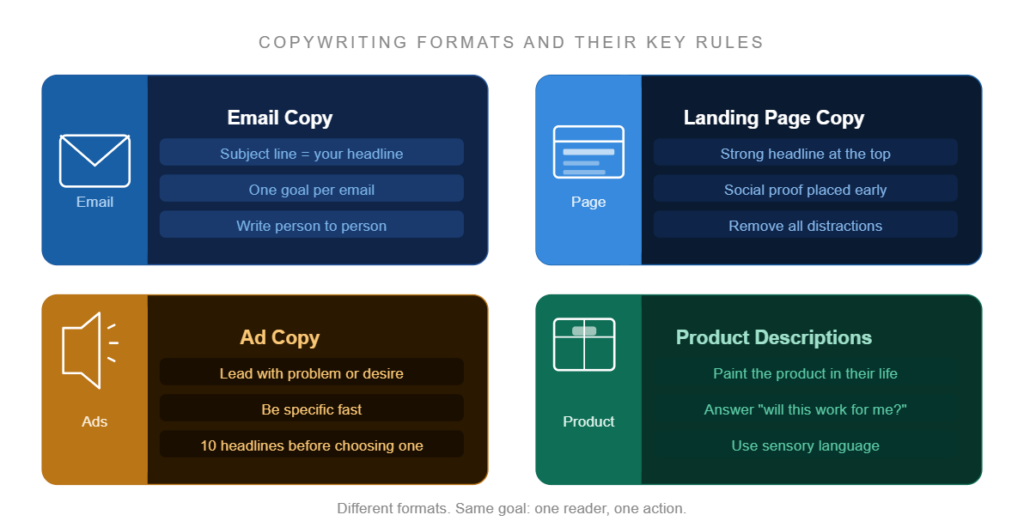
Copywriting is not a single skill. It is a cluster of related skills applied to different formats. Here is how I think about the most common ones.
Email Copywriting
The subject line is the headline of an email. It determines whether the email gets opened at all. I write subject lines before I write the email body because the subject line tells me what the email needs to be about.
Email copy should feel like a message from one person to one person. No mass-broadcast tone. No corporate language. Write the way you would write to a colleague you like and respect.
Every email should have one goal. Ask for one thing. Link to one place.
Landing Page Copy
A landing page is the most purpose-built piece of copy you will ever write. Everything on the page exists to support a single conversion goal.
I structure landing pages with a strong headline at the top, a clear subheadline that expands on the promise, social proof as early as possible, a benefit-driven body that handles objections, and a repeated CTA that appears at least three times on a long page.
Remove anything that does not directly support the conversion. Navigation menus. Distracting links. Sections that exist to make the client feel good rather than the reader feel motivated.
Ad Copywriting
Ad copy has a fraction of a second to earn attention. The reader did not come looking for your ad. You interrupted them.
Start with the problem or the desire. Skip the setup. Be specific fast. Make the CTA impossible to miss.
I write at least ten versions of every ad headline before I choose one. The first version is rarely the best one.
Product Descriptions
Product descriptions are where most e-commerce brands leave money on the table. They copy the manufacturer’s specs and call it done.
A good product description paints a picture of the product in the customer’s life. It uses sensory language. It answers the question will this work for me before the customer has to ask.
How I Edit My Own Copy
Writing copy is the first half. Editing it is where the real work happens. I always let a draft sit for at least a few hours before I edit. Fresh eyes catch things a tired brain misses.
The Read-Aloud Test
I read every piece of copy out loud. If I stumble on a sentence, the reader will too. If I lose my own interest halfway through a paragraph, the reader already left.
Reading aloud also catches run-on sentences, awkward rhythm, and words that look fine on screen but feel strange in the ear.
The Highlighter Test
I go through the copy and highlight every sentence that does actual persuasive work. Then I look at everything that is not highlighted. If those sentences are not building trust, providing proof, handling objections, or creating desire, I cut them.
Most first drafts have at least 20% that can be removed without losing anything important. Shorter is almost always stronger.
The Stranger Test
I ask myself: if a stranger with zero knowledge of this brand or product read this, would they understand exactly who it is for, what problem it solves, and what they should do next?
If the answer is no, something in the copy is assuming too much context. Fix it.
What Makes a Copywriter Worth Hiring
Over the years I have worked alongside many copywriters and hired several. The ones who consistently deliver results share a handful of traits.
They are obsessive researchers. They spend time in the world of the reader before they write a word.
They are strategic thinkers. They know that the goal of every piece of copy is a specific outcome, and they reverse-engineer from that outcome.
They handle feedback like professionals. Good copy often requires multiple rounds of revision. The best copywriters treat feedback as data, not criticism.
They test everything they can. They write multiple versions of headlines and CTAs. They pay attention to what the numbers say.
They keep learning. Copywriting evolves with culture, platforms, and psychology. The best writers I know are still studying the craft years into their careers.
The best investment a business can make in its copywriting is hiring a writer who thinks like a strategist and writes like a human.
Final Thoughts From My Own Desk
I have written copy that flopped and copy that generated hundreds of thousands of dollars in sales. The difference was almost never talent. It was almost always preparation.
The copywriters who get results are the ones who know their reader inside out, structure their arguments with care, back up their claims with proof, and keep editing until every sentence earns its place on the page.
Start with your reader. End with a clear action. Earn every word in between.
That is the whole game.
Frequently Asked Questions
1: Do I need a degree to become a copywriter?
No. Copywriting is a skill, not a credential. Most working copywriters are self-taught or learned through courses, mentors, and practice. What matters is whether your copy works. Build a portfolio with real or speculative samples, study the fundamentals, and start writing. Nobody in a client meeting will ask to see your diploma.
2: How long should a piece of copy be?
As long as it needs to be and no longer. This is not a cop-out answer. Length depends entirely on the complexity of the buying decision. A five-dollar app needs a short ad. A high-ticket coaching program needs a long sales page. The rule is simple. Keep every sentence that moves the reader closer to action. Cut every sentence that does not. The right length is what is left after that process.
3: What is the difference between a copywriter and a content writer?
A content writer creates material that educates, entertains, or informs. Think blog posts, guides, and newsletters that build an audience over time. A copywriter writes with direct persuasion in mind. The goal is always a specific action from a specific reader. In practice many writers do both, but the mindset is different. Content builds. Copy converts.
4: How do I write a headline if I have no idea where to start?
Start with the biggest benefit or the most painful problem. Write ten options using different angles: a specific promise, a question, a surprising fact, a number, a direct callout to your reader. Then pick the one that is most specific and most relevant to the person you are writing for. The first headline you think of is rarely your best one. The tenth often is.
5: How do I know if my copy is working?
You measure it. Track your click-through rate, conversion rate, open rate, and any other metric tied directly to the action you wanted readers to take. If those numbers are not moving, something in the copy is not connecting. Test different headlines, different leads, or different CTAs one at a time. Change one variable per test so you know what made the difference. Copy that cannot be measured cannot be improved.
