Are you ready to expand your content writing skills? Let’s cut to the chase and explore the various content writing types that can boost your career and versatility as a writer.
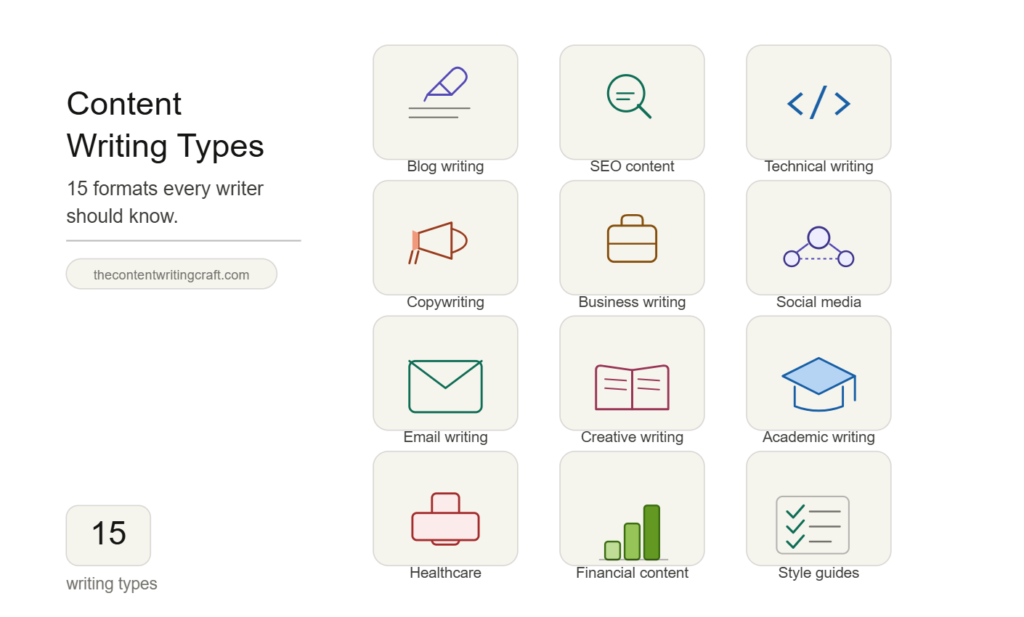
- Content Writing Types
- Blog and Article Writing
- Website Content Writing and SEO Content
- Technical Content Writing and Documentation
- Copywriting vs. Content Writing
- Business Writing and Proposals
- Social Media and Email Content Writing
- Specialized Industry Content
- Creative and Narrative Writing Approaches
- Academic and Educational Content
- Content Style Guides and Writing Skills
- The Content Writing Craft Approach
Content Writing Types
Content writing isn’t a one-size-fits-all skill. The digital world demands specialized approaches for different platforms, audiences, and goals. Knowing which type fits which situation makes you more valuable in the marketplace.
Each content type requires specific techniques, tones, and structures. What works for a blog post won’t necessarily work for technical documentation or social media content.
Most writers make the mistake of trying to master all types at once. Start by understanding each type, then specialize in areas that match your strengths or industry needs.
Blog and Article Writing
Blog writing focuses on engaging readers through conversational tone and relatable topics. Blogs typically range from 500-2,000 words and aim to build loyal readership through regular publishing.
“Blogs are the conversation starters of the internet,” says Ann Handley, Chief Content Officer at MarketingProfs. “They’re where brands can show personality while delivering genuine value.”
Articles, on the other hand, tend to be more comprehensive and structured. They dive deeper into subjects with research-backed information and expert insights. Think of articles as the more formal cousins of blog posts.
Blog Writing Tips:
- Focus on solving specific problems for your audience
- Use conversational language that feels like you’re talking directly to one person
- Include personal anecdotes or examples to illustrate points
- Break up text with subheadings, images, and bullet points for easy scanning
Articles require more rigorous research and often include citations or expert quotes. They build authority and can serve as cornerstone content for websites or publications.
Did you know? According to Orbit Media, the average blog post takes 4 hours and 1 minute to write—up 65% from 2014. This reflects the growing emphasis on quality over quantity in content creation.
Website Content Writing and SEO Content
Website content writing requires understanding user experience and customer journey stages. Each page serves a specific purpose, from educating visitors to converting them into customers.
Website content must be:
- Clear and scannable
- Purpose-driven for each page
- Consistent in brand voice
- Structured to guide users toward desired actions
SEO content writing blends creativity with technical knowledge. It’s about creating valuable content that also ranks well in search engines.
“The best SEO content solves problems for humans first, search engines second,” says Rand Fishkin, founder of SparkToro. “When you truly answer the user’s question better than anyone else, rankings follow naturally.”
SEO content writers need to understand:
- Keyword research and strategic placement
- Search intent behind queries
- On-page optimization techniques
- Content structures that enhance readability and engagement
Many writers make the mistake of keyword stuffing or creating thin content. Modern SEO requires comprehensive coverage of topics with natural language that addresses user needs.
Technical Content Writing and Documentation
Technical content writing translates complex information into understandable guidance. This includes product documentation, user manuals, technical guides, and API documentation.
Good technical writers can:
- Break down complex concepts into simple explanations
- Create logical, step-by-step instructions
- Anticipate user questions and provide clear answers
- Use visuals effectively to support written instructions
Documentation often follows specific structures and may require knowledge of tools like MadCap Flare, Confluence, or GitHub. Understanding information architecture is crucial for organizing technical content logically.
A study by Instruction (formerly TechSmith) found that 91% of people prefer visual content over traditional, text-based or static media. This highlights the importance of incorporating diagrams, screenshots, and videos in technical documentation.
Copywriting vs. Content Writing
Many writers confuse copywriting with content writing, but they serve different purposes.
Copywriting aims to persuade and drive immediate action. It’s the art of writing text for advertising or marketing. The focus is on creating compelling messages that convert readers into buyers.
Copywriting appears in:
- Landing pages
- Sales emails
- Product descriptions
- Advertisements
- Call-to-action buttons
Content writing educates, entertains, or informs. While it may indirectly lead to sales, its primary goal is to build relationships and provide value.
“Copywriting without content is a salesperson with nothing to sell. Content without copywriting is a store nobody visits,” says Brian Clark, founder of Copyblogger.
Good writers often develop skills in both areas, understanding when to educate and when to sell. This versatility makes them more valuable to clients and employers.
Business Writing and Proposals
Business writing includes proposals, reports, case studies, white papers, and other formal business documents. These content types require precision, clarity, and attention to detail.
Proposals and pitches need to:
- Clearly outline problems and solutions
- Present compelling value propositions
- Include specific, measurable outcomes
- Follow logical structures that build persuasive arguments
Case studies tell success stories through a problem-solution-result framework. They provide social proof and demonstrate real-world applications of products or services.
White papers present in-depth research and analysis on specific topics, positioning the author or company as a thought leader in the industry.
Business writing often requires collaboration with subject matter experts and stakeholders. Writers need strong interviewing skills to extract key information and translate technical or business jargon into clear communication.
Social Media and Email Content Writing
Social media content writing adapts to different platforms and audience expectations. What works on LinkedIn won’t necessarily work on Instagram or TikTok.
Effective social media writing:
- Captures attention quickly
- Encourages engagement
- Fits platform-specific constraints and cultures
- Often incorporates visual elements
User-generated content strategies involve prompting and curating content created by customers or community members. This creates authenticity and builds community around brands.
Email content writing balances relationship-building with conversion goals. From newsletters to automated sequences, email writing requires understanding audience segments and customer journey stages.
“Email has an ability many channels don’t: creating valuable, personal touches at scale,” says Justine Jordan, former VP of Marketing at Litmus.
Interactive content writing creates experiences rather than passive reading. This includes quizzes, calculators, assessments, and interactive infographics that engage users actively.
Specialized Industry Content
Some industries require highly specialized content knowledge and approaches:
Healthcare Content Writing must balance accessibility with accuracy. Writers need awareness of regulatory requirements (like HIPAA compliance) and the ability to translate medical terminology for patient education.
Financial Content Writing explains complex financial concepts clearly while maintaining compliance with regulations. It requires precise language that avoids making promises or guarantees while still being engaging.
Legal Content Writing demands accuracy and often requires collaboration with legal professionals. It translates complex legal concepts into understandable language without oversimplification.
Real Estate Content Writing combines descriptive language with practical information. Property listings, neighborhood guides, and market analyses all require specific approaches.
Tech Content Writing explains complex technologies to various audiences, from technical decision-makers to end users. It often includes product comparisons, how-to guides, and thought leadership on industry trends.
Creative and Narrative Writing Approaches
Even in professional content writing, creative approaches have their place:
Storytelling in B2B uses narrative structures to make complex business solutions relatable. Case studies, origin stories, and customer journey narratives all employ storytelling techniques.
“Stories are just data with a soul,” says Brené Brown, research professor and author. This applies even in business contexts, where stories can make data meaningful and memorable.
Experimental Storytelling embraces innovative formats like interactive timelines, scrollytelling, and multimedia presentations. These approaches can differentiate content in crowded spaces.
Travel Content Writing combines practical information with evocative descriptions. It helps readers imagine experiences while providing actionable details for planning.
Personal Essays can humanize brands and create emotional connections with audiences. They work well for thought leadership and values-based content.
Academic and Educational Content
Academic Writing follows specific conventions and citation styles. It prioritizes evidence-based arguments and contributes to scholarly conversations.
Scientific Writing communicates research findings clearly and accurately. It requires precision and often follows structured formats like IMRaD (Introduction, Methods, Results, and Discussion).
Expository Writing explains concepts thoroughly and objectively. It’s common in educational materials, how-to guides, and explanatory journalism.
Descriptive Writing uses sensory details to help readers visualize concepts or experiences. This technique enhances engagement across many content types.
Content Style Guides and Writing Skills
Creating consistent content often requires style guides, which are documents that outline voice, tone, grammar preferences, and formatting standards for an organization.
Content style guides help:
- Maintain brand consistency across writers and platforms
- Streamline editing processes
- Clarify expectations for contributors
- Document organization-specific terminology and usage
Developing fundamental writing skills supports all content types:
- Research techniques for gathering accurate information
- Outlining and structuring content logically
- Editing for clarity and concision
- Adapting tone and voice for different audiences
The Content Writing Craft Approach
At The Content Writing Craft, we help writers develop versatility across content types while finding their unique strengths. Our training focuses on adaptable skills that transfer between specializations.
The most successful content writers understand the purpose behind each content type and adapt their approach accordingly. They know when to inform, when to persuade, and how to engage different audiences across platforms.
Which of these content writing type do you want to master next to expand your professional skillset? Let us know in the comments below!